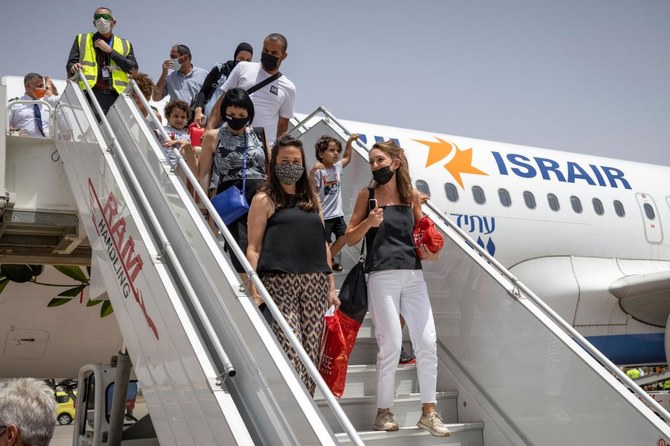
MARRAKESH: The first direct commercial flight between Israel and Morocco landed in Marrakesh on Sunday, AFP correspondents said, more than seven months after the countries normalized diplomatic relations in a US-brokered deal.
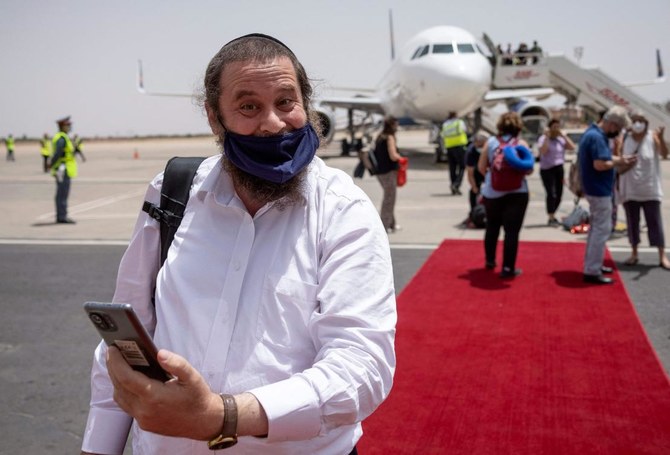
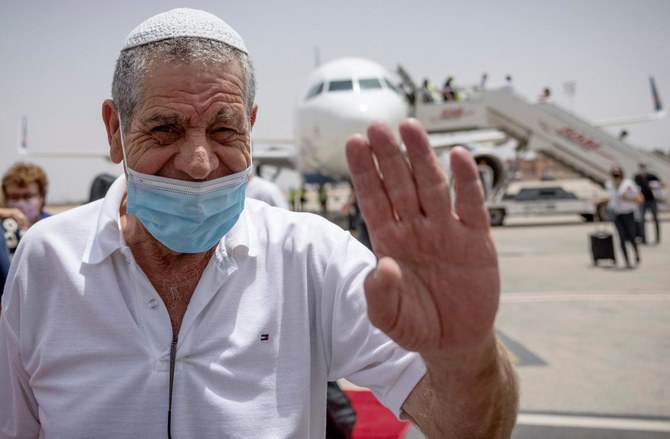
About 100 passengers from Tel Aviv arrived on an Israir flight early on Sunday afternoon to be met with dates, cakes and mint tea at a welcoming ceremony organized in their honor.
“I am originally from Marrakesh. I’ve come back here around 30 times but this time, the trip has a special flavour — it’s as if it were the first time!” an emotional Pinhas Moyal told AFP from the tarmac, his mask and bag in the colors of the Moroccan flag.
Israir spokeswoman Tali Leibovitz told AFP that two to three flights per week were planned on the route.
Israeli national carrier El Al announced it too had launched a service to Marrakesh on Sunday, and planned five flights per week there and to Casablanca.
At a ceremony sending off the El Al flight attended by Moroccan envoy Abderrahim Beyyoudh, Israel’s Tourism Minister Yoel Razvozov said the service would boost “trade, tourism and economic cooperation between the countries,” according to an El Al statement.
The El Al flight was expected in Marrakesh later in the afternoon.
Morocco was one of four regional states to agree to normalize ties with Israel last year, along with the United Arab Emirates, Bahrain and Sudan.
The move came as the administration of former US president Donald Trump recognized Morocco’s sovereignty over Western Sahara, a disputed and divided former Spanish colony.
Morocco is home to North Africa’s largest Jewish community, which numbers around 3,000. Some 700,000 Jews of Moroccan origin live in Israel.
“It’s great to return to the land of my ancestors,” said 58-year-old Sophie Levi, originally from Casablanca, who was on the Israir flight.
“We’re finally breathing again after two years of Covid.”
Some 50,000 to 70,000 tourists annually traveled to Morocco from Israel via third countries before the coronavirus pandemic, many of them of Moroccan origin.
In December last year, a direct flight carrying Israeli officials traveled from Tel Aviv to Rabat, where they signed several bilateral deals, including on air links.
Rabat had a liaison office in Tel Aviv but relations came to a halt during the 2000-2005 second Palestinian intifada, or uprising.
The normalization deals between Arab states and Israel have been deemed a “betrayal” by the Palestinians, who believe the process should only follow a resolution of the Israeli-Palestinian conflict.
Israeli Foreign Minister Yair Lapid said last week that he would visit Morocco shortly after direct flights commenced.


![]()
![]()
![]()
![]()


Israel launches direct flights to Morocco

Short Url
https://arab.news/y6tp8
Israel launches direct flights to Morocco
- About 100 passengers from Tel Aviv arrived on an Israir flight early on Sunday afternoon
- Israeli national carrier El Al announced it too had launched a service to Marrakesh on Sunday


Libya’s security authorities free more than 200 migrants from ‘secret prison’, two security sources say
BENGHAZI: Libya’s security authorities have freed more than 200 migrants from what they described as a secret prison in the town of Kufra in the southeast of the country after they were held captive in inhuman conditions, two security sources from the city told Reuters on Sunday.
The security sources, speaking on condition of anonymity, said that the security authorities had found an underground prison, nearly three meters deep, which the sources said was run by a Libyan human trafficker.
One of the sources said this person had not yet been detained.
“Some of the freed migrants were held captive up to two years in the underground cells,” this source said.
The other source said what the operation had found was “one of the most serious crimes against humanity that has been uncovered in the region.”
“The operation resulted in a raid on a secret prison within the city, where several inhumane underground detention cells were uncovered,” one of the sources added.
The freed migrants are from sub-Saharan Africa, mainly from Somalia and Eritrea, including women and children, the sources said. Kufra lies in eastern Libya, about 1,700 kilometers (1,000 miles) from the capital Tripoli.
Libya has become a transit route for migrants fleeing conflict and poverty to Europe via dangerous routes across the desert and over the Mediterranean since the toppling of Muammar Qaddafi in a NATO-backed uprising in 2011.
The oil-based Libyan economy is also a draw for impoverished migrants seeking work, but security throughout the sprawling country is poor, leaving migrants vulnerable to abuses.
At least 21 bodies of migrants were found in a mass grave in eastern Libya last week, with up to 10 survivors in the group bearing signs of having been tortured before they were freed from captivity, two security sources told Reuters.
Libya’s attorney general said in a statement on Friday the authorities in the east of the country had referred a defendant to the court for trial in connection with the mass grave on charges of “committing serious violations against migrants.”
In February last year, 39 bodies of migrants were recovered from about 55 mass graves in Kufra. The town houses tens of thousands of Sudanese refugees who fled the conflict that erupted in Sudan in 2023.
The security sources, speaking on condition of anonymity, said that the security authorities had found an underground prison, nearly three meters deep, which the sources said was run by a Libyan human trafficker.
One of the sources said this person had not yet been detained.
“Some of the freed migrants were held captive up to two years in the underground cells,” this source said.
The other source said what the operation had found was “one of the most serious crimes against humanity that has been uncovered in the region.”
“The operation resulted in a raid on a secret prison within the city, where several inhumane underground detention cells were uncovered,” one of the sources added.
The freed migrants are from sub-Saharan Africa, mainly from Somalia and Eritrea, including women and children, the sources said. Kufra lies in eastern Libya, about 1,700 kilometers (1,000 miles) from the capital Tripoli.
Libya has become a transit route for migrants fleeing conflict and poverty to Europe via dangerous routes across the desert and over the Mediterranean since the toppling of Muammar Qaddafi in a NATO-backed uprising in 2011.
The oil-based Libyan economy is also a draw for impoverished migrants seeking work, but security throughout the sprawling country is poor, leaving migrants vulnerable to abuses.
At least 21 bodies of migrants were found in a mass grave in eastern Libya last week, with up to 10 survivors in the group bearing signs of having been tortured before they were freed from captivity, two security sources told Reuters.
Libya’s attorney general said in a statement on Friday the authorities in the east of the country had referred a defendant to the court for trial in connection with the mass grave on charges of “committing serious violations against migrants.”
In February last year, 39 bodies of migrants were recovered from about 55 mass graves in Kufra. The town houses tens of thousands of Sudanese refugees who fled the conflict that erupted in Sudan in 2023.
Latest updates



© 2026 SAUDI RESEARCH & PUBLISHING COMPANY, All Rights Reserved And subject to Terms of Use Agreement.