

Bangladesh imposes strict COVID-19 lockdown after lifting rules for Eid

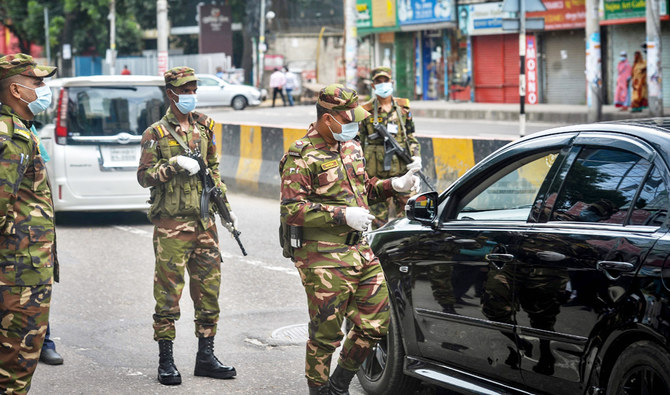
Security personnel positioned on the road to enforce a lockdown imposed by the Bangladesh's government to curb the spread of Covid-19 coronavirus in Dhaka on July 23, 2021. (AFP)
Short Url
Updated 24 July 2021
Follow

Bangladesh imposes strict COVID-19 lockdown after lifting rules for Eid

  • A strict curfew for four weeks and acceleration of mass vaccination may help Bangladesh control the delta variant by September

DHAKA: Bangladesh on Friday imposed a two-week nationwide lockdown after having eased coronavirus disease (COVID-19) restrictions to allow millions of people to travel for Eid Al-Adha celebrations.
Authorities had lifted measures on July 13 in consideration of “the need to maintain normal economic activity” and allow for the second-most important religious holiday in the Muslim-majority country to go ahead relatively unhindered, despite a surge in virus cases and deaths.
The highly infectious delta variant of COVID-19 has contributed toward pushing up the rate of positive tests in the south Asian nation to more than 31 percent.
At least 1.14 million people among Bangladesh’s population of 169 million have contracted the virus since the pandemic outbreak and nearly 19,000 have died, 166 in the past 24 hours. However, figures on recorded cases and deaths are thought to be grossly underreported.
Farhad Hossain, state minister for public administration, said on Thursday the latest lockdown would be stricter than before, with not only all government and private offices shut, but also garment factories. During the previous lockdown, the garment sector, which is the country’s largest source of income, was allowed to operate.

FASTFACT

National 2-week shutdown will see all businesses, including garment sector, close as virus cases, deaths surge.

“Offices, courts, garment factories, and all other export-oriented industries, everything to be precise, will remain closed,” Hossain added.
He pointed out that those who had traveled to their villages for Eid, would not be allowed to return to the cities until Aug. 5.
Although the lockdown is now again in place, health experts fear damage will already have been done by the government’s decision to lift preventive rules for Eid.
Prof. Dr. Alamgir Chowdhury, principal scientific officer of the Institute of Epidemiology Disease Control and Research (IEDCR), told Arab News: “The lockdown restrictions were lifted at a moment when we just started noticing a downward trend in the positivity rate.
“But now it will increase again, as people from the cities rushed to their villages, flouting health and safety protocols in the last week.”
And Prof. Dr. A.S.M. Amanullah, a public health expert at the University of Dhaka, said that while the country was currently recording between 10,000 and 15,000 new daily infections, the real figures were likely to be “much higher.”
“In this situation, lockdown may not work to bring the infection rate down. A strict curfew for four weeks and acceleration of mass vaccination may help Bangladesh control the delta variant by September.
“It was not wise to relax the lockdown restrictions during Eid Al-Adha. Health authorities didn’t care about the advice of the national COVID-19 control committee. As a result, it is only a matter of time before there is a surge in new infections, probably in the next two weeks,” he added.
While businesses are expecting huge losses from the lockdown, especially in the garment industry, some economists claim the situation would have been worse had there been no restrictions.
Dr. Mostafizur Rahman, of the Center for Policy Dialogue, an NGO involved in economic research, said: “Bangladesh needs a circuit-breaker for this second wave of coronavirus. If this wave continues for a longer period, the country may face a negative branding as a hotspot of COVID-19 infections which will be even worse in the long run.”
He noted that the government had taken some difficult decisions, especially as the country had received numerous apparel orders for the coming winter season.
“To make up for the losses of this lockdown, manufacturers may consider increasing working shifts at their factories. Some factories may require air shipments to meet buyer delivery times and the government may facilitate this.
“Port facilities should also be prepared on a high-priority basis for exporting the garment products while the lockdown is lifted,” Rahman added.


Italian police fire tear gas as protesters clash near Winter Olympics hockey venue

Updated 08 February 2026
Follow

Italian police fire tear gas as protesters clash near Winter Olympics hockey venue

  • Police vans behind a temporary metal fence secured the road to the athletes’ village, but the protest veered away, continuing on a trajectory toward the Santagiulia venue

MILAN: Italian police fired tear gas and a water cannon at dozens of protesters who threw firecrackers and tried to access a highway near a Winter Olympics venue on Saturday.
The brief confrontation came at the end of a peaceful march by thousands against the environmental impact of the Games and the presence of US agents in Italy.
Police held off the violent demonstrators, who appeared to be trying to reach the Santagiulia Olympic ice hockey rink, after the skirmish. By then, the larger peaceful protest, including families with small children and students, had dispersed.
Earlier, a group of masked protesters had set off smoke bombs and firecrackers on a bridge overlooking a construction site about 800 meters (a half-mile) from the Olympic Village that’s housing around 1,500 athletes.
Police vans behind a temporary metal fence secured the road to the athletes’ village, but the protest veered away, continuing on a trajectory toward the Santagiulia venue. A heavy police presence guarded the entire route.
There was no indication that the protest and resulting road closure interfered with athletes’ transfers to their events, all on the outskirts of Milan.
The demonstration coincided with US Vice President JD Vance’s visit to Milan as head of the American delegation that attended the opening ceremony on Friday.
He and his family visited Leonardo da Vinci’s “The Last Supper” closer to the city center, far from the protest, which also was against the deployment of US Immigration and Customs Enforcement agents to provide security to the US delegation.
US Homeland Security Investigations, an ICE unit that focuses on cross-border crimes, frequently sends its officers to overseas events like the Olympics to assist with security. The ICE arm at the forefront of the immigration crackdown in the US is known as Enforcement and Removal Operations, and there is no indication its officers are being sent to Italy.
At the larger, peaceful demonstration, which police said numbered 10,000, people carried cardboard cutouts to represent trees felled to build the new bobsled run in Cortina. A group of dancers performed to beating drums. Music blasted from a truck leading the march, one a profanity-laced anti-ICE anthem.
“Let’s take back the cities and free the mountains,” read a banner by a group calling itself the Unsustainable Olympic Committee. Another group called the Association of Proletariat Excursionists organized the cutout trees.
“They bypassed the laws that usually are needed for major infrastructure project, citing urgency for the Games,” said protester Guido Maffioli, who expressed concern that the private entity organizing the Games would eventually pass on debt to Italian taxpayers.
Homemade signs read “Get out of the Games: Genocide States, Fascist Police and Polluting Sponsors,” the final one a reference to fossil fuel companies that are sponsors of the Games. One woman carried an artificial tree on her back decorated with the sign: “Infernal Olympics.”
The demonstration followed another last week when hundreds protested the deployment of ICE agents.
Like last week, demonstrators Saturday said they were opposed to ICE agents’ presence, despite official statements that a small number of agents from an investigative arm would be present in US diplomatic territory, and not operational on the streets.