

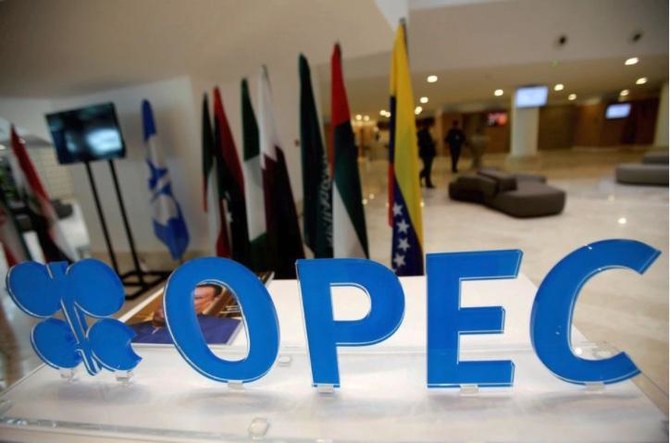
OPEC should leave oil market in hands of the Saudis – Mizuho

Discipline on production has helped oil rally after falling into negative territory for the first time last year. (Reuters)
Short Url
Updated 23 July 2021
Follow

OPEC should leave oil market in hands of the Saudis – Mizuho

  • Saudi Arabia has managed production effectively during COVID era
  • Risks remain as COVID resurgence could hurt demand

RIYADH: OPEC and the entire energy industry should thank Saudi Arabia for helping oil prices recover from negative territory last year, and the market would be best left to the Kingdom to manage, according to a senior investment banking energy commentator.

“They’ve done a magnificent job of managing their production program in the COVID era,” Robert Yawger, executive director of Energy Futures at Mizuho Securities said in an interview on Bloomberg Television on Thursday.

Crude oil futures fell below zero for the first time in history on April 20 last year as demand evaporated amid widespread lockdowns in response to the coronavirus pandemic.

That was an “unprecedented event” and “left a terrible scar on the industry,” said Yawger. “It rallied back under the management of the Saudis. The rest of OPEC has a lot to thank them for. Anyone that has anything to do with energy has a lot to thank them for, for that matter.”

WTI crude, the US benchmark, reached a six-year high of $76.98 on July 5 as OPEC+ failed to find agreement on output quotas, but has edged lower since then as the UAE and Saudi Arabia hammered out a compromise. The group will raise output by 400,000 barrels a month from August for 14 months.

While discipline on production has helped bring prices back, the market is at risk if renewed lockdowns hurt demand, said Yawger.

“I understand that everyone wants to get as many barrels on the market as possible, but you just can’t do that,” he said. “You cannot flood the market. It’s a very fragile state right now.”

“In my opinion, it’s best to let the Saudis manage it; they’ve done an incredible job. As long as they don’t flood the market themselves,” he said.

“Everybody remembers negative prices. That was the result of the price war last year. They all came to the assumption that it’s better to keep the barrels off the market and let the Saudis take charge and manage the situation than let prices slide in that direction again. Nobody can sustain that kind of slide for very long.”

“I don’t know if we’re going to see that $76.98 number again. That may be a challenge.”

US COVID-19 cases have climbed in recent weeks, reaching almost 64,000 yesterday compared with below 10,000 a day at the beginning of the month. However, that’s down from the peak in January of more than 250,000 new cases per day.

“If we have a COVID flare up that’s a third of what it was last fall, we have a serious problem on our hands and demand would not be that supersized as a result,” said Yawger. “If everybody was vaccinated we would not even be having this conversation. But because we’re headed into the winter with a big part of the population that’s not vaccinated, it has the potential to be a big problem for crude oil demand.”


First EU–Saudi roundtable on critical raw materials reflects shared policy commitment

Updated 16 January 2026
Follow

First EU–Saudi roundtable on critical raw materials reflects shared policy commitment

RIYADH: The EU–Saudi Arabia Business and Investment Dialogue on Advancing Critical Raw Materials Value Chains, held in Riyadh as part of the Future Minerals Forum, brought together senior policymakers, industry leaders, and investors to advance strategic cooperation across critical raw materials value chains.

Organized under a Team Europe approach by the EU–GCC Cooperation on Green Transition Project, in coordination with the EU Delegation to Saudi Arabia, the European Chamber of Commerce in the Kingdom and in close cooperation with FMF, the dialogue provided a high-level platform to explore European actions under the EU Critical Raw Materials Act and ResourceEU alongside the Kingdom’s aspirations for minerals, industrial, and investment priorities.

This is in line with Saudi Vision 2030 and broader regional ambitions across the GCC, MENA, and Africa.

ResourceEU is the EU’s new strategic action plan, launched in late 2025, to secure a reliable supply of critical raw materials like lithium, rare earths, and cobalt, reducing dependency on single suppliers, such as China, by boosting domestic extraction, processing, recycling, stockpiling, and strategic partnerships with resource-rich nations.

The first ever EU–Saudi roundtable on critical raw materials was opened by the bloc’s Ambassador to the Kingdom, Christophe Farnaud, together with Saudi Deputy Minister for Mining Development Turki Al-Babtain, turning policy alignment into concrete cooperation.

Farnaud underlined the central role of international cooperation in the implementation of the EU’s critical raw materials policy framework.

“As the European Union advances the implementation of its Critical Raw Materials policy, international cooperation is indispensable to building secure, diversified, and sustainable value chains. Saudi Arabia is a key partner in this effort. This dialogue reflects our shared commitment to translate policy alignment into concrete business and investment cooperation that supports the green and digital transitions,” said the ambassador.

Discussions focused on strengthening resilient, diversified, and responsible CRM supply chains that are essential to the green and digital transitions.

Participants explored concrete opportunities for EU–Saudi cooperation across the full value chain, including exploration, mining, and processing and refining, as well as recycling, downstream manufacturing, and the mobilization of private investment and sustainable finance, underpinned by high environmental, social, and governance standards.

From the Saudi side, the dialogue was framed as a key contribution to the Kingdom’s industrial transformation and long-term economic diversification agenda under Vision 2030, with a strong focus on responsible resource development and global market integration.

“Developing globally competitive mineral hubs and sustainable value chains is a central pillar of Saudi Vision 2030 and the Kingdom’s industrial transformation. Our engagement with the European Union through this dialogue to strengthen upstream and downstream integration, attract high-quality investment, and advance responsible mining and processing. Enhanced cooperation with the EU, capitalizing on the demand dynamics of the EU Critical Raw Materials Act, will be key to delivering long-term value for both sides,” said Al-Babtain.

Valere Moutarlier, deputy director-general for European industry decarbonization, and directorate-general for the internal market, industry, entrepreneurship and SMEs at European Commission, said the EU Critical Raw Materials Act and ResourceEU provided a clear framework to strengthen Europe’s resilience while deepening its cooperation with international partners.

“Cooperation with Saudi Arabia is essential to advancing secure, sustainable, and diversified critical raw materials value chains. Dialogues such as this play a key role in translating policy ambitions into concrete industrial and investment cooperation,” she added.