LAHORE: Over 25,000 people in Lahore’s metropolitan area alone have sought emergency medical help in the past two days, largely due to overeating, doctors say, as Pakistanis celebrated the Eid Al-Adha holiday with meat-heavy feasts.
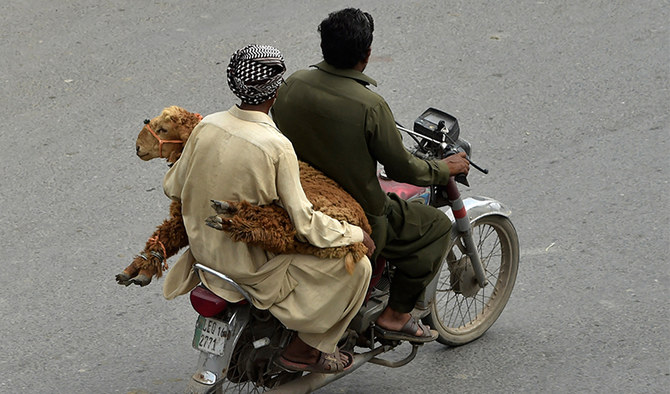
Eid Al-Adha, the second most important festival of Islam, was observed in Pakistan on Wednesday, with celebrations running through Friday. Muslims traditionally mark the occasion by sacrificing livestock, usually a goat, a cow, a camel, and giving the meat to the poor. Cooking meat dishes is a major part of the festivities.
According to data from government-run hospitals in Lahore — Mayo Hospital, Jinnah Hospital, General Hospital, Services Hospital, Ganga Ram Hospital, Shahdara Hospital, Government Mian Mir Hospital, Nawaz Sharif Hospital and Kot Khawaja Saeed Hospital — 20,600 people have visited their emergency rooms since the beginning of Eid holidays.
At Services Hospital, gastrologist Dr. Muhammed Shahzad Hafeez said 3,000 patients complaining of heartburn and bloating have been admitted during the period and the numbers are expected to rise.
“People indulge in heavy meat dishes on Eid, which leads to serious problems in the gastrointestinal tract like reflux and acidity which could wreak havoc on the body,” Dr. Hafeez told Arab News.
The number of people seeking help at Lahore’s private hospitals was over 5,000.
Dr. Prof. Naeem Ahmed, surgeon at Ghurki Hospital and Punjab Medical Center, said most of the people had symptoms of gastroesophageal refluxes, indigestion.
“A sudden change to a different eating routine, coupled with unhealthy food, can affect the digestion process and cause bloating and heartburn,” he said. “According to figures coming from private hospitals, around 5,000 cases have been reported due to overeating on Eid.”
For Dr. Hafeez, the soaring numbers are not surprising and the only way to avoid the painful results of overeating is by not eating too much.
“Typically, we see a spike in overeating cases during this time of the year,” he said. “It is advisable to eat mindfully, as your intestines have a normal pattern of activity — both mechanical and secretory.”


In Lahore, at least 25,000 hospitalized as Pakistanis overeat during Eid
https://arab.news/9e4de
In Lahore, at least 25,000 hospitalized as Pakistanis overeat during Eid

- Most of the patients in emergency rooms complained of heartburn and bloating
- Doctors blame heavy-meat meals, a major part of Eid Al-Adha festivities, for the surge

Pakistan, China to sign multiple MoUs at major agriculture investment conference today
- Hundreds of Chinese and Pakistani firms to attend Islamabad event
- Conference seen as part of expanding CPEC ties into agriculture, trade
KARACHI: Islamabad and Beijing are set to sign multiple memorandums of understanding (MoUs) to boost agricultural investment and cooperation at a major conference taking place in the capital today, Monday, with hundreds of Chinese and Pakistani companies expected to participate.
The conference is being billed by Pakistan’s Ministry of National Food Security and Research as a platform for deepening bilateral agricultural ties and supporting broader economic engagement between the two countries.
“Multiple memorandums of understanding will be signed at the Pakistan–China Agricultural Conference,” the Ministry of National Food Security said in a statement. “115 Chinese and 165 Pakistani companies will participate.”
The conference reflects a growing emphasis on expanding Pakistan-China economic cooperation beyond the transport and energy foundations of the flagship China-Pakistan Economic Corridor (CPEC) into agriculture, industry and technology.
Under its first phase launched in 2015, CPEC, a core component of China’s Belt and Road Initiative, focused primarily on transportation infrastructure, energy generation and connectivity projects linking western China to the Arabian Sea via Pakistan. That phase included motorways, power plants and the development of the Gwadar Port in the country's southwest, aimed at helping Pakistan address chronic power shortages and enhance transport connectivity.
In recent years, both governments have formally moved toward a “CPEC 2.0” phase aimed at diversifying the corridor’s impact into areas such as special economic zones, innovation, digital cooperation and agriculture. Second-phase discussions have highlighted Pakistan’s goal of modernizing its agricultural sector, attracting Chinese technology and investment, and boosting export potential, with high-level talks taking place between planning officials and investors in Beijing.
Agri-sector cooperation has also seen practical collaboration, with joint initiatives examining technology transfer, export protocols and value-chain development, including partnerships in livestock, mechanization and horticulture.
Organizers say the Islamabad conference will bring together government policymakers, private sector investors, industry associations and multinational agribusiness firms from both nations. Discussions will center on investment opportunities, technology adoption, export expansion and building linkages with global buyers within the framework of Pakistan-China economic cooperation.


