Facebook decided faith groups are good for business. Now, it wants your prayers

Facebook sees worshippers as a vital community to drive engagement on the world’s largest social media platform. (The Independent)
Short Url
Updated 22 July 2021
Follow

Facebook decided faith groups are good for business. Now, it wants your prayers

  • Facebook adds prayer tool, an attempt to reach out to the religious and faith communities, accessible to all US Facebook Groups
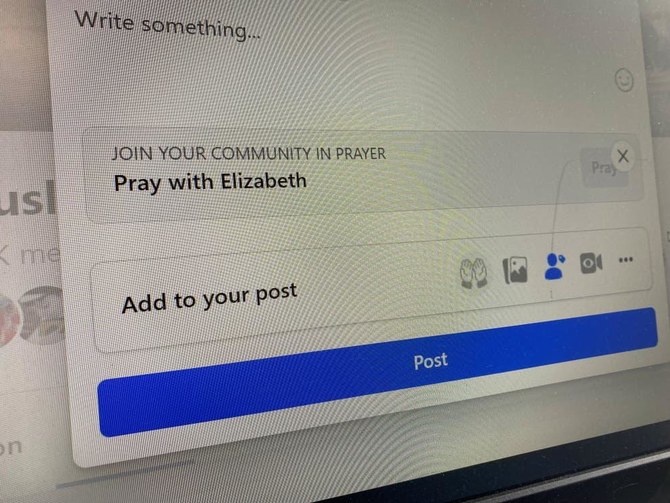
  • The tool essentially allows users to request prayers, and other users can click a button to say “I prayed,” and their names will be counted underneath the post

LONDON: Facebook has long sought your attention. In recent weeks, it has started asking for your prayers as well in a new tool now available for US Facebook Groups.
The prayer feature is part of Facebook’s recent and concerted outreach to the religious community, which it is speaking about in detail to media for the first time. Facebook sees worshippers as a vital community to drive engagement on the world’s largest social media platform. As early as 2017, CEO Mark Zuckerberg cited churches as one example in a lengthy manifesto on connecting the world and the company created a team focused on “faith partnerships.”
COVID gave new urgency to the efforts, Facebook’s head of faith partnerships Nona Jones told Reuters in an interview. The new prayers product was spun up after the company saw an increase in people asking each other for prayers during the pandemic, said Jones, who is also a pastor in Florida.
The outreach culminated in the company holding its first virtual faith summit with religious leaders last month. During the live event broadcast on Facebook Live where the company played videos with heart emojis floating across the screen as religious leaders ministered to their congregations, Chief Operating Officer Sheryl Sandberg discussed a future where leaders engaged worshippers with virtual reality tools and augmented reality.
At the end of May, Facebook made its prayer tool, which it had been testing with some faith communities, accessible for all US Facebook Groups to turn on. In one private Group seen by Reuters, a woman used the tool to request prayers for an aunt sick with coronavirus. People replied by clicking a button to say “I prayed,” and their names were counted underneath. Users could choose to be notified with a reminder to pray again tomorrow. Others requested prayers for a daughter’s broken heart, a son’s driving test and problems with an insurance company.
Jones confirmed prayer posts are used to personalize ads on Facebook, like other content. A spokesperson said the data could feed into how Facebook’s machine learning systems decide which ads to show users. Advertisers will not be able to directly target ads based on the content of the prayer or use of the feature, the person said. The spokesperson also said prayer tool use would not be factored into the categories that ad buyers already use to slice up Facebook audiences based on a demonstrated interest in topics, like “faith,” or “Catholic Church.”
“One of the biggest communities using Facebook products to connect are people of faith,” said outgoing Facebook app head Fidji Simo, in a fireside chat at the summit, following panels with religious leaders and a session for spiritual breathwork, a breathing and meditation exercise.
“When I looked at the data of what was taking off during the pandemic, we were seeing massive growth in the spiritual category.”
Early in the pandemic, Facebook sent “starter kits” of equipment like small tripods and phone holders to faith groups for live-streaming and shooting content as places of worship closed down. It launched a faith resources website with e-learning courses and quizzes on best practices, touting that “the people your house of worship wants to reach are on Facebook platforms already.”
This year, it has started up an Interfaith Advisory Council to hold regular meetings with faith leaders and educators. As well as consulting religious leaders — who told Reuters their wish lists for the site included church planning tools and emojis showing more diverse forms of worship — Facebook has been picking the brains of organizations already running large online faith platforms like evangelical megachurch Life.Church, pastor Kyle Kutter said.

MIXED RECEPTION
While many religious leaders who spoke to Reuters welcomed Facebook’s attention in a year when their communities were forced to stay at home, some Group users cited concerns over the privacy of prayer posts, questioning how their spiritual activities could be exploited online, or said they found it clinical.
Simcha Fisher, a member of a Catholic women’s Facebook Group, said she had only seen the prayer post used by friends who noted it felt “icky.” Her friend had compared Facebook to an overbearing parent getting involved in interactions occurring naturally on the platform: “Anytime Facebook rolls out something new, you know it’s because they’re hoping to make money off it...to eventually sell you something, somehow,” Fisher said.
Some religious leaders and Group members said they wanted to see the same level of commitment Facebook had shown in launching prayers to dealing with abuse targeted at their communities on the site. Khizer Subhani, who runs a Facebook Group for Muslims in the Bay Area which was given early access to the prayers feature, said he welcomed the company’s focus but weighed it against his frustrations over Facebook’s handling of hate speech around religious groups on the platform.
For Facebook, which faces attacks from global regulators and lawmakers, including over its track record of failing to curb harmful content like violent rhetoric and vaccine misinformation, connecting the faithful during a global pandemic is the kind of application it says it wants to double down on. Faith communities represent “the best of Facebook and we hope to keep it that way, now and in the future,” Sandberg said at the summit.


MenaML hosts 2026 Winter School in Saudi Arabia to boost AI education, collaboration in region

Updated 16 January 2026
Follow

MenaML hosts 2026 Winter School in Saudi Arabia to boost AI education, collaboration in region

  • Second edition of Winter School will be hosted in partnership with KAUST

DUBAI: The Middle East and North Africa Machine Learning Winter School will host its second edition in Saudi Arabia this year, in partnership with the King Abdullah University of Science and Technology.

The non-profit held its inaugural edition in Doha last year in partnership with the Qatar Computing Research Institute.

The initiative began when like-minded individuals from Google DeepMind and QCRI came together to launch a platform connecting a “community of top-tier AI practitioners with a shared interest in shaping the future of the MENA region,” Sami Alabed, a research scientist at Google DeepMind and one of the co-founders of MenaML, told Arab News.

Along with Alabed, the core team includes Maria Abi Raad and Amal Rannen-Triki from Google DeepMind, as well as Safa Messaoud and Yazan Boshmaf from QCRI.

Maria Abi Raad

Messaoud said that the school has three goals: building local talent in artificial intelligence, enhancing employability and connection, and reversing brain drain while fostering regional opportunity.

AI has dominated boardrooms and courtrooms alike globally, but “AI research and education in MENA are currently in a nascent, yet booming, stage,” she added.

Launched at a pivotal moment for the region, the initiative was timed to ensure “regional representation in the global AI story while cultivating AI models that are culturally aligned,” said Rannen-Triki.

The school’s vision is to cultivate researchers capable of developing “sophisticated, culturally aligned AI models” that reflect the region’s values and linguistic and cultural diversity, said Messaoud.

This approach, she added, enables the region to contribute meaningfully to the global AI ecosystem while ensuring that AI technologies remain locally relevant and ethically grounded.

MenaML aims to host its annual program in a different city each year, partnering with reputable institutions in each host location.

“Innovation does not happen in silos; breakthroughs are born from collaboration that extends beyond borders and lab lines,” said Alabed.

“Bringing together frontier labs to share their knowledge echoes this message, where each partner brings a unique viewpoint,” he added.

This year, MenaML has partnered with KAUST, which “offers deep dives into specialized areas critical to the region, blending collaborative spaces with self-learning and placement programs,” said Abi Raad.

The program, developed in partnership with KAUST, brings together speakers from 16 institutions and focuses on four key areas: AI and society, AI and sciences, AI development, and regional initiatives.

“These themes align with the scientific priorities and research excellence pillars of KAUST as well as the needs of regional industries seeking to deploy AI safely and effectively,” said Bernard Ghanem, professor of electrical and computer engineering and computer science at KAUST and director of the Center of Excellence in Generative AI.

The program will also highlight efficiency in AI systems, with the overall goal of equipping “participants with the conceptual and practical understanding needed to contribute meaningfully to next-generation AI research and development,” he told Arab News.

For KAUST, hosting the MenaML Winter School aligns with Saudi Arabia’s ambition to become a global hub for AI research under Vision 2030.

By attracting top researchers, industry partners, and young talent to the Kingdom, it helps cement the Kingdom’s position as a center for AI excellence, Ghanem said.

It also aligns closely with Vision 2030’s “goals of building human capital, fostering innovation, and developing a knowledge-based economy” and “contributes to the long-term development of a world-leading AI ecosystem in Saudi Arabia,” he added.

Although the program accepts students from around the world, participants must demonstrate a connection to the MENA region, Abi Raad said.

The goal is to build bridges between those who may have left the region and those who remain, enabling them to start conversations and collaborate, she added.

A certain percentage of spots is reserved for participants from the host country, while a small percentage is allocated to fully international students with no regional ties, with the objective of offering them a glimpse into the regional AI ecosystem.

Looking ahead, MenaML envisions growing from an annual event into a sustainable, central pillar of the regional AI ecosystem, inspired by the growth trajectory of global movements like TED or the Deep Learning Indaba, a sister organization supporting AI research and education in Africa.

Boshmaf said MenaML’s long-term ambition is to evolve beyond its flagship event into a broader movement, anchored by local MenaMLx chapters across the region.

Over time, the initiative aims to play a central role in strengthening the regional AI ecosystem by working with governments and the private sector to support workforce development, AI governance and safety education, and collaborative research, while raising the region’s global visibility through its talent network and international partnerships.

He added: “If TED is the global stage for ‘ideas worth spreading,’ MenaML is to be the regional stage for ‘AI ideas worth building.’”

The MenaML Winter School will run from Jan. 24 to 29 at KAUST in Saudi Arabia.