Indian opposition accuses BJP of turning country into ‘surveillance state’

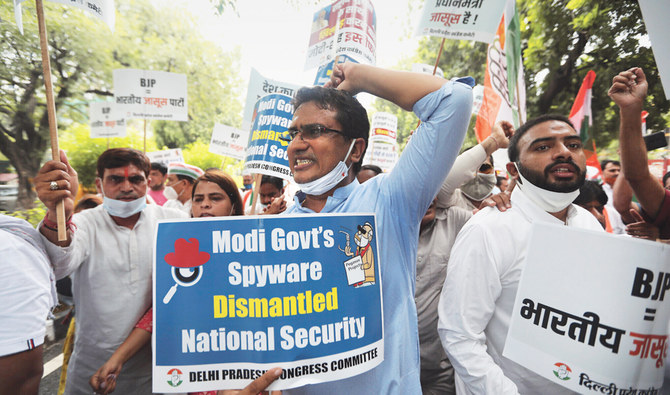
India’s Congress Party held a press conference and demonstrations in New Delhi on Wednesday to demand the resignation of Home Minister Amit Shah. (AP)
Short Url
Updated 22 July 2021
Follow

Indian opposition accuses BJP of turning country into ‘surveillance state’

  • They are experts at creating ‘fiction,’ says ruling party spokesman

NEW DELHI: India’s main opposition Congress Party continued countrywide protests against Prime Minister Narendra Modi on Wednesday, accusing him of turning India into a “surveillance state” following reports that dozens of opposition leaders, journalists, civil society activists and judges were the potential targets of snooping by Israeli-made spyware Pegasus.

The leaked list, which was shared by Forbidden Stories, a Paris-based nonprofit, and rights group Amnesty International, showed that at least 1,000 phone numbers of high-profile Indians were hacked through the spyware. These include two serving ministers, over 40 journalists, three important opposition leaders, one sitting judge and scores of businesspersons and activists.
Senior leader of the Congress Party Rahul Gandhi and two aides were among those who were targeted by the Israeli-made spyware.
On Wednesday, the party held a press conference to demand the resignation of Home Minister Amit Shah and accountability for the snooping.
“You (Narendra Modi) are trying to turn a democratic state into a surveillance state,” Chief Minister of West Bengal Mamta Banerjee told a large gathering in Kolkata. “Three things make democracy — media, judiciary and the Election Commission — and Pegasus has captured all three.”

SPEEDREAD

• The leaked list showed that at least 1,000 phone numbers of high-profile Indians were hacked through the spyware.

• These include two serving ministers, over 40 journalists, three important opposition leaders, one sitting judge and scores of businesspersons and activists.

Gandhi’s mobile was hacked during the 2019 general elections when he was the main challenger to Modi, according to a Congress Party spokesman.
“Is spying on India’s security forces, judiciary, Cabinet ministers, opposition leaders including Rahul Gandhi, journalists and other activities through a foreign entity’s spyware not treason and an inexcusable dismantling of national security?” Congress Party spokesman Randeep Surjewala said at a press conference in New Delhi on Tuesday.
Indian news portal The Wire, one of the 16 media consortiums investigating the leak, revealed on Tuesday that senior Karnataka politicians and their personal assistants were selected as potential targets for surveillance in 2018-19 when the opposition coalition government was pulled down and the ruling Bharatiya Janata Party (BJP) installed its own government by engineering defections in the opposition camps.
“It’s not merely spying on individuals to defame or control them. It is a sinister conspiracy to destroy democracy and establish dictatorship,” Mallikarjun Kharge, Congress Party leader in the upper house of parliament, told reporters on Tuesday.
The Modi government has called the report false and baseless.
Sudesh Verma, a spokesman for Modi’s ruling BJP party, told Arab News on Wednesday that Indian opposition parties were experts at creating “fiction.”
“If the mobile phones of anyone have been hacked, they should take legal recourse to find the truth,” Verma said. “The government does not need such spyware to snoop on its citizens.”
Pegasus spyware uses a sophisticated method of attack called zero-click attacks, by which it can infect smartphones without users’ knowledge and access virtually all their data.


From round fruits to lucky charms: How Filipinos invite prosperous New Year

Updated 4 sec ago
Follow

From round fruits to lucky charms: How Filipinos invite prosperous New Year

  • Lights are lit, doors and windows open to allow good spirits in
  • Sticky rice dishes are served to keep family sticking together

MANILA: With the dining table set with symbolic foods, a bit of noise and rituals to invite good luck, Filipinos are ready to welcome the New Year, carefully observing every tradition and superstition to bring prosperity.

Media noche or the midnight dinner on New Year’s Eve is central to the celebration. Besides traditional meats, there will be sticky rice dishes to keep the family sticking together, and pancit or long rice noodles to represent long life.

There should also be 13 round fruits prepared specifically for the occasion, with 12 representing each month of the year, and the 13th adding extra luck. Because they are round like coins, they are believed to invite abundance, wealth and prosperity.

“We cook bilo-bilo (sticky rice balls) with coconut milk and palitaw (sweet rice cakes). It’s something we simply grew up with,” said Cel Reyes from Mabini in Batangas province, south of Manila.

“It’s sticky, so it symbolizes togetherness, and it is also round. Anything that’s round is prepared also as a symbol of prosperity.”

In Malabon, a coastal city in the northern part of Metro Manila, Priam Nepomuceno’s 86-year-old mother-in-law sets unhulled rice on the table.

“Because of the gold color, it’s believed to bring luck and abundance,” he said. “Grapes are also hung on the door. They’re not meant to be eaten and are kept hanging for the whole year as a symbol of prosperity.”

Some people also jump when the clock strikes 12, believing it will help them grow taller.

In many households, all lights are lit before midnight, with doors and windows open to allow good spirits to enter, while noise from firecrackers and party horns keeps the bad ones at bay.

“By nature, Filipinos are superstitious. We believe in good luck, deities. We give in to faith and luck, and it’s tied to deep spirituality,” said Juanita Galang-Trinidad, an 80-year-old editor from Bulacan province north of Manila.

“We also put 12 coins in varying amounts in our pockets and wear polka dot clothing. Rice, cereal, and salt containers should be full.”

New Year’s celebrations, like Christmas, bring families together, but with extra traditions for good luck. Beyond the midnight feast and keeping round objects on the table and at hand, Filipinos try to pay off debts to avoid financial trouble in the coming year.

On New Year’s Eve, they also avoid serving chicken, as chickens are believed to scratch backward when they eat, symbolically scratching away good fortune.

“We hold on to our traditions despite these growing changes, modernity, in our environment,” Trinidad said.

“We still hold on to our traditions and customs because they identify us as a people, as Filipinos.”