Israeli-led mission sails to Sudan for major Red Sea coral study

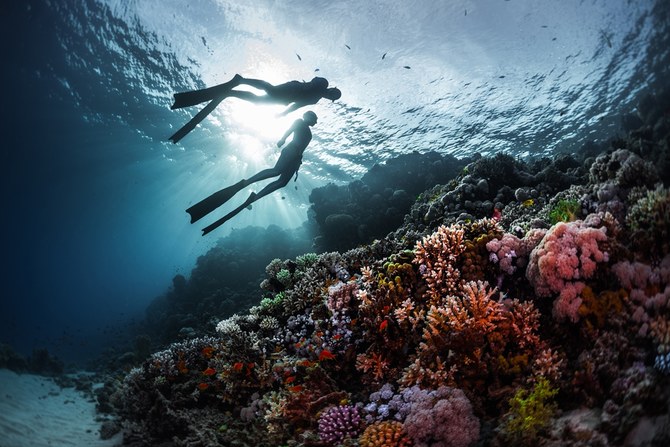
An Israeli-led scientific expedition sailed Tuesday from the southern city of Eilat to Port Sudan, launching a joint project with Sudanese researchers to help preserve the Red Sea's unique coral reefs. (Shutterstock)
Short Url
Updated 20 July 2021
Follow

Israeli-led mission sails to Sudan for major Red Sea coral study

  • The collaboration aims to create a first-ever comprehensive study of the entire Red Sea
  • Reefs in the northern Red Sea have stayed stable because of their unique heat resistance

EILAT, Israel: An Israeli-led scientific expedition sailed Tuesday from the southern city of Eilat toward Port Sudan, launching a joint project with Sudanese researchers that could help preserve the Red Sea’s unique coral reefs.
The collaboration, aided by Sudan’s normalization of ties with Israel last year, aims to create a first-ever comprehensive study of the entire Red Sea, possibly yielding precious information on the long-term viability of reefs.
While coral populations around the world are undergoing bleaching caused by climate change, reefs in the northern Red Sea, where the Gulf of Eilat lies, have stayed stable because of their unique heat resistance.
The mission is being headed by Maoz Fine of the Interuniversity Institute for Marine Sciences in Eilat, whose groundbreaking research offered insight into the durability of the northern Red Sea reefs.
He found that the northern Red Sea corals underwent a form of “thermal selection” in their journey from the Indian Ocean through warmer water thousands of years ago.
For years Fine had said that a comprehensive study at the Red Sea reefs was necessary to fully understand the variation from north to south.
But such a study faced diplomatic hurdles, with Arab states to the Red Sea’s south reluctant to work with Israel.
Fine’s collaboration with expedition co-leader Anders Meibom of Ecole Polytechnique Federale in Lausanne (EPFL) facilitated involvement from the Swiss government, which offered financial support and diplomatic efforts to connect Israel and regional Arab states.
While planning for the mission pre-dated last year’s normalization deal, the establishment of Israeli-Sudanese diplomatic relations was “very fortunate,” Bern’s ambassador to Israel, Jean-Daniel Ruch, told AFP.
The six scientists and four crew members — all European except Fine — is set to reach Port Sudan on the Swiss-flagged Fleur de Passion in four days, where a Sudanese team of researchers will join with a ship of their own.
The two vessels will spend five to six weeks collecting coral samples and testing their heat durability as the ship heads south.
Fine told AFP that moving from the healthier northern reefs to the struggling south was like “traveling back in time,” possibly offering new insights into the disparity between the two areas.
Meibom said the mission aimed to create “a real, holistic view of what the corals are, what state are they in, and where we can expect them to survive and for how long.”
Such a “baseline” would help scientists “understand where are the corals that have the biggest potential for survival in the future,” he told AFP.
For Meibom, the Red Sea expedition was a “neutral vehicle” between Israeli and Arab scientists, ideally fostering information sharing and better regional sea management policy.
The project, which formally began last month with a short excursion in Jordan’s Gulf of Aqaba, will continue over three years, aiming to involve further Red Sea countries.


Agonizing wait as Switzerland works to identify New Year’s fire victims

Updated 41 min 31 sec ago
Follow

Agonizing wait as Switzerland works to identify New Year’s fire victims

  • Authorities begin moving bodies from burned-out bar in luxury ski resor Crans-Montana
  • At least 40 people were killed in one of Switzerland's worst tragedies

CRANS-MONTANA, Switzerland: Families endured an agonizing wait for news of their loved ones Friday as Swiss investigators rushed to identify victims of a ski resort fire at a New Year’s celebration that killed at least 40 people.
Authorities began moving bodies from the burned-out bar in the luxury ski resort town Crans-Montana late Friday morning, with the first silver-colored hearse rolling into the funeral center in nearby Sion shortly after 11:00 am (1000 GMT), AFP journalists saw.
Around 115 people were also injured in the fire, many of them critical condition.
As the scope of the tragedy — one of Switzerland’s worst — began to sink in, Crans-Montana appeared enveloped in a stunned silence.

Mathias Reynard, president of the Council of State of Valais Canton, with Italy's Foreign Minister Antonio Tajani outside "Le Constellation" bar in Crans-Montana where a fire and explosion on New Year's Eve killed more than 40 people. (Reuters)

“The atmosphere is heavy,” Dejan Bajic, a 56-year-old tourist from Geneva who has been coming to the resort since 1974, told AFP.
“It’s like a small village; everyone knows someone who knows someone who’s been affected,” he said.
It is not yet clear what set off the blaze at Le Constellation, a bar popular with young tourists, at around 1:30 am (0030 GMT) Thursday.
Bystanders described scenes of panic and chaos as people tried to break the windows to escape and others, covered in burns, poured into the street.

‘Screaming in pain’

Edmond Cocquyt, a Belgian tourist, told AFP he had seen “bodies lying here, ... covered with a white sheet,” and “young people, totally burned, who were still alive... Screaming in pain.”
The exact death toll was still being established.
And it could rise, with canton president Mathias Reynard telling the regional newspaper Wallizer Bote that at least 80 of the 115 injured were in critical condition.
Swiss authorities warned it could take days to identify everyone who perished, an agonizing wait for family and friends.
Condolences poured in from around the world, including from Pope Leo XIV, who offered “compassion and solidarity” to victims’ families.
Online, desperate appeals abound to find the missing.
“We’ve tried to reach our friends. We took loads of photos and posted them on Instagram, Facebook, all possible social networks to try to find them,” said Eleonore, 17. “But there’s nothing. No response.”

‘The apocalypse’

The exact number of people who were at the bar when it went up in flames remains unclear.
Le Constellation had a capacity of 300 people, plus another 40 people on its terrace, according to the Crans-Montana website.
Swiss President Guy Parmelin, who took office on Thursday, called the fire “a calamity of unprecedented, terrifying proportions” and announced that flags would be flown at half-mast for five days.
“We thought it was just a small fire — but when we got there, it was war,” Mathys, from the neighboring village of Chermignon-d’en-Bas, told AFP. “That’s the only word I can use to describe it: the apocalypse.”

Authorities have declined to speculate on what caused the tragedy, saying only that it was not an attack.
Several witness accounts, broadcast by various media, pointed to sparklers mounted on champagne bottles and held aloft by restaurant staff as part of a regular “show” for patrons.

‘Dramatic’

Pictures and videos shared on social media also showed sparklers on champagne bottles held into the air, as an orange glow began spreading across the ceiling.
One video showed the flames advancing quickly as revellers initially continued to dance.
One young man playfully attempted to extinguish the flames with a large white cloth, but the scene became panic-stricken as people scrambled and screamed in the dark against a backdrop of smoke and flames.
The canton’s chief prosecutor, Beatrice Pilloud, said investigators would examine whether the bar met safety standards.
Red and white caution tape, flowers and candles adorned the street outside, while police shielded the site with white screens.
Italian Foreign Minister Antonio Tajani, who said 13 Italians had been injured in the fire, and six remained missing, was among those to lay flowers at the site.
The French foreign ministry said nine French citizens figured among the injured, and eight others remained unaccounted for.
After emergency units at local hospitals filled, many of the injured were transported across Switzerland and beyond.
Patients are being treated in Italy, France and Germany, and Polish Prime Minister Donald Tusk said his country was ready to provide “specialized medical care to 14 injured.”
Multiple sources told AFP the bar owners were French nationals: a couple originally from Corsica who, according to a relative, are safe, but have been unreachable since the tragedy.