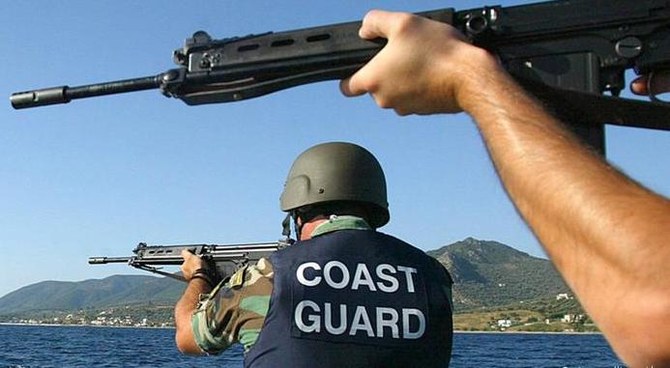
NICOSIA: A Turkish coast guard vessel fired warning shots Friday at a Cyprus police boat on patrol for undocumented migrants near the line of control off the island’s north coast, Cypriot media reported.
The incident came amid high tensions on the island as Turkish President Recep Tayyip Erdogan prepares to visit the breakway Turkish Cypriot north next week to mark the anniversary of Turkey’s 1974 invasion.
The Cypriot vessel spotted the Turkish coast guard some 11 nautical miles from the small fishing port of Kato Pyrgos, just west of the UN-patrolled armistice line separating government-held territory from the breakaway north, the Cyprus News Agency reported.
Cyprus police spokesman Christos Andreou told CNA that the coast guard cutter was inside Cypriot territorial waters at 3:30 am (0030 GMT) when the incident took place.
He said the boat was on a regular patrol to check for irregular migrants as the area is a dropping-off point for migrants coming from Turkey.
“The patrol boat’s three-member crew seeing the intentions of the Turkish coast guard tried to avoid any incident and headed toward the fishing shelter at Kato Pyrgos,” he said.
“At a distance of four nautical miles from the shelter, the marine police boat received warning shots from the Turkish coast guard.
“Then, being a short distance from the shores, the Turkish coast guard left for the occupied territories” (of northern Cyprus), he said.
Tensions have been running high ahead of Erdogan’s visit to the island next week, when he will make what Greek Cypriots see as a provocative tour of the abandoned beach resort of Varosha, which was emptied of its Greek Cypriot residents by the Turkish invasion.
Cyprus police have stepped up both land and sea patrols since the government declared a “state of emergency” in May following an influx of Syrian migrants that has flooded its reception centers.
Nicosia says most migrants enter government-controlled areas illegally via the UN-patrolled buffer zone from the breakaway north.
Cyprus, the European Union’s most easterly member state, has had the bloc’s highest proportion of asylum applications per capita for four consecutive years.
Nicosia has asked the EU for help preventing irregular migrant flows from Turkey before they reach Cyprus, equivalent to an arrangement for Greece agreed in 2016.
“Despite the enormous efforts by the Cypriot authorities to manage the disproportionate migratory pressures, we are still in an extremely difficult situation,” Interior Minister Nicos Nouris told reporters in June.
He said the division of the island by a 180-kilometer-long cease-fire line “creates unique conditions for the development of irregular migration.”
He said that the proportion of applicants and beneficiaries of international protection in Cyprus corresponds to four percent of the country’s population.
“Unfortunately, during the first months of 2021, the increasing irregular arrivals, especially of Syrian nationals, either by sea or land through the Green Line, indicate an alarming trend,” he said.
“The continuation of the large numbers of migration flows from Turkey is the main challenge for Cyprus.”


Turkish ship fires warning shots at Cyprus coast guard
https://arab.news/ndcn5
Turkish ship fires warning shots at Cyprus coast guard

- Nicosia has asked the EU for help preventing irregular migrant flows from Turkey before they reach Cyprus


Bangladesh readies for polls, worry among Hasina supporters
- The Muslim-majority nation of 170 million people will hold elections on February 12, its first since the uprising
- Hasina was sentenced to death for crimes against humanity in Nov. and her former ruling party has been outlawed
Gopalganj: Bangladesh is preparing for the first election since the overthrow of Sheikh Hasina, but supporters of her banned Awami League (AL) are struggling to decide whether to shift their allegiance.
In Gopalganj, south of the capital Dhaka and a strong bastion of Hasina’s iron-grip rule, residents are grappling with an election without the party that shaped their political lives for decades.
“Sheikh Hasina may have done wrong — she and her friends and allies — but what did the millions of Awami League supporters do?” said tricycle delivery driver Mohammad Shahjahan Fakir, 68, adding that he would not vote.
“Why won’t the ‘boat’ symbol be there on the ballot paper?” he said, referring to AL’s former election icon.
The Muslim-majority nation of 170 million people will hold elections on February 12, its first since the uprising.
Hasina, who crushed opposition parties during her rule, won landslide victories in Gopalganj in every election since 1991.
After a failed attempt to cling to power and a brutal crackdown on protesters, she was ousted as prime minister in August 2024 and fled to India.
She was sentenced to death in absentia for crimes against humanity by a court in Dhaka in November, and her former ruling party, once the country’s most popular, has been outlawed.
Human Rights Watch has condemned the AL ban as “draconian.”
“There’s so much confusion right now,” said Mohammad Shafayet Biswas, 46, a banana and betel leaf seller in Gopalganj.
“A couple of candidates are running from this constituency — I don’t even know who they are.”
As a crowd gathered in the district, one man shouted: “Who is going to the polling centers? We don’t even have our candidates this time.”
‘DEHUMANISE’
Hasina’s father, Sheikh Mujibur Rahman, the founding president of Bangladesh, hailed from Gopalganj and is buried in the town.
Statues of Rahman have been torn down nationwide, but in Gopalganj, murals and statues are well-maintained.
Since Hasina’s downfall, clashes have broken out during campaigning by other parties, including one between police and AL supporters in July 2025, after which authorities filed more than 8,000 cases against residents.
Sazzad Siddiqui, a professor at Dhaka University, believes voter turnout in Gopalganj could be the lowest in the country.
“Many people here are still in denial that Sheikh Hasina did something very wrong,” said Siddiqui, who sat on a government commission formed after the 2025 unrest.
“At the same time, the government has constantly tried to dehumanize them.”
This time, frontrunners include candidates from the Bangladesh Nationalist Party (BNP) and Jamaat-e-Islami, the country’s largest religious party.
Both are from Hasina’s arch-rivals, now eyeing power.
“I am going door to door,” BNP candidate S.M Zilany, 57, told AFP, saying many would-be voters had never had a candidate canvass for their backing.
“I promise them I will stand by them.”
Zilany said he had run twice against Hasina — and was struck down by 34 legal cases he claimed had been politically motivated.
This time, he said that there was “a campaign to discourage voters from turning up.”
Jamaat candidate M.M Rezaul Karim, 53, said that under Hasina, the party had been driven underground.
“People want a change in leadership,” Karim told AFP, saying he was open to all voters, whatever their previous loyalties.
“We believe in coexistence; those involved in crimes should be punished; others must be spared,” Karim said.
Those once loyal to Hasina appear disillusioned. Some say they had abandoned the AL, but remain unsure whom to support.
“I am not going to vote,” said one woman, who asked not to be named.
“Who should I vote for except Hasina? She is like a sister.”


