‘God help this country:’ Lebanon in limbo as PM-designate Hariri quits

1 / 2
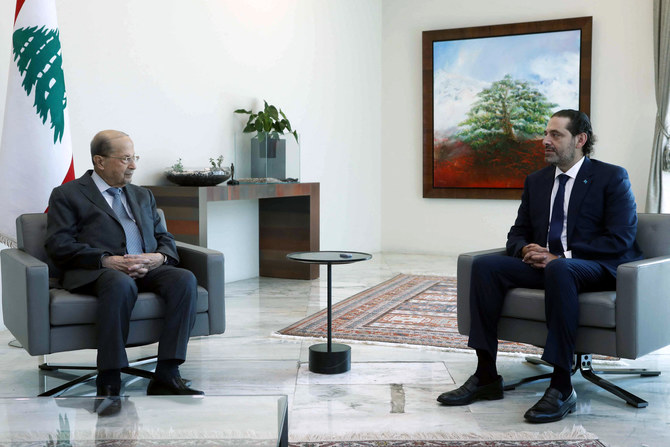
Lebanon's President Michel Aoun meeting with Prime minister-designate Saad Hariri at the presidential palace on Wednesday. (AFP)
2 / 2
Lebanese Prime Minister-Designate Saad Hariri arrives at his meeting with Lebanese President Michel Aoun on Wednesday. (AP)
Short Url
Updated 16 July 2021
Follow

‘God help this country:’ Lebanon in limbo as PM-designate Hariri quits

  • President rejects 24-member cabinet lineup
  • Angry protests spread as pound hits new low

BEIRUT: Lebanon’s Prime Minister-designate Saad Hariri stepped down on Thursday, citing “key differences” with President Michel Aoun after nine months of political wrangling that failed to form a government for the crisis-ridden country.

Following his second meeting with the president in the past 24 hours, Hariri announced that “Aoun’s position has not changed.”

The two men held their 19th meeting on Wednesday, with Hariri presenting a lineup for a 24-member cabinet.

“God help this country,” Hariri said. “Aoun requested fundamental changes to the cabinet lineup I had presented to him on Wednesday, related to the naming of Christian ministers. He told me that we would not be able to reach an agreement.”

Aoun’s office hit back in a statement, saying that Hariri “was not ready to discuss amendments of any kind.”

The president said he would set a date for binding parliamentary consultations as soon as possible to assign an alternative figure to take over the task of forming a government.

Following Hariri’s move, the Lebanese pound hit a new low and was selling for higher than LBP20,000 to the dollar on the black market.

The resignation and the sharp rise in the price of the dollar sparked angry protests that spread in Beirut, Sidon, Tripoli and Baalbek.

Opinion

This section contains relevant reference points, placed in (Opinion field)

Protesters destroyed restaurants and cafes and expelled customers from these establishments in the southern city of Tyre.

In Beirut, streets were blocked and there were clashes with soldiers in the vicinity of Beirut Arab University, leaving some injured.

In Tripoli, there were repeated calls through loudspeakers for people to take to the streets.

Relations between Aoun and Hariri were under great strain because of the political differences and disputes between the president and his political party, the Free Patriotic Movement (FPM), on one side and Hariri’s Future Movement on the other.

Dr. Harith Suleiman, an academic and political writer, said he was not shocked to see Lebanon reach this impasse as Aoun had been “hindering all attempts” to form a rescue government for the past nine months.

“Aoun does not want Hariri to head the government and is insisting on giving the blocking third to himself and his political party to be able to sack the government whenever he feels like it,” he told Arab News. “He wants the blocking third to be solely given for his party, without Hezbollah, because he does want Hezbollah to be able to apply pressure in case it was to support a presidential candidate other than the FPM’s candidate, Gebran Bassil.

“It is not easy now to name a well-respected Sunni figure who would resist Aoun and his son-in-law, Gebran Bassil, to form a government that would stop the collapse. Bassil wants a premier who would be willing to work for him and take his orders.”
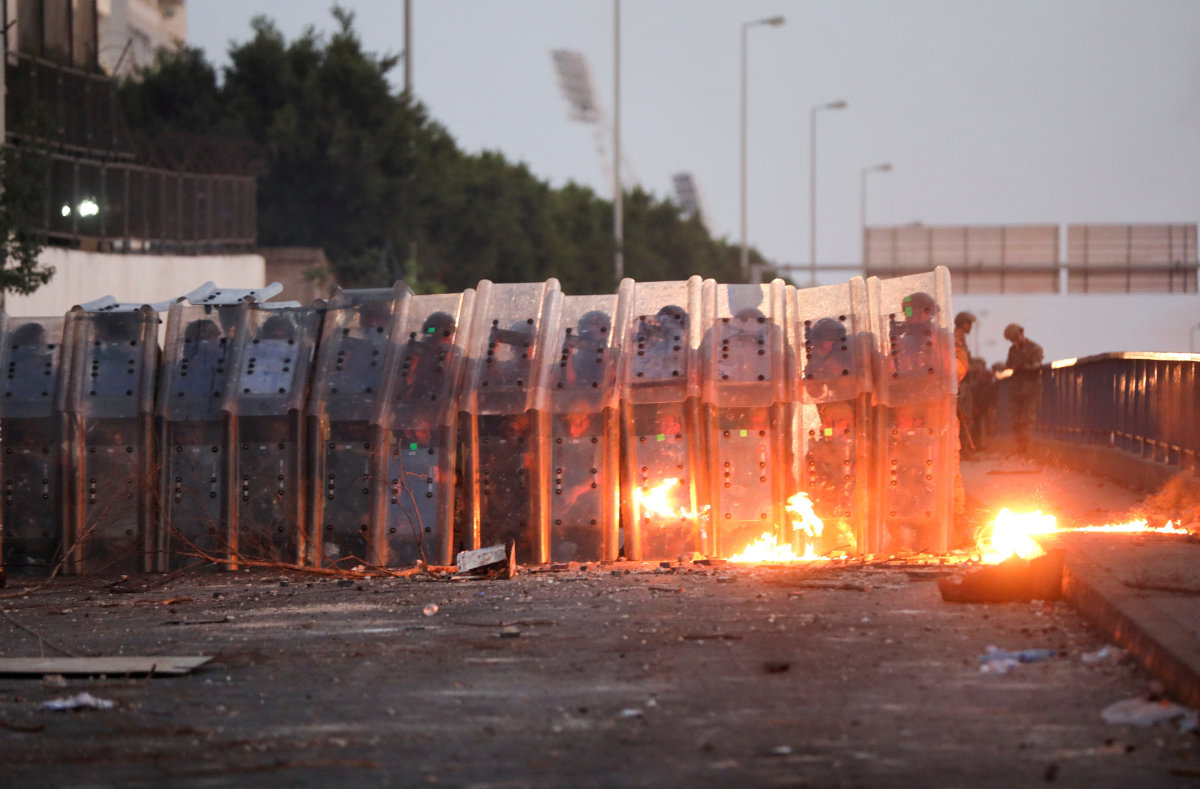


Lebanese army take cover behind shields as they deploy during a protest in Beirut on Thursday after PM-designate Saad al-Hariri abandoned his effort to form a new government. (REUTERS/Mohamed Azakir)

Regarding the failure of foreign pressure to reach a solution in Lebanon, Suleiman added: “We will remain hostages until the conclusion of the American-Iranian talks in Vienna. How can foreign countries ask us to save ourselves while we are hostages? Can the kidnapped rebel against their kidnappers?”

Former lawmaker Fares Souaid said Aoun was still in the presidential palace “only because of Hezbollah.”

“In the confrontation of political forces, the public opinion and the Arab and international decision-making bodies, the situation is worse than dangerous,” he added.

The US State Department said that Secretary of State Antony Blinken would discuss with his French counterpart Jean-Yves Le Drian the efforts exerted to address the situation in Lebanon, adding that “Lebanon’s leaders must form a government able to carry out reforms to end the crisis.”

FASTFACT

Aoun said he would set a date for binding parliamentary consultations as soon as possible to assign an alternative figure to take over the task of forming a government.

On Thursday, the US ambassador to Lebanon Dorothy Shea and her French counterpart Anne Grillo handed a joint letter to Aoun from Blinken and Le Drian in which they stressed “their countries’ interest in the Lebanese situation” and “the need to form a government soon to address the critical situation that Lebanon is facing.”

France on Thursday reiterated its commitment to supporting the Lebanese while sources said that French presidential envoy Patrick Durel met Mohamed Raad, head of Hezbollah's parliamentary bloc, on Wednesday night.

During a celebration on France’s national day, Grillo addressed the Lebanese and said: “This celebration is held this year in the context of the solidarity that we have been expressing to you for several months, and especially after Aug. 4, 2020, the day of the Beirut port explosion. 

“Once again today, I am reiterating to you that France, the French people, and the French residents in Lebanon will always support you. The situation today is urgent and pressing. France has always sought to gather support for Lebanon. At the initiative of the French president and with the support of the UN, a third international conference to support the Lebanese people will be held on Aug. 4. This date will constitute a new milestone ... following the two previous conferences that helped raise €250 million ($295.07 million) for Lebanon, including €80 million from France.”


Iranian strikes kill two in UAE, injure eight in Qatar as regional conflict escalates

Updated 01 March 2026
Follow

Iranian strikes kill two in UAE, injure eight in Qatar as regional conflict escalates

  • UAE defense ministry said Iran fired 137 missiles and 209 drones at the territory
  • Qatar intercepted most of the 65 missiles and 12 drones launched by Iran, said officials

ABU DHABI: Explosions rocked cities across the Gulf on Saturday, killing two people in Abu Dhabi, while smoke and flames rose from Dubai landmark The Palm as Iran launched waves of attacks in retaliation for US and Israeli strikes.

The attacks hit airports in Abu Dhabi, Dubai and Kuwait, as well as Gulf military bases and residential areas, raising fears of a wider conflict and rattling a region long seen as a haven of peace and security.

Across the UAE, Iran fired 137 missiles and 209 drones at the territory, the country’s defense ministry said, as projectiles streaked across the skies of every Gulf state but Oman, a mediator in the recent US-Iran talks.

The UAE defense ministry said most of the missiles and drones were intercepted but at Abu Dhabi’s Zayed International Airport officials said at least one person was killed and seven wounded in an “incident.”

Earlier, falling debris killed a Pakistani civilian in Abu Dhabi, the United Arab Emirates’ capital, officials said.

At Dubai International Airport four people were injured according to airport authorities and four others were also hurt at the luxury Palm development.

In Qatar, officials said Iran launched 65 missiles and 12 drones toward the Gulf state, most of which were intercepted, but eight people were injured in the salvos, with one of them in critical condition.

“We are scared of what the future is for us now, and we can’t say how the next few days are going to be,” Maha Manbaz, a nursing student in Doha told AFP.

Terrified’

Smoke poured from US bases in Abu Dhabi and Bahrain’s capital Manama, home of the American navy’s Fifth Fleet, witnesses saw.

A drone struck Kuwait’s international airport and a base housing US personnel was targeted. Three Kuwaiti soldiers and 12 other people were wounded, authorities said.

After Iran’s Revolutionary Guards reported missile strikes, US Central Command (CENTCOM) said on X that no American naval vessels were hit, damage to US facilities was minimal, and no US casualties had been reported.

Residential buildings were also targeted in Manama, with officials saying firefighters and civil defense teams had been dispatched to the scene.

“The sound of the first explosion terrified me,” said a 50-year-old retiree living near the US base in Manama’s Juffair area, where residents were quickly evacuated.

The UAE, Saudi Arabia and Qatar warned they reserved the right to respond to the attacks.

The oil-and-gas-rich Arab monarchies, lying just across the Gulf from Iran, are long-term American allies and host a clutch of US military bases.

“The Gulf states are sandwiched between Iran and Israel, and have to bear the worst inclinations of both,” said Bader Al-Saif, an assistant professor at Kuwait University.

“Iran’s attacks on the Gulf are misplaced. They’ll only alienate its neighbors and invite further distancing from Iran,” he added.

Conflict is unusual in the Gulf, which has traded on its reputation for stability to become the Middle East’s commercial and diplomatic hub.

‘Significant damage’

The unprecedented barrage targeted Qatar’s Al Udeid base, the region’s biggest US military base, as well as Riyadh and eastern Saudi Arabia.

The UAE, Qatar and Kuwait all announced that their airspace was closed.

An AFP journalist in Qatar saw one missile destroyed in a puff of white smoke, while another in Dubai saw a volley of Patriot interceptors taking off.

Iran fired missiles at Al Udeid last June after US strikes targeted Iranian nuclear facilities during a brief war with Israel.

The escalation also saw Saudi Crown Prince Mohammed bin Salman and UAE President Mohamed bin Zayed speak for the first time since a public row in late December.

The Saudi de facto ruler called the Emirati president and the pair discussed Iran’s retaliatory strikes on the Gulf and expressed solidarity and sympathy.

In Kuwait, an Iranian missile attack caused “significant damage” to the runway at an air base hosting Italian air force personnel, Italian Foreign Minister Antonio Tajani was quoted by the ANSA news agency as saying.

Late on Saturday, Kuwaiti officials said a drone targeted a naval base there with air defense forces intercepting the projectile, according to a post by the defense ministry on X.

For many residents in the Gulf, which has drawn a cosmopolitan, largely expat population, the reaction was one of shock.

“I heard the explosions, I don’t know what I felt,” a Lebanese woman living in Riyadh told AFP.

“We came to the Gulf because it’s known to be safer than Lebanon. Now I don’t know what to do or how to think really.”