

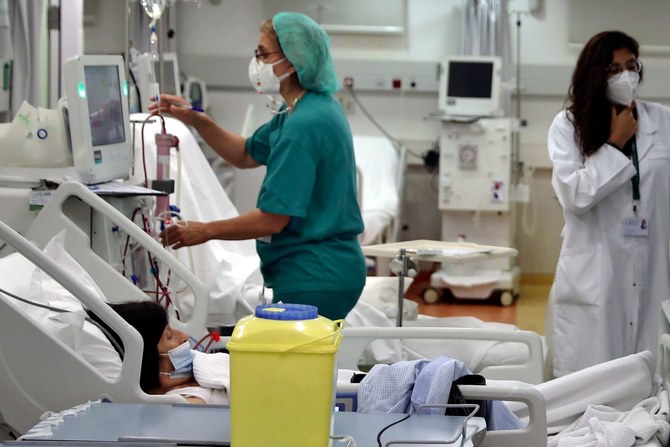

DUBAI: Two public hospitals in Lebanon have threatened to shut their doors from Thursday, July 15, if officials fail to disburse urgently needed supplies, funds and materials as the healthcare sector inches closer toward a collapse.
Lebanon has been hit with an unprecedented financial, economic, and monetary crisis that has wiped out life savings coupled with a crippling liquidity crunch.
Shahar Gharbi Governmental Hospital, located in the heart of Aley district, announced Tuesday that it would stop receiving patients as of Thursday.
“We’re facing crisis after crisis. Fuel shortages, medicine shortages and unsustainable wages,” Nawal Al Hasaniya, a member of the hospital’s secretary administration, told Arab News.
The health sector, as with virtually all other sectors across the country, has been reeling under the burden of the country’s severe financial crisis, prompting medical practitioners to repeatedly sound the alarm.
The national currency has lost more than 91 percent of its value since October 2019, causing the value of the minimum wage to plummet to around $35 per month.
At Sibline Government Hospital on the southern outskirts of Beirut, managing doctor Ali Al Barraj echoed Hasaniya’s concerns.
“It’s an extremely tough situation. Starting tomorrow we’re going to shut down,” he said.
Just like Shahar Hospital, his facility will limit its activities to only treating life-threatening conditions such as dialysis and heart conditions.
Employees, they explained, now earn as little as $40 per month, with Barraj calling on the Health Ministry to disperse LL3 billion while raising their wages.
A similar plea was made by Sibline Hospital, yet both have fallen on deaf ears.
“Until now, we haven’t heard anything, and we are headed toward an escalation,” Hasaniya said.
Last week, the Union of Governmental Hospital Workers urged officials to increase their allowances and pay late salaries amid soaring inflation and food insecurity.
“We’ve reached a point where our patients aren’t even served chicken or meat,” Hasaniya said.
To make matters worse, her hospital is facing shortages of vital medication used to treat infections and blood clots.
“We’ve been out of these two medications for over a week now,” she added, highlighting that even when medication is distributed by the Health Ministry, quantities delivered are extremely low.
“This forces us to ration whatever supplies we have,” she noted.
A supply order seen by Arab News, submitted on June 6, shows that Sibline Hospital had requested over 14 items needed to operate its laboratories.
Almost six weeks later, these supplies have yet to be delivered, Hasaniya said.
Lebanon is also currently witnessing a resurgence of COVID-19 infections, two weeks after seemingly bringing the pandemic under control.
On Tuesday, the small Mediterranean country recorded the highest number of new coronavirus cases in many weeks, prompting Firas Abiad, the head of one of Lebanon’s largest public hospitals, to issue a cry for help.
“Access to healthcare for vulnerable patients, Lebanese or other, is in jeopardy. Private hospitals, facing mounting costs and stagnant tariffs, are limiting access to patients able to pay extra fees. Some services are provided on a cash basis only, while others are closed,” he tweeted.
Despite the urgency of the situation, Lebanon has been without a fully functioning government for eight months, with negotiations stalled in a quagmire that has seen politicians bicker over cabinet portfolios and quotas.
According to Save the Children, the UK-based charity, more children are being forced into work as the country grapples with its worst economic crisis in decades.
Increasing poverty has brought about a “dramatic increase” in the number of kids scouring the streets looking to collect scrap metal or plastic, or sell gasoline or tissues, it noted, with 306 cases identified in the first six months of 2021 alone compared with 346 during all of last year.
“The crisis in public hospitals was precipitated by the additional burden of receiving more vulnerable patients as poverty levels soar. Their staff is already depleted, financially, physically, and mentally. This could not have come at a worse time, as COVID-19 numbers rise.”
The Ministry of Health could not be reached for comment.


