

‘Catastrophe’ warning as Lebanon's fuel crisis hits hospitals  

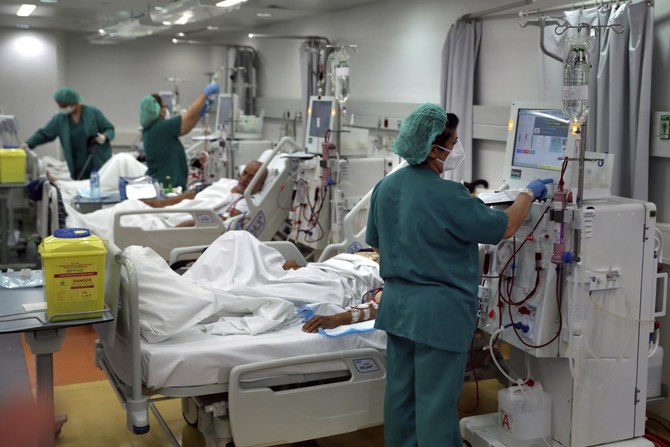
Lebanon’s hospitals were already struggling to cope with the coronavirus disease (COVID-19) pandemic before the latest electricity crisis. (AP)
Short Url
Updated 29 June 2021
Follow

‘Catastrophe’ warning as Lebanon's fuel crisis hits hospitals  

  • Doctors say they are being stretched even further with shortages of medical supplies and fuel

DUBAI: Dr. Samer Saade’s car ran out of fuel this morning while he was on his way to work at Hammoud Hospital University Medical Center in Sidon, southern Lebanon.

He parked his car on the side of the road in Khaldeh and took a cab for the remainder of the 30-km journey.

“I haven’t been able to fill my car for the past four days,” Saade told Arab News. “Either queue lines at gas stations are out of this world or the pumps are simply closed,” he said.

The emergency room physician, like practically all Lebanese, has been hit hard by the ongoing fuel shortage in the crisis-hit country.

Giant queues clogging roads near petrol stations have become a common sight and refueling is limited to 15 or 20 liters, making long-distance travel a thing of the past.

The fuel crisis, however, is not only limited to the petrol needed for cars; it has also made its way to the country’s beleaguered electricity grid.

Lebanon’s hospitals were already struggling to cope with the coronavirus disease (COVID-19) pandemic before the latest electricity crisis.

Now, doctors say, they are being stretched even further with shortages of medical supplies and fuel.

“Medicine shortages, equipment shortages, hyperinflation pricing out the poor from getting care — anything that can go wrong in this country will go wrong, basically,” Saade said.

At the hospital, state electricity “barely comes on for two or three hours per day,” Saade said, with four private generators needed to fill the gap.

Two of Lebanon’s Turkish power barges have been shut down amid an ongoing feud with the parent company, while the other four state-owned power plants are running on fumes.

“We were already used to state electricity being out, but now we don’t even know if we’ll manage to secure enough fuel for the generators,” Saade told Arab News.

In total, his hospital has four generators that operate, with two operating at any given time.

According to Saade, his hospital has enough fuel reserves for the upcoming four days.

“After that, I don’t know. We’re living day-by-day,” he said.

Forty km away at Rafik Hariri University Hospital in Beirut, an establishment that found itself at the frontlines of the pandemic, the situation is even more precarious.

As prolonged electricity cuts surged, the hospital has been rationing electricity since yesterday and turning off air-conditioning in all areas except those used for medical purposes, the hospital’s general manager Firas Abiad wrote in a tweet.

“Air-conditioning throughout our premises except in areas needed for medical purposes, such as operating and examination rooms will be turned off due to protracted electricity cuts,” Abiad said.

Accompanying his tweet was a letter Abiad sent to caretaker Energy Minister Raymond Ghajar asking for support in maintaining the hospital’s electricity supply.

If the problem persists, “we’re headed toward a catastrophe,” Saade said.

“Ventilators, CPR machines, basically everything needed for critical care facilities will be shut down,” he added.

Lebanon has been without a fully functioning government for eight months, with negotiations stalled in a quagmire that has seen politicians bicker over cabinet portfolios and quotas.

Meanwhile, food insecurity and extreme poverty plague the country as any semblance of normal life dissipates.

Several industries have sounded the alarm over a lack of fuel, which has caused private generators to struggle to keep pace with increased state outages.

The head of the Lebanese poultry syndicate urged officials over the weekend to deliver diesel to chicken farms before power cuts compromise the wellbeing of livestock and the safety and quality of refrigerated chicken.

Meanwhile, the crisis is also jeopardizing public sector operations.

The General Security headquarters in Beirut, the country’s main intelligence agency, was hit with a blackout yesterday when a generator shutdown coincided with a state power cut.

Despite Lebanon needing to preserve its last remaining foreign currency reserves for any possible economic recovery, the central bank has continued to subsidize fuel, medicine and wheat, draining the state’s coffers of some $5 billion annually.

But the cash-strapped small Mediterranean country has now begun rolling back its subsidy program, starting with fuel.

Lebanon will now start importing fuel at LL3,900 to the dollar, as opposed to the official rate of LL1,500. On the black market, the Lebanese pound is trading at around LL18,000 per greenback, representing a depreciation of around 92 percent for the national currency.

Effective today, a price hike of around 30 to 40 percent on all fuel derivatives has been implemented.

The price of 20 liters of gas will now cost LL61,000 ($40 at the official rate), up from LL45,200, while 20 liters of diesel will cost LL46,100, up from LL33,300.

“These price increases will surely affect our ability to secure fuel while also increasing our costs and, as a result, the cost on patients,” Dr. Mohammed Khodrin, head of Akkar Governmental Hospital, told Arab News. 


Syrian army pushes into Aleppo district after Kurdish groups reject withdrawal

Updated 10 January 2026
Follow

Syrian army pushes into Aleppo district after Kurdish groups reject withdrawal

  • Two Syrian security officials told Reuters the ceasefire efforts had failed and that the army would seize the neighborhood by force

ALEPPO, Syria: The Syrian army said it would push into the last Kurdish-held district of Aleppo ​city on Friday after Kurdish groups there rejected a government demand for their fighters to withdraw under a ceasefire deal.
The violence in Aleppo has brought into focus one of the main faultlines in Syria as the country tries to rebuild after a devastating war, with Kurdish forces resisting efforts by President Ahmed Al-Sharaa’s Islamist-led government to bring their fighters under centralized authority.
At least nine civilians have been killed and more than 140,000 have fled their homes in Aleppo, where Kurdish forces are trying to cling on to several neighborhoods they have run since the early days of the war, which began in 2011.

HIGHLIGHTS

• Standoff pits government against Kurdish forces

• Sharaa says Kurds are ‘fundamental’ part of Syria

• More than 140,000 have fled homes due to unrest

• Turkish, Syrian foreign ministers discuss Aleppo by phone

ِA ceasefire was announced by the defense ministry overnight, demanding the withdrawal of Kurdish forces to the Kurdish-held northeast. That would effectively end Kurdish control over the pockets of Aleppo that Kurdish forces have held.

CEASEFIRE ‘FAILED,’ SECURITY OFFICIALS SAY
But in a statement, Kurdish councils that run Aleppo’s Sheikh Maksoud and Ashrafiyah districts ‌said calls to leave ‌were “a call to surrender” and that Kurdish forces would instead “defend their neighborhoods,” accusing government forces ‌of intensive ⁠shelling.
Hours ​later, the ‌Syrian army said that the deadline for Kurdish fighters to withdraw had expired, and that it would begin a military operation to clear the last Kurdish-held neighborhood of Sheikh Maksoud.
Two Syrian security officials told Reuters the ceasefire efforts had failed and that the army would seize the neighborhood by force.
The Syrian defense ministry had earlier carried out strikes on parts of Sheikh Maksoud that it said were being used by the Kurdish-led Syrian Democratic Forces (SDF) to launch attacks on the “people of Aleppo.” It said on Friday that SDF strikes had killed three army soldiers.
Kurdish security forces in Aleppo said some of the strikes hit a hospital, calling it a war crime. The defense ministry disputed that, saying the structure was a large arms depot and that it had been destroyed in the resumption of strikes on Friday.
It ⁠posted an aerial video that it said showed the location after the strikes, and said secondary explosions were visible, proving it was a weapons cache.
Reuters could not immediately verify the claim.
The SDF is ‌a powerful Kurdish-led security force that controls northeastern Syria. It says it withdrew its fighters from ‍Aleppo last year, leaving Kurdish neighborhoods in the hands of the Kurdish ‍Asayish police.
Under an agreement with Damascus last March the SDF was due to integrate with the defense ministry by the end of 2025, ‍but there has been little progress.

FRANCE, US SEEK DE-ESCALATION
France’s foreign ministry said it was working with the United States to de-escalate.
A ministry statement said President Emmanuel Macron had urged Sharaa on Thursday “to exercise restraint and reiterated France’s commitment to a united Syria where all segments of Syrian society are represented and protected.”
A Western diplomat told Reuters that mediation efforts were focused on calming the situation and producing a deal that would see Kurdish forces leave Aleppo and provide security guarantees for Kurds who remained.
The diplomat ​said US envoy Tom Barrack was en route to Damascus. A spokesperson for Barrack declined to comment. Washington has been closely involved in efforts to promote integration between the SDF — which has long enjoyed US military support — and Damascus, with which the ⁠United States has developed close ties under President Donald Trump.
The ceasefire declared by the government overnight said Kurdish forces should withdraw by 9 a.m. (0600 GMT) on Friday, but no one withdrew overnight, Syrian security sources said.
Barrack had welcomed what he called a “temporary ceasefire” and said Washington was working intensively to extend it beyond the 9 a.m. deadline. “We are hopeful this weekend will bring a more enduring calm and deeper dialogue,” he wrote on X.

TURKISH WARNING
Turkiye views the SDF as a terrorist organization linked to the outlawed Kurdistan Workers’ Party and has warned of military action if it does not honor the integration agreement.
Turkish Foreign Minister Hakan Fidan, speaking on Thursday, expressed hope that the situation in Aleppo would be normalized “through the withdrawal of SDF elements.”
Though Sharaa, a former Al-Qaeda commander who belongs to the Sunni Muslim majority, has repeatedly vowed to protect minorities, bouts of violence in which government-aligned fighters have killed hundreds of Alawites and Druze have spread alarm in minority communities over the last year.
The Kurdish councils in Aleppo said Damascus could not be trusted “with our security and our neighborhoods,” and that attacks on the areas aimed to bring about displacement.
Sharaa, in a phone call with Iraqi Kurdish leader Masoud Barzani on Friday, affirmed that the Kurds were “a fundamental part ‌of the Syrian national fabric,” the Syrian presidency said.
Neither the government nor the Kurdish forces have announced a toll of casualties among their fighters from the recent clashes.