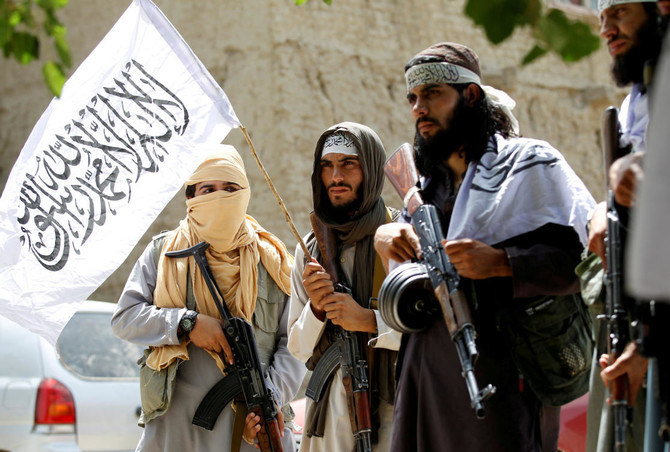
ISLAMABAD: The Afghan Taliban have said the group would not allow the militant Pakistan Taliban to use Afghanistan’s soil against Pakistan after the withdrawal of United States and allied forces later this year, saying the two groups were separate entities.
The Pakistani Taliban, fighting to overthrow the Pakistan government and install their own brand of strict Islam, are an umbrella of militant groups called Tehrik-e-Taliban Pakistan (TTP), which in recent years has broken into many divisions.
The TTP has been designated a terrorist group by the United States but been in disarray in recent years, especially after several of its top leaders were killed by US drone strikes on both sides of the Pak-Afghan border, forcing its members into shelter in Afghanistan or to flee to urban Pakistan.
Bolstering their bid to re-establish themselves in the border lands, the group struck an alliance in July last year with half a dozen small militant factions. Since then, the TTP has stepped up attacks on security forces in northwest Pakistan, raising fears of a revival of their insurgency with support from the Afghan Taliban, especially as US forces continue to pull out of war-torn Afghanistan and the Afghan Taliban capture more territory.
“Pakistani Taliban are not our problem and it is Pakistan’s internal issue and we pray for the resolution of [Pakistan’s] internal matters amicably,” Taliban spokesman Zabihullah Mujahid said in an interview to Pakistani TV channel Hum News on Monday night.
“From our country [Afghanistan], not a single person will be allowed to use our land and interfere in neighboring country [Pakistan], and we will not allow [anyone] to attack Pakistan using Afghan soil.”
On a separate political talk show on Hum News, another Afghan Taliban spokesman, Suhail Shaheen, also reiterated that the group would not allow Afghan soil to be used against any other country or individual, adding that the Tehrik-i-Taliban Pakistan was not a part of the Afghan Taliban.
Last month, Pakistan’s foreign office rejected claims by the Afghan foreign minister that the TTP was not present or active in Afghanistan.
A United Nations report last July said more than 6,000 Pakistani insurgents were hiding in Afghanistan, most belonging to the outlawed Pakistani Taliban group responsible for attacking Pakistani military and civilian targets.
“Over last many years, TTP has launched several gruesome terrorist attacks inside Pakistan using Afghan soil without any retribution from its hosts,” the Pakistani foreign office said in June. “TTP following its orchestrated reunification with its splinter groups with the help of Hostile Intelligence Agencies (HIAs), its continued presence in Afghanistan with impunity and its cross-border attacks against Pakistan, pose persistent threat to our security and stability.”
The UN report last year said the Tehreek-e-Taliban had linked up with the Afghan-based affiliate of the Daesh group or Daesh. Some of TTP’s members had even joined the Daesh affiliate, which had its headquarters in eastern Afghanistan, the UN said.
The TTP has claimed responsibility for many high profile assaults in Pakistan, including an armed attack on a school in Peshawar in 2014 in which 134 children and 19 adults were killed. The TTP also claimed the 2012 shooting of then teenage activist Malala Yousafzai, targeted for her campaign against Taliban efforts to deny girls education.
Pakistan began fencing its 2,600 km porous border with Afghanistan in 2017 to prevent militants crossing into the country and says it has completed nearly 90 percent of the work.

Will not allow Tehrik-e-Taliban to use Afghan soil against Pakistan — Afghan Taliban
https://arab.news/yrssk
Will not allow Tehrik-e-Taliban to use Afghan soil against Pakistan — Afghan Taliban
- Pakistani Taliban or TTP, in disarray in recent years, are fighting to overthrow the Pakistan government
- US withdrawal has raised fears of TTP revival with support from the Afghan Taliban
Pakistan opposition to continue protest over ex-PM Khan’s health amid conflicting reports
- Pakistan’s government insists that the ex-premier’s eye condition has improved
- Khan’s personal doctor says briefed on his condition but cannot confirm veracity
ISLAMABAD: Pakistan’s opposition alliance on Monday vowed to continue their protest sit-in at parliament and demanded “clarity” over the health of jailed former prime minister Imran Khan, following conflicting medical reports about his eye condition.
The 73-year-old former cricket star-turned-politician has been held at the high-security Adiala prison in Rawalpindi since 2023. Concerns arose about his health last week when a court-appointed lawyer, Barrister Salman Safdar, was asked to visit Khan at the jail to assess his living conditions. Safdar reported that Khan had suffered “severe vision loss” in his right eye due to central retinal vein occlusion (CRVO), leaving him with just 15 percent sight in the affected eye.
On Sunday, a team of doctors from various hospitals visited the prison to examine Khan’s eye condition, according to the Adiala jail superintendent, who later submitted his report in the court. On Monday, a Supreme Court bench led by Chief Justice Yahya Afridi observed that based on reports from the prison authorities and the amicus curiae, Khan’s “living conditions in jail do not presently exhibit any perverse aspects.” It noted that Khan had “generally expressed satisfaction with the prevailing conditions of his confinement” and had not sought facilities beyond the existing level of care.
Having carefully perused both reports in detail, the bench observed that their general contents and the overall picture emerging therefrom are largely consistent. The opposition alliance, which continued to stage its sit-in for a fourth consecutive day on Monday, held a meeting at the parliament building on Monday evening to deliberate on the emerging situation and discuss their future course of action.
“The sit-in will continue till there is clarity on the matter of [Khan's] health,” Sher Ali Arbab, a lawmaker from Khan's Pakistan Tehreek-e-Insaf (PTI) party who has been participating in the sit-in, told Arab News, adding that PTI Chairman Gohar Ali Khan and Opposition Leader in Senate Raja Nasir Abbas had briefed them about their meeting with doctors who had visited Khan on Sunday.
Speaking to reporters outside parliament, Gohar said the doctors had informed them that Khan’s condition had improved.
“They said, 'There has been a significant and satisfactory improvement.' With that satisfactory improvement, we also felt satisfied,” he said, noting that the macular thickness in Khan’s eye had reportedly dropped from 550 to 300 microns, a sign of subsiding swelling.
Gohar said the party did not want to politicize Khan’s health.
“We are not doctors, nor is this our field,” he said, noting that Khan’s personal physician in Lahore, Dr. Aasim Yusuf, and his eye specialist Dr. Khurram Mirza had also sought input from the Islamabad-based medical team.
“Our doctors also expressed satisfaction over the report.”
CONFLICTING ACCOUNTS
Despite Gohar’s cautious optimism, Khan’s personal physician, Dr. Yusuf, issued a video message on Monday, saying he could neither “confirm nor deny the veracity” of the government’s claims.
“Because I have not seen him myself and have not been able to participate in his care... I’m unable to confirm what we have been told,” Yusuf said.
He appealed to authorities to grant him or fellow physician, Dr. Faisal Sultan, immediate access to Khan, arguing that the ex-premier should be moved to Shifa International Hospital in Islamabad for specialist care.
Speaking to Arab News, PTI’s central information secretary Sheikh Waqas Akram said Khan’s sister and their cousin, Dr. Nausherwan Burki, will speak to media on Tuesday to express their views about the situation.
The government insists that Khan’s condition has improved.
“His eye [condition] has improved and is better than before,” State Minister Talal Chaudhry told the media in a brief interaction on Monday.
“The Supreme Court of Pakistan is involved, and doctors are involved. What medicine he receives, whether he needs to be hospitalized or sent home, these decisions are made by doctors. Neither lawyers nor any political party will decide this.”


