

Pakistan says Iran border 46% fenced, to be completed in a year

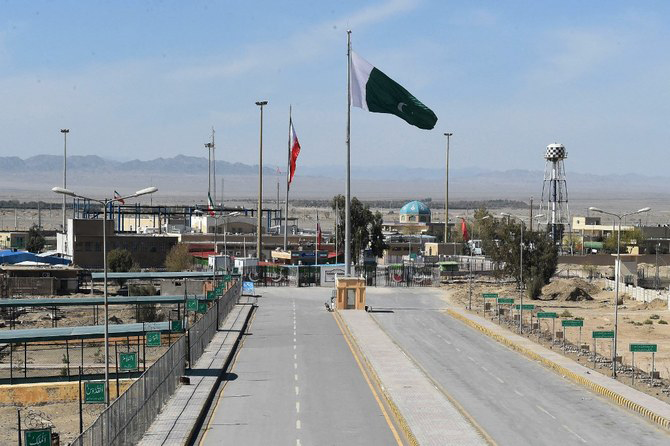
General view of Pakistan-Iran border in Taftan, one of Pakistan’s border crossing with Iran. (AFP/File)
Short Url
Updated 13 July 2021
Follow

Pakistan says Iran border 46% fenced, to be completed in a year

  • Final decision on banning Tehreek-e-Labbaik religious political party to be taken next month, says Pakistani interior minister

KARACHI: Work on fencing along Pakistan’s border with Iran is underway and will be completed within a year, Pakistan’s Interior Minister Sheikh Rasheed Ahmed said on Monday.

The 959-km Pakistan-Iran border begins at the Koh-i-Malik Salih mountain and ends at Gwadar Bay in the Gulf of Oman. It includes a diverse landscape of mountain ridges, seasonal streams and rivers, and is notorious for human trafficking and smuggling, as well as cross-border militancy. 

In February last year, then-Pakistani Army spokesperson Gen. Asif Ghafoor said Pakistan and Iran were considering fencing the common border so that “no third party could sabotage relations” between the two countries. 

Both nations have repeatedly accused each other of allowing militants to cross their shared frontier and carry out attacks. Both deny state complicity. 

In May this year, Moazzam Jah Ansari, commandant of the paramilitary Frontier Constabulary in Balochistan, a province that borders Iran, told the Pakistani Senate that Iran was resisting the fencing. 

“Pakistan’s border with Afghanistan is 90 percent fenced and the rest will be completed within one month,” Ahmed told reporters. “The border with Iran is 46 percent fenced and it will be completed within a year’s time,” he said, adding that his ministry was “fully focused” on border management. 

Ahmed said that a final decision on the fate of the Tehreek-e-Labbaik Pakistan (TLP), a religious political party that was banned by the government in April this year for holding violent protests, would be taken next month.  

“The last and important (issue) is that a summary of the decision regarding the TLP has been sent, and tomorrow, a meeting of the Cabinet will decide what should be the fate of TLP,” Ahmed added. 

The law requires that the Cabinet gives its approval to enforce a government ban on any political party before the election commission dissolves it and it is proscribed from contesting elections.


Trump insists he struck Iran on his own terms

Updated 04 March 2026
Follow

Trump insists he struck Iran on his own terms

  • “We are now a nation divided between those who want to fight wars for Israel and those who just want peace and to be able to afford their bills and health insurance,” Marjorie Taylor Greene posted on X.
  • Rubio himself doubled down on Tuesday after meeting with US House and Senate members, while insisting that “No, I told you this had to happen anyway”

WASHINGTON, United States: President Donald Trump and his team scrambled Tuesday to reclaim the narrative on why he decided to attack Iran, after his top diplomat suggested the US struck only after learning of an imminent Israeli strike.
Secretary of State Marco Rubio alarmed Democrats — who say only Congress can declare war — as well as many of Trump’s MAGA supporters on Monday when he said: “We knew that there was going to be an Israeli action.”
“We knew that that would precipitate an attack against American forces, and we knew that if we didn’t pre-emptively go after them before they launched those attacks, we would suffer higher casualties,” Rubio told reporters.
Administration officials quickly backpedalled, insisting Trump authorized the strikes because Tehran was not seriously negotiating an accord on limiting its nuclear ambitions, and the United States needed to destroy Iran’s missile capabilities.
“No, Marco Rubio Didn’t Claim That Israel Dragged Trump into War with Iran,” White House Press Secretary Karoline Leavitt posted Tuesday on X.
At an Oval Office meeting later with Germany’s chancellor, Trump went further, saying that “Based on the way the negotiation was going, I think they (Iran) were going to attack first. And I didn’t want that to happen.”
“So, if anything, I might have forced Israel’s hand.”

- Had to happen? -

Rubio himself doubled down on Tuesday after meeting with US House and Senate members, while insisting that “No, I told you this had to happen anyway.”
“The president made a decision. The decision he made was that Iran was not going to be allowed to hide... behind this ability to conduct an attack.”
Critics seized on the muddied messaging to accuse Trump of precipitating the country into a war without a clear rationale, without informing Congress — and without a clear idea of how it might end.
They noted that just two weeks ago, Israel Prime Minister Benjamin Netanyahu pressed Trump again in Washington to take a hard line, in their seventh meeting since Trump’s return to power last year.
Some Republican allies rallied behind the president, with Senator Tom Cotton, chairman of the Senate Intelligence Committee, insisting that “No one pushes or drags Donald Trump anywhere.”
“He acts in the vital national security interest of the United States,” Cotton told the “Fox & Friends” morning show.
But as crucial US midterm elections approach that could see Republicans lose their congressional majority, Trump risks shedding supporters who had welcomed his pledge to end foreign military interventions.
“We are now a nation divided between those who want to fight wars for Israel and those who just want peace and to be able to afford their bills and health insurance,” Marjorie Taylor Greene, a top former Trump ally and a major figure in the populist and isolationist hard right, posted on X.
