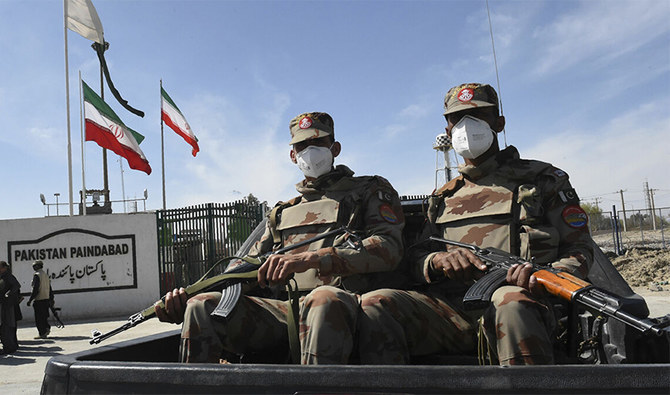

DUBAI/KARACHI: A major intelligence-based operation is ongoing against militants hiding near Pakistan’s border with Iran in the southwestern Balochistan province, Pakistani intelligence officials and local witnesses said, in the latest attempt to combat violence on the 900-km shared frontier.
Over the years, Iran and Pakistan have accused each other of not doing enough to stamp out militants allegedly sheltering across the border.
In the most recent attack that has caused friction between the two nations, six Pakistani security personnel were killed in a bomb attack on a paramilitary Frontier Corps vehicle, the army’s media wing said on May 19. Six Pakistani soldiers were also killed in a roadside bomb attack in Balochistan on May 8.
Several militant groups are active in Balochistan, Pakistan’s biggest but poorest province. Much of the violence in the past has been blamed on, or claimed by, ethnic Baloch separatists.
Baloch Khan, a spokesperson for Baloch Raaji Ajoi Sangar (BRAS), an umbrella group of Baloch insurgent groups, confirmed in a media statement last month that a “Pakistan army operation” was ongoing and soldiers were surrounding and raiding remote villages. However, he said no commanders or fighters of BRAS had been killed in the attacks.
An intelligence official who declined to be named told Arab News that it is called the Ground Zero Clearance Operation.
Two additional intelligence officials confirmed that an operation is ongoing. Two local witnesses in the Mand area of Kech district also confirmed “actions” in their area.
In a Twitter post on May 23, a pro-government politician from Balochistan, Nawabzada Jamal Khan Raisani, said the Pakistani military had launched “a sweeping operation” against the Baloch Liberation Army (BLA) and the Balochistan Liberation Front (BLF) along the border with Iran.
Both groups are part of BRAS, along with the Baloch Republican Army and the Baloch Republican Guards.
“The action began (on May 21) with a string of terrorists neutralized and hideouts busted,” Raisani said.
He told Arab News that a senior BLF commander, Abdul Hameed (alias Ghazin Baloch), was among two dozen militants killed in the ongoing operation, which he said was led by Pakistani soldiers and intelligence officers.
The media wing of the Pakistani military and the Foreign Office declined a request by Arab News for comment.
Ijaz Ahmed Shah, the federal interior minister, said his team would respond to emailed questions, but no reply had been received until the time of press.
Balochistan Home Minister Mir Zia Ullah Langove did not respond to specific questions about the operation “for security reasons,” but said: “We have taken effective actions.”
Speaking on condition of anonymity as he was not authorized to speak to the media on the issue, one intelligence officer based in the city of Turbat said a “bank of targets” had been gathered by officials over many weeks, and raids are now being carried out in several areas, particularly against militants hiding in the border areas of Kecch, Panjgur and Gwadar.
Pakistan began fencing its 900-km border with Iran in May last year, which had become a source of “frustration” for militants, the intelligence official said, leading them to plan more attacks.
Last month, Pakistan’s military chief Gen. Qamar Javed Bajwa spoke to his Iranian counterpart Maj. Gen. Mohammed Bagheri via telephone.
They discussed border fencing, the improvement of border terminals, enhancing security and recent attacks on Pakistani troops near the border, among other issues, according to a statement from the Pakistani Army’s media wing.
On April 20 last year, just days after militants killed 14 bus passengers in an attack along the border with Iran, Pakistani Foreign Minister Shah Mahmood Qureshi said the insurgents behind the attack were based in Iran, calling on Tehran to take action. The attack had been claimed by BRAS.
“The training camps and logistical camps of this new alliance (BRAS) ... are inside the Iranian border region,” Qureshi told reporters in Islamabad. Iran denied any state involvement.
Just days after Qureshi’s comments, Iranian President Hassan Rouhani said during a televised news conference with Pakistani Prime Minister Imran Khan, who was visiting Tehran, that the two nations would form a joint quick reaction force to combat militant activity on their shared border.
“We agreed to increase the security cooperation of the two countries, our border forces, our intelligence forces, and also to form a joint quick reaction force on the border of the two countries for fighting terrorism,” Rouhani said.