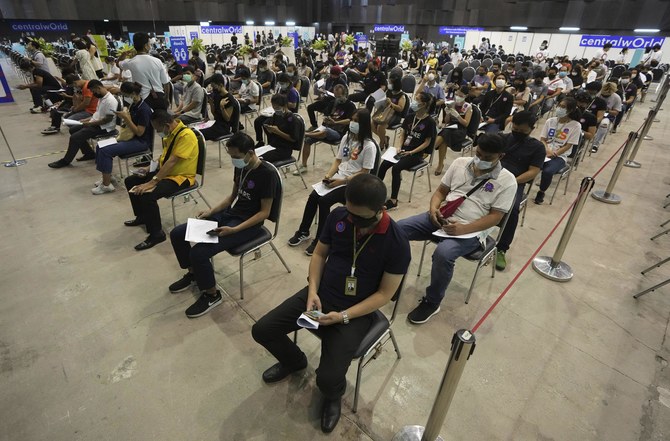
Thailand starts tighter coronavirus lockdown around capital

Thailand recorded 8,656 infections and 80 deaths on Monday. (AP)
Short Url
Updated 12 July 2021
Follow

Thailand starts tighter coronavirus lockdown around capital

  • The restrictions, initially for two weeks, aim to slow the spread of the coronavirus

BANGKOK: Thailand implemented its toughest coronavirus restrictions in more than a year on Monday in Bangkok and surrounding provinces, with new curbs on movement and gatherings imposed and widespread suspensions by airlines and bus firms.
Authorities have urged people in and around Bangkok, the outbreak epicenter, to work from home and have set up 145 checkpoints in 10 high-risk provinces, including 88 in the capital, to try to curb non-essential regional travel.
The restrictions, initially for two weeks, aim to slow the spread of the coronavirus and include a curfew, mall closures and a five-person limit on gatherings, after a period of record or near-record deaths and cases.
Thailand recorded 8,656 infections and 80 deaths on Monday, among the 345,027 cases and 2,791 fatalities overall, the vast majority from an outbreak since early April that is being fueled by the highly transmissible Alpha and Delta COVID-19 variants.
Transport companies are adjusting services to comply with the measures and nighttime curfew hours, with reduced daytime public transport in and around Bangkok.
Thai AirAsia has suspended all domestic flights until July 31 while Bangkok Airways and Thai Airways subsidiary Thai Smile will offer reduced domestic flights.


UNICEF warns of rise in sexual deepfakes of children

Updated 12 sec ago
Follow

UNICEF warns of rise in sexual deepfakes of children

  • The findings underscored the use of “nudification” tools, which digitally alter or remove clothing to create sexualized images

UNITED NATIONS, United States: The UN children’s agency on Wednesday highlighted a rapid rise in the use of artificial intelligence to create sexually explicit images of children, warning of real harm to young victims caused by the deepfakes.
According to a UNICEF-led investigation in 11 countries, at least 1.2 million children said their images were manipulated into sexually explicit deepfakes — in some countries at a rate equivalent to “one child in a typical classroom” of 25 students.
The findings underscored the use of “nudification” tools, which digitally alter or remove clothing to create sexualized images.
“We must be clear. Sexualized images of children generated or manipulated using AI tools are child sexual abuse material,” UNICEF said in a statement.
“Deepfake abuse is abuse, and there is nothing fake about the harm it causes.”
The agency criticized AI developers for creating tools without proper safeguards.
“The risks can be compounded when generative AI tools are embedded directly into social media platforms where manipulated images spread rapidly,” UNICEF said.
Elon Musk’s AI chatbot Grok has been hit with bans and investigations in several countries for allowing users to create and share sexualized pictures of women and children using simple text prompts.
UNICEF’s study found that children are increasingly aware of deepfakes.
“In some of the study countries, up to two-thirds of children said they worry that AI could be used to create fake sexual images or videos. Levels of concern vary widely between countries, underscoring the urgent need for stronger awareness, prevention, and protection measures,” the agency said.
UNICEF urged “robust guardrails” for AI chatbots, as well as moves by digital companies to prevent the circulation of deepfakes, not just the removal of offending images after they have already been shared.
Legislation is also needed across all countries to expand definitions of child sexual abuse material to include AI-generated imagery, it said.
The countries included in the study were Armenia, Brazil, Colombia, Dominican Republic, Mexico, Montenegro, Morocco, North Macedonia, Pakistan, Serbia, and Tunisia.