BANGKOK: A massive explosion at a factory on the outskirts of Bangkok early Monday killed at least one person and injured 11 more, while prompting the evacuation of a wide area, including the hospital where casualties were initially treated, over fears of poisonous fumes from burning chemicals and the possibility of additional denotations.
The fire broke out at around 3 a.m. at a foam and plastic pellet manufacturing factory just outside Bangkok near Suvarnabhumi Airport, blowing out windows of surrounding homes and sending debris raining from the air.
The blast could be heard for kilometers and surveillance footage from a nearby house captured the bright flash and boom, followed by the damage to the home and the one next door from the shockwaves.
Firefighters used helicopters to dump water on hard-to-access areas in the large complex. By mid-morning the main blaze at the Ming Dih Chemical factory had been brought under control, but a massive tank containing the chemical styrene monomer continued to burn, said local disaster prevention official Chailit Suwannakitpong.
Styrene monomer, a hazardous liquid chemical used in the production of disposable foam plates, cups and other products, can produce poisonous fumes when ignited. Chailit said officials were trying to move all people out of the area, including doctors and patients from the neighborhood’s main hospital, over fear of the fumes and the possibility of more explosions.
The chemical itself also emits styrene gas, a neurotoxin, which can immobilize people within minutes of inhalation and can be fatal at high concentrations. Last year in the Indian city of Visakhapatnam, a leak of styrene gas from a chemical factory killed 12 people and sickened more than 1,000.
Firefighters could be seen in photos from Thai media climbing through twisted steel wreckage of the complex’s warehouses to get their hoses close enough to the flames as they fought to control the blaze. The charred body of the only fatality identified so far — a male volunteer rescue worker — lay face down among the wreckage.
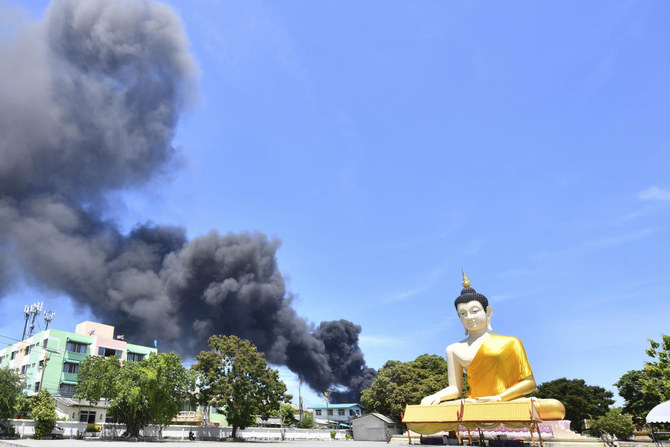
Other photos showed nearby homes with their windows blown out and wreckage in the streets, with black smoke billowing over the area even hours later.
The area around the blast is a mixture of older industrial complexes and newer housing developments that were built after the opening of the airport in 2006.
Jaruwan Chamsopa, who lives about 3 kilometers from the factory, said the loud explosion in the middle of the night broke her house’s windows, damaged the roof and caused parts of the ceiling to tumble down. She said the windows of every house on her road were broken as well.
“I was shocked when the explosion took place,” she told The Associated Press. “I came out and saw a big fire in the sky.”
She said she and her husband and mother didn’t evacuate until 8 a.m.
“I didn’t realize that it would be such a dangerous chemical that I have to evacuate,” she said. “I am worried because the black smoke reached my house.”
Authorities ordered the evacuation of an area 5 kilometers around the scene and evacuation centers were set up in a school and a government office for those forced from their homes.
So far, 11 injuries have been reported, including one serious, and people were being taken to a nearby hospital for treatment, before that hospital was evacuated itself.
There was no immediate word on what might have caused the fire in Bang Phli district, and the company was not reachable by phone.
The initial explosion shook the terminal building at Suvarnabhumi, setting off alarms at Bangkok’s main international airport.
Airport officials said in a statement that no flights had been canceled but that it was continuing to monitor the situation and was prepared to “put in place contingency plans in case of emergency.” It said it would not compromise on safety.


![]()

One dead at Thailand factory blast, prompts evacuation over toxic fume fears
Short Url
https://arab.news/jst7p
One dead at Thailand factory blast, prompts evacuation over toxic fume fears
- Fire broke out at around 3 a.m. at a foam and plastic pellet manufacturing factory just outside Bangkok near Suvarnabhumi Airport


Latest updates


Recommended


© 2026 SAUDI RESEARCH & PUBLISHING COMPANY, All Rights Reserved And subject to Terms of Use Agreement.