

How Ithra’s Seeing & Perceiving exhibition challenges what you see

1 / 5
Each artwork mimics the observers’ perception and encourages them to explore the meaning beyond what they can see. (AN photos by Huda Bashatah)
2 / 5
Each artwork mimics the observers’ perception and encourages them to explore the meaning beyond what they can see. (AN photos by Huda Bashatah)
3 / 5
Each artwork mimics the observers’ perception and encourages them to explore the meaning beyond what they can see. (AN photos by Huda Bashatah)
4 / 5
Each artwork mimics the observers’ perception and encourages them to explore the meaning beyond what they can see. (AN photos by Huda Bashatah)
5 / 5
Each artwork mimics the observers’ perception and encourages them to explore the meaning beyond what they can see. (AN photos by Huda Bashatah)
Short Url
Updated 13 July 2021
Follow

How Ithra’s Seeing & Perceiving exhibition challenges what you see

  • Each artwork mimics the observers’ perception and encourages them to explore the meaning beyond what they can see
  • Among the international installations was one by the rising Saudi artist Wala Fadul

The King Abdul Aziz Center for World Culture (Ithra) has launched its third art exhibition this year under the title “Seeing & Perceiving” — the first contemporary public show since the outbreak of COVID-19.

The contemporary art exhibition showcases 26 works by 20 leading names in the art scene from around the globe: 60 percent are from the Middle East, including Saudis, while 40 percent are from around the world.

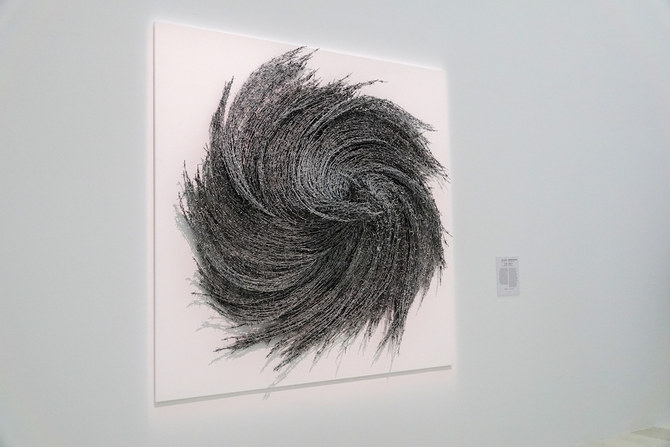
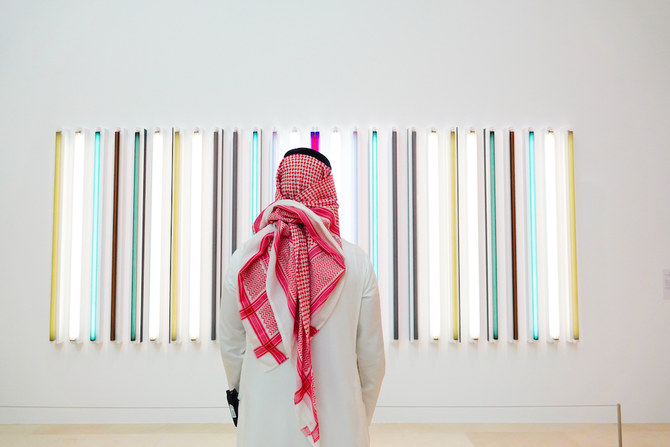
Each artwork mimics the observers’ perception and encourages them to explore the meaning beyond what they can see.

“The exhibit displays art pieces from around the world; each art piece reflects a deep different meaning the more you look at it,” said Ashraf Fakeeh, head of programs at Ithra.

He added: “One of the art missions is to reinterpret life in a different way, perhaps as it speaks to your mind and soul, and the artworks here are challenging as they keep you wondering what are you looking at and how would you read it.”

Among the international installations was one by the rising Saudi artist Wala Fadul, 26, the winner of Ithra’s second Artist Open Call program, held virtually in 2020 with 158 competitive candidates.

The art installation was commissioned by Ithra, titled “Light Upon Light,” and has a sacred geometry pattern inspired by a Qur’anic verse in Surah An-Nur. It is a holographic variable of hologram fans viewed in seven colors.

In an interview with Arab News, Fadul said that her work is based on different perspectives of light and what it symbolizes for humans inspired by the imagery communication between humans and materials, and its meanings.

“In one of John Berger’s (an English critic) art books, there is a fascinating line that says ‘Seeing comes before words and it made me really wonder what comes before seeing, and the answer was the light,’” Fadul said.

She added: “There was a contradiction between me and (my) friends on the fact that light cannot be considered as an existing material. However, to me light is the base of everything. Although we cannot touch it, we realize its impact, and this is the main message that I want to deliver.”

Winning in Ithra’s Artist Open Call program in 2020 gave Fadul the chance to participate in the Seeing & Perceiving exhibition, where her artwork was adopted, financed and facilitated to come into reality.

“My artwork is installed among other local and international artworks in the exhibit of experienced artists, and this is a huge privilege for me,” she said.

Fadul is encouraging all upcoming Saudi artists to prove their art and creativity. “This is our time, we are living the change, and we are part of the journey, so we need the work and creativity will lead us to that.”

What do you see?

Three of the site-specific installations and commissioned pieces were created specifically for and at Ithra, including an eye-catching visual engagement in the escalator that leads to the center’s library by the American artist Darel Carey.

His art challenges the observer’s perception of space and optical illusion. “As far as my goal and what I want to achieve through my art, first and foremost is for people to enjoy it,” Carey told Arab News. “It is a very interactive, immersive type of experience, and also my goal is to have people think about what they see and wonder about how they perceive the way mind and eyes work.”

The contemporary exhibition prompts questions about the reality and nature of artworks. It is full of tricky, vague yet attractive artworks as every installation depends on deriving meaning through many different angles. It opens up endless horizons for understanding the artistic content.

Candida Pestana, Ithra’s contemporary art curator, told Arab News that the Seeing & Perceiving exhibition stimulated critical thinking, so everything a viewer sees perhaps will changes the second, third and last time they look at it. “We want to create the element of surprise, so they can question what they are seeing overall.”

The exhibition began on June 23 and runs until March 26. Ithra art museum receives about 100,000 visitors a year. The center is a creative and interactive public space with different programs for everyone, and it is Saudi Aramco’s most ambitious initiative and the largest cultural contribution to the Kingdom.

Highlights:

* Seeing & Perceiving showcases 26 art installations by 20 international artists.

* Some installations use realistic imagery to create the optical illusion that the depicted objects exist in three dimensions.

* The exhibition aims to make observers perceive artworks in different ways.

* The contemporary art exhibition empowers local talent.

* Ithra is showcasing 60 percent of its newly acquired art collection through the exhibition.


Riyadh takes shape at Tuwaiq Sculpture Symposium 2026

Updated 5 sec ago
Follow

Riyadh takes shape at Tuwaiq Sculpture Symposium 2026

RIYADH: This season, one of Riyadh’s busiest streets has taken on an unexpected role.

Under the theme “Traces of What Will Be,”sculptors are carving granite and shaping reclaimed metal at the seventh Tuwaiq Sculpture Symposium, running from Jan. 10 to Feb. 22.

The symposium is unfolding along Prince Mohammed bin Abdulaziz Road, known locally as Al‑Tahlia, a name that translates to desalination. The choice of location is deliberate.

The area is historically linked to Riyadh’s early desalination infrastructure, a turning point that helped to shift the city from water scarcity toward long‑term urban growth.

Twenty‑five artists from 18 countries are participating in this year’s event, producing large‑scale works in an open‑air setting embedded within the city.

The site serves as both workplace and eventual exhibition space, with sculptures remaining in progress throughout the symposium’s duration.

In her opening remarks, Sarah Al-Ruwayti, director of the Tuwaiq Sculpture Symposium, said that this year new materials had been introduced, including recycled iron, reflecting a focus on sustainability and renewal.

She added that the live-sculpting format allowed visitors to witness the transformation of raw stone and metal into finished artworks.

Working primarily with local stone and reclaimed metal, the participating artists are responding to both the material and the place.

For Saudi sculptor Wafaa Al‑Qunaibet, that relationship is central to her work, which draws on the physical and symbolic journey of water.

“My work … presents the connection from the salted water to sweet water,” Al‑Qunaibet told Arab News.

Using five pieces of granite and two bronze elements, she explained that the bronze components represented pipes, structures that carry saline water and allow it to be transformed into something usable.

The sculpture reflected movement through resistance, using stone to convey the difficulty of that transition, and water as a force that enables life to continue.

“I throw the stone through the difficult to show how life is easy with the water,” she said, pointing to water’s role in sustaining trees, environments and daily life.

Formally, the work relies on circular elements, a choice Al‑Qunaibet described as both technically demanding and socially resonant.

“The circle usually engages the people, engages the culture,” she said. Repeated circular forms extend through the work, linking together into a long, pipe‑like structure that reinforces the idea of connection.

Sculpting on site also shaped the scale of the piece. The space and materials provided during the symposium allowed Al‑Qunaibet to expand the work beyond her initial plans.

The openness of the site pushed the sculpture toward a six‑part configuration rather than a smaller arrangement.

Working across stone, steel, bronze and cement, American sculptor Carole Turner brings a public‑art perspective to the symposium, responding to the site’s historical and symbolic ties to desalination.

“My work is actually called New Future,” Turner told Arab News. “As the groundwater comes up, it meets at the top, where the desalination would take place, and fresh water comes down the other side.”

Her sculpture engages directly with the symposium’s theme by addressing systems that often go unseen. “Desalination does not leave a trace,” she said. “But it affects the future.”

Turner has been sculpting for more than two decades, though she describes making objects as something she has done since childhood. Over time, she transitioned into sculpture as a full‑time practice, drawn to its ability to communicate across age and background.

Public interaction remains central to her approach. “Curiosity is always something that makes you curious, and you want to explore it,” she said. Turner added that this sense of discovery is especially important for children encountering art in public spaces.

Saudi sculptor Mohammed Al‑Thagafi’s work for this year’s symposium reflects ideas of coexistence within Riyadh’s evolving urban landscape, focusing on the relationships between long‑standing traditions and a rapidly changing society.

The sculpture is composed of seven elements made from granite and stainless steel.

“Granite is a national material we are proud of. It represents authenticity, the foundation, and the roots of Saudi society,” Al‑Thagafi told Arab News.

“It talks about the openness happening in society, with other communities and other cultures.”

That dialogue between materials mirrors broader social shifts shaping the capital, particularly in how public space is shared and experienced.

Because the sculpture will be installed in parks and public squares, Al‑Thagafi emphasized the importance of creating multi‑part works that invite engagement.

Encountering art in everyday environments, he said, encouraged people to question meaning, placement, simplicity and abstraction, helping to build visual‑arts awareness across society.

For Al‑Thagafi, this year marked his fifth appearance at the symposium. “I have produced more than 2,600 sculptures, and here in Riyadh alone, I have more than 30 field works.”

Because the works are still underway, visitors can also view a small on‑site gallery displaying scaled models of the final sculptures.

These miniature models offer insight into each artist’s planning process, revealing how monumental forms are conceived before being executed at full scale.

As the symposium moves toward its conclusion, the completed sculptures will remain on site, allowing the public to encounter them in the environment that shaped their creation.