

Pakistan's Sindh province to consider mandatory vaccine policy next week

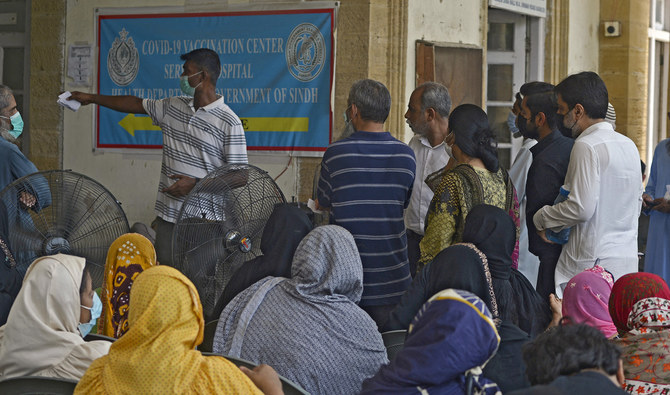
People queue up to register themselves to get inoculated with the jab of Covid-19 coronavirus vaccine at a vaccination camp held in karachi on May 22, 2021. (AFP/File)
Short Url
Updated 10 July 2021
Follow

Pakistan's Sindh province to consider mandatory vaccine policy next week

  • Sindh Health Department wants all medical services, except for emergency cases, to be available only to vaccinated persons
  • Sindh's coronavirus positivity rate has already increased to 6.8 percent from 4.9 percent in the first week of July

KARACHI: Pakistan's Sindh province will take into consideration next week mandatory coronavirus vaccination for its residents, a government spokesperson said on Saturday, after the provincial health department recommended the measure to stop the disease spread.

As authorities have warned earlier this week that a fourth wave of the coronavirus is starting in Pakistan, health officials are struggling to increase the pace of vaccination. So far, slightly over 19 million people, or about 8 percent of the country's population have been inoculated against COVID-19.

With a population of 47 million, Sindh has so far administered 4 million coronavirus vaccine doses, while it is observing a sharp rise in cases with the rate having already increased to 6.8 percent from 4.9 percent in the first week of July, data released on Saturday showed.

Sindh Health Department director general Dr. Irshad Memon said in statement on Friday that except for emergency cases and elective surgeries, private and government hospitals in the province would provide medical services only to vaccinated persons. He added that COVID-19 vaccination would be mandatory for "job tests and interviews, entry into restaurants, hotels and marriage halls."

"Next week a task force meeting will be held to review the situation and decisions may be taken accordingly," Rasheed Channa, spokesperson for the Sindh chief minister, told Arab News in response to a question whether the health department's recommendations will be implemented.

Consequences, however, are planned for government officials who do not get vaccinated. Last month, Sindh Chief Minister Syed Murad Ali Shah announced that the salaries of unvaccinated employees would be suspended.

"It has not been decided yet," Channa said, "but the chief minister has directed the finance department to work out details of employees who have got themselves vaccinated, so that action could be taken against unvaccinated."


Pakistan steps up local vaccine manufacturing push with Saudi cooperation Eleven-member Saudi delegation’ to arrive in Pakistan today to give practical shape to local vaccine manufacturing in Pakistan, says health ministry Domestic vaccine manufacturing

Updated 5 sec ago
Follow

Pakistan steps up local vaccine manufacturing push with Saudi cooperation Eleven-member Saudi delegation’ to arrive in Pakistan today to give practical shape to local vaccine manufacturing in Pakistan, says health ministry Domestic vaccine manufacturing

  • Talks with Saudi delegation aim to support domestic production for national immunization needs, ministry says
  • Pakistan currently imports all vaccines, which ramps up foreign exchange and procurement pressures

ISLAMABAD: A high-level Saudi delegation is arriving in Pakistan today, Monday, to give practical shape to local vaccine manufacturing in Pakistan, the health ministry said in a statement amid Islamabad’s push to meet its national immunization needs. 

The eleven-member Saudi delegation’s visit marks a “critical milestone” in strengthening bilateral cooperation between Pakistan and Saudi Arabia in health, pharmaceutical manufacturing and industrial collaboration, the ministry said. 

It added that the development takes place after Pakistan Health Minister Syed Mustafa Kamal held three meetings with his Saudi counterpart over the past seven months in which both sides discussed local vaccine manufacturing, investment opportunities and technical cooperation. Kamal also met Saudi Arabia’s minister of industry to discuss the same. Both sides designated focal persons to ensure effective coordination and follow-up after the meetings. 

“The visit of the high-level Saudi delegation is expected to prove a decisive step toward giving practical shape to the process of local vaccine manufacturing in Pakistan,” Kamal was quoted as saying by the health ministry. 

The Pakistani health minister reaffirmed Islamabad’s commitment to establishing local vaccine production facilities, stating that domestic manufacturing will not only meet Pakistan’s national immunization needs but will also enable surplus production for export. 

This, he said, would contribute to Pakistan’s economic growth and national stability.

“Ensuring the availability of safe, high-quality vaccines for the public remains the government’s top priority, ” the minister said. 

Since Pakistan does not produce vaccines locally, it has to import them from other countries. Producing vaccines will help the South Asian country save valuable foreign exchange and avoid longer procurement delays as it seeks to inoculate its population against various diseases. 

Pakistan, a country of over 240 million people, regularly holds national immunization campaigns against diseases such as polio, measles, rubella and hepatitis.