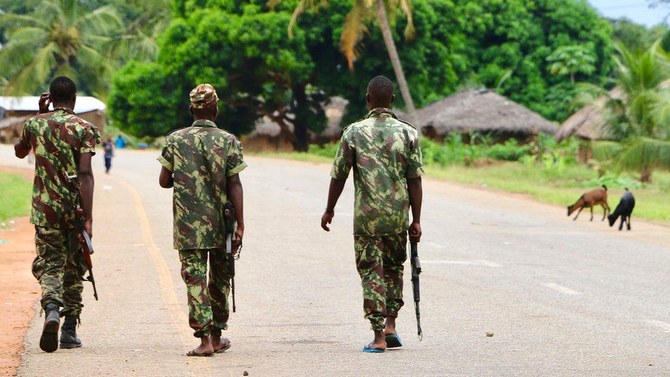
KIGALI: Rwanda said on Friday it will send 1,000 troops to Mozambique to help the country battle extremist militants wreaking havoc in the north of the gas-rich nation.
The planned deployment comes on the heels of a similar decision last month by the 16 nations in the Southern African Development Community (SADC) regional bloc.
Analysts warned however that such multiple missions could further militarise the impoverished Cabo Delgado province, which has been terrorized by Daesh-linked extremists since late 2017.
“The government of Rwanda, at the request of the government of Mozambique, will today start the deployment of a 1,000-person contingent of the Rwanda Defense Force and the Rwanda National Police to Cabo Delgado Province,” Kigali said in a statement.
The forces will “support efforts to restore Mozambican state authority by conducting combat and security operations, as well as stabilization and security-sector reform,” it added.
The Rwandan contingent will work with the Mozambique Armed Defense Forces and those from SADC “in designated sectors of responsibility.”
There was no immediate reaction to the announcement from the government in Maputo, whose President Filipe Nyusi vowed last month to root out the militants with the help of regional allies.
Attacks have escalated in northern Mozambique over the past year, fueling fears the violence could spill over into neighboring countries.
The insurgency has claimed more than 2,900 lives, according to conflict data tracker ACLED, and displaced around 800,000 people, according to the United Nations.
But Adriano Nuvunga, head of Mozambique’s Center for Democracy and Development in Maputo, voiced concern at the Rwandan deployment.
“We see this as a not good move because it will further militarise northern Cabo Delgado and it can lead deep into the conflict moving in the wrong direction.”
Rwanda is already a major contributor to the UN’s peacekeeping force in the Central African Republic and last year sent hundreds of troops to the unstable country after an attempted coup.
Nyusi, himself a former defense minister, had long shied away from asking for foreign military intervention to fight the extremists, instead relying on private military companies.
But last month he vowed to crush the militants with the help of SADC and “friendly countries.”
Alexandre Raymakers, Africa Analyst at UK-based global risk consultancy Verisk Maplecroft, said he believes the Rwandan contingent could be used to secure key LNG sites in an effort to lure back international investors.
“The Rwandan security forces have developed a reputation for being a highly capable fighting force,” he said.
But, he added, “the presence of multiple military missions, in the form of a potential Rwandan contingent and the SADC, will likely lead to conflicting priorities and friction at the military command level, hindering the overall.”


![]()

Rwanda sends 1,000 troops to insurgency-hit Mozambique
Short Url
https://arab.news/5xdzc
Rwanda sends 1,000 troops to insurgency-hit Mozambique
- Attacks have escalated in northern Mozambique, fueling fears the violence could spill over into neighboring countries
- Rwanda is already a major contributor to the UN’s peacekeeping force in the Central African Republic


Latest updates


© 2026 SAUDI RESEARCH & PUBLISHING COMPANY, All Rights Reserved And subject to Terms of Use Agreement.