

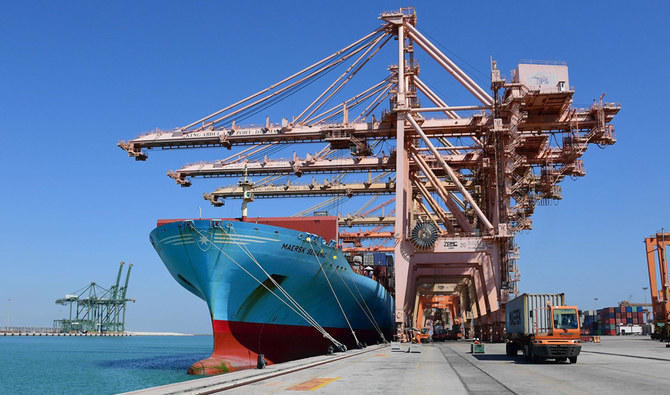
Saudi Ports Authority to invite private sector to build 8 new terminals

The investments align with the Vision 2030 objectives aimed at making the Kingdom a leading global logistics platform and a connecting hub for the three continents. (SPA)
Short Url
Updated 09 July 2021
Follow

Saudi Ports Authority to invite private sector to build 8 new terminals

  • Investments will equip ports with container, bulk cargo and passenger facilities
  • Eight ports include Jeddah Islamic, King Abdulaziz in Damman

RIYADH: The Saudi Ports Authority (Mawani) has announced investment opportunities in partnership with the private sector to develop and operate multi-purpose terminals in eight of the nation’s ports.

The opportunities are in the form of build-operate-transfer (BOT) contracts for terminals in Jeddah Islamic Port, King Abdulaziz Port in Dammam, Ras Al-Khair Port, Jizan Port, Yanbu Commercial Port, King Fahad Industrial Port in Jubail, King Fahad Industrial Port in Yanbu, and Jubail Commercial Port, Mawani said in a statement on Thursday.

The initiative aims at equipping the ports to serve various functions including containers, general cargo, bulk cargo, RoRo cargo, passengers, and livestock.

No figure was given for the size of the financial investment required to build the terminals.

The investments align with the Vision 2030 objectives aimed at making the Kingdom a leading global logistics platform and a connecting hub for the three continents.

Transport and logistics will contribute 10 percent of Saudi GDP by 2030, up from 6 percent today, following the implementation of the Kingdom’s new strategy for the sector, Minister of Transport Saleh Aljasser said on Tuesday.

“Transport and logistics are a major focus of the programs of the Kingdom’s Vision 2030 and a vital enabling factor for economic sectors toward sustainable development,” Crown Prince Mohammed Bin Salman said at the launch of the National Transport and Logistics Strategy on July 1.

He added that areas covered by the strategy include the development of infrastructure, the launch of a number of platforms and logistics zones in the Kingdom, the implementation of advanced operating models and systems, and the building and enhancement of effective partnerships between the government and the private sector.


Aramco’s 13% rally helps Saudi stocks post second weekly gain

Updated 12 March 2026
Follow

Aramco’s 13% rally helps Saudi stocks post second weekly gain

RIYADH: Saudi Aramco extended its year-to-date rally to nearly 13 percent on Thursday, helping the Kingdom’s benchmark stock index secure a second straight weekly gain despite a weaker final trading session.  

Saudi Aramco shares, which carry the heaviest weighting on the Saudi Exchange, closed at SR26.86 ($7.16), leaving the stock 12.72 percent higher since the start of 2026. The stock also remained 3.09 percent above last week’s close, even after falling 1.1 percent in Thursday’s session.

The rise in energy shares came as escalating tensions in the Middle East pushed oil prices above $100 a barrel, after attacks on tankers in the Gulf and the Strait of Hormuz heightened concerns over supply disruptions.

The Tadawul All Share Index maintained its weekly uptrend, rising nearly 1.07 percent week on week to close at 10,778.32, despite falling 0.45 percent in Thursday’s session. Compared with the first trading day of the year, the index has gained 4.01 percent.

Total trading turnover on the benchmark index reached SR5.05 billion at Thursday’s close, with 88 stocks advancing and 176 declining.

Aramco’s performance continued to anchor sentiment after the company reported adjusted net income of $104.7 billion for 2025 earlier this week, while net profit fell 12.1 percent year on year to $93.39 billion, compared with $106.25 billion in 2024, as lower crude prices weighed on earnings despite higher sales volumes across oil, gas and refined products.

On a March 10 earnings call, Aramco CEO Amin Nasser warned that prolonged disruption in the Strait of Hormuz could have severe implications for global energy markets. Roughly 20 percent of the world’s oil normally passes through the waterway each day, but shipments have been largely blocked.

“There would be catastrophic consequences for the world’s oil markets and the longer the disruption goes on ... the more drastic the consequences for the global economy,” he said.

“While we have faced disruptions in the past, this one by far is the biggest crisis the region’s oil and gas industry has faced.”

Saudi equities showed mixed performance in Thursday’s session. The MSCI Tadawul Index fell 5.99 points, or 0.40 percent, to close at 1,476.76.

The Kingdom’s parallel market Nomu gained 132.47 points, or 0.6 percent, to close at 22,370.4, with 38 stocks advancing and 34 declining.

On March 11, the International Energy Agency announced the release of 400 million barrels of oil from its reserves, the largest such move in its history. As part of that, the US said it would release 172 million barrels starting next week.