ISLAMABAD: One of the greatest stars in the golden age of Indian cinema from the 1940s to the 1960s, Dilip Kumar, died Wednesday at the age of 98, a family friend said on Twitter.
Kumar, who had a career spanning over 50 years and acted in nearly 60 films, was born Mohammed Yusuf Khan on December 11, 1922, in Peshawar in what was then united India, before independence from British rule and the creation of Pakistan. He was an actor, film producer and philanthropist, best known as one of the greatest actors in the history of Hindi cinema.
Kumar has been credited for bringing a distinct form of method acting technique to Indian cinema and holds the record for the most Filmfare Award for Best Actor wins. He was also the inaugural recipient of the award.
Kumar is survived by his wife, Saira Banu, a top Bollywood leading lady in the 1960s and 1970s.
“With a heavy heart and profound grief, I announce the passing away of our beloved Dilip Saab, few minutes ago,” Faisal Farooqui posted on Kumar’s official Twitter. “We are from God and to Him we return.”
With a heavy heart and profound grief, I announce the passing away of our beloved Dilip Saab, few minutes ago.
We are from God and to Him we return. - Faisal Farooqui
— Dilip Kumar (@TheDilipKumar) July 7, 2021
On June 30, a post on Kumar’s Twitter account said he had been admitted to Hinduja Hospital in Mumbai to address illness related to old age.
Dilip Saab has been admitted to Hinduja Hospital, Khar to address medical issues related to illness which are frequently expected in a 98 year old. Your love and prayers are truly appreciated by Saab- Faisal Farooqui
— Dilip Kumar (@TheDilipKumar) June 30, 2021
The New York Times in its obituary called him “the last of a triumvirate of actors who ruled Hindi cinema in the 1950s and ‘60s.”
“In post-independence India, Mr. Kumar and two other stars set about defining the Hindi film hero,” the Times said. “Raj Kapoor reflected the newly minted Indian’s confusion: his signature role was that of the Chaplinesque naïf negotiating a world that was losing its innocence. Dev Anand, known as the Gregory Peck of India, embodied a Western insouciance that still lingered; he became a stylish matinee idol.”
Kumar delved deeply into his characters, “breaking free from the semaphoric silent-movie style of acting popularized by megastars like Sohrab Modi and Prithviraj Kapoor.”
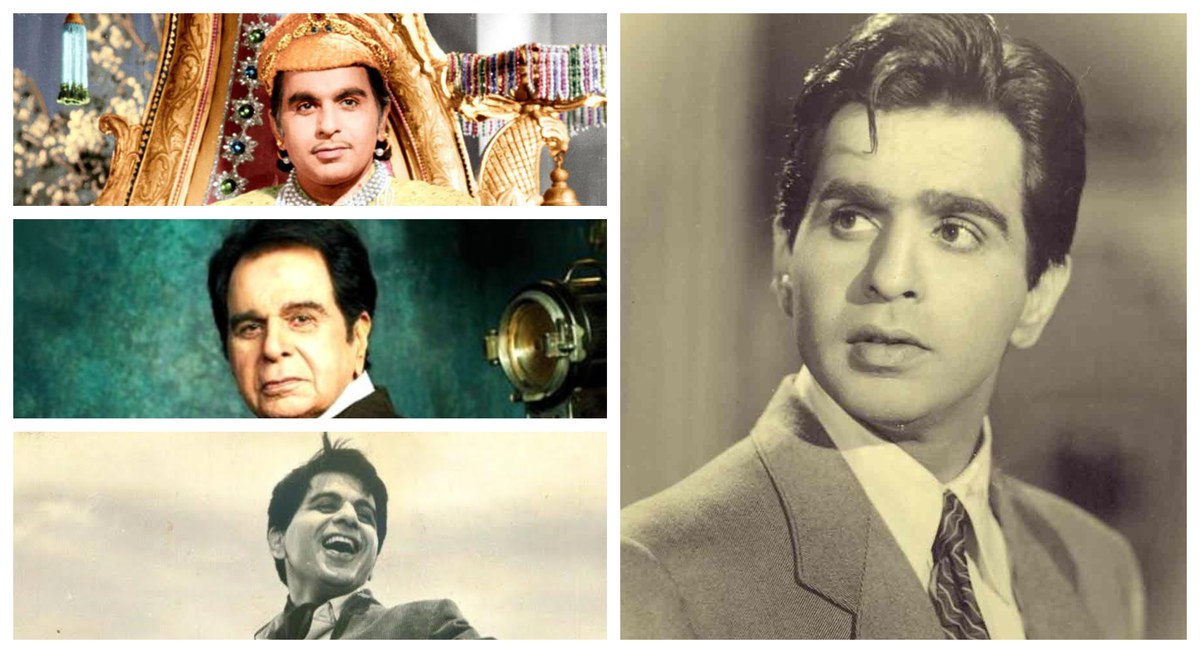
This combination of photos shows India's veteran actor Dilip Kumar. (Photo courtesy Social Media)
As one of the country’s earliest method actors, he was often compared to Marlon Brando, another early adopter of the technique, even though Kumar credited himself with using the technique first.
Kumar received the Padma Bhushan, one of India’s highest civilian awards, in 1991, the Dadasaheb Phalke, India’s highest award for cinematic excellence, in 1994, and the Padma Vibhushan in 2015. From 2000 to 2006, he served as a member of the Rajya Sabha, the upper house of Parliament.
In 1998, the Pakistani government conferred on him their highest civilian honor, the Nishan-e-Imtiaz.
Kumar did his first film, “Jwar Bhata” in 1944, which tanked. His breakthrough role came in 1949, with “Andaz,” where he played a jilted lover who is caught in a triangle between the woman he loves and her husband.
That role catapulted him to stardom and was the beginning of a decade where he made a career of playing tragic roles.
Bimal Roy’s adaptation of Sarat Chandra Chattopadhyay’s seminal novel “Devdas” was the turning point in an already successful career, catapulting him to superstardom.
His role as the doomed lover in “Devdas,” earned Kumar the epithet of “tragedy king” — the man who embodied melancholy on screen.
T 3958 - An institution has gone .. whenever the history of Indian Cinema will be written , it shall always be 'before Dilip Kumar, and after Dilip Kumar' ..
My duas for peace of his soul and the strength to the family to bear this loss ..
Deeply saddened ..— Amitabh Bachchan (@SrBachchan) July 7, 2021
“An institution has gone .. whenever the history of Indian Cinema will be written , it shall always be ‘before Dilip Kumar, and after Dilip Kumar,” legendary actor Amitabh Bachchan said on Twitter.
Kumar said he felt weighed down after years of playing tragic roles. In the late 1950’s, he made a conscious attempt to play more upbeat roles, acting in romantic films like “Madhumati,” “Aan” and “Naya Daur.”
In his later years, although the hits were harder to come by, Kumar retained his stature as India’s first marquee star — the man whose face on a poster was enough for audiences to throng the theaters.
“Dilip Kumar ji will be remembered as a cinematic legend. He was blessed with unparalleled brilliance, due to which audiences across generations were enthralled,” Indian Prime Minister Narendra Modi said.
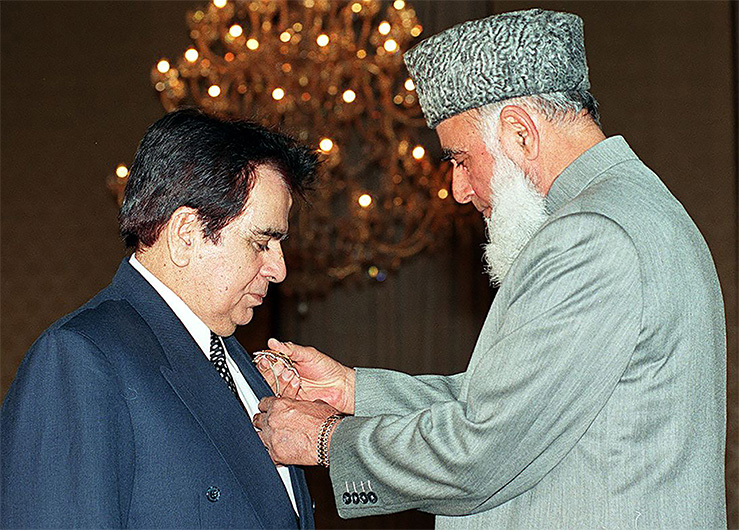
In this file photo, President of Pakistan Rafiq Tarrar (R) decorates Indian film actor Dilip Kumar with the highest civil award, "Nishan-i-Imtaiz", in an award ceremony at the President House, Islamabad, Pakistan, on March 23, 1998. (AFP)