

Pakistan rejects RSF report naming PM Khan in press freedom predators list

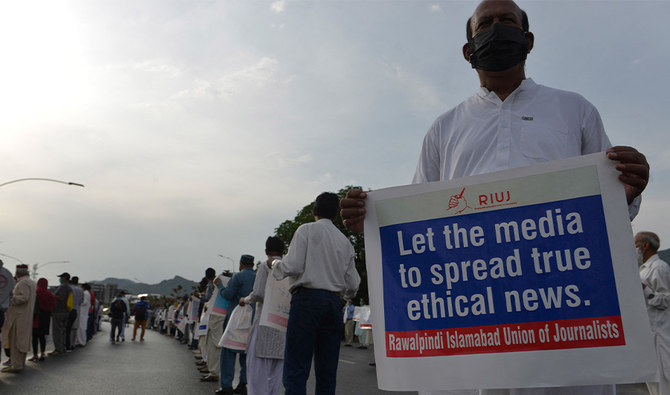
Journalists stand in a demonstration to mark the World Press Freedom Day in Islamabad on May 3, 2020. (AFP)
Short Url
Updated 07 July 2021
Follow

Pakistan rejects RSF report naming PM Khan in press freedom predators list

  • Reporters Without Borders has published a list of 37 heads of state who “crack down massively on press freedom“
  • Information minister says Pakistan facing ‘international propaganda war,’ has demanded RSF clarify criteria for including Khan in list

ISLAMABAD: Federal Minister for Information and Broadcasting, Chaudhry Fawad Hussain, said on Tuesday Pakistan had demanded that international press freedom group Reporters Without Borders share the criteria it had used to include Prime Minister Imran Khan on a list of 37 world leaders “who crack down massively on press freedom.”
Two women, the prime ministers of India and Bangladesh and Hong Kong’s administrative chief, were also on the list. This is the first time in five years that the watchdog, known by its French initials RSF, has published its press freedom predators list.
“Pakistan is facing an international propaganda war in which [issues like] missing persons and freedom of expression are used [against it],” Hussain told Dunya News’ Nuqta-e- Nazar talk show, adding that the government had demanded that RSF share the standards it had used to compile the list.
RSF has said cases of brazen censorship had multiplied in Pakistan since Khan became prime minister in August 2018, with newspaper distribution interrupted, media outlets threatened with the withdrawal of advertising and signals of television channels jammed.
“Journalists who cross the red lines have been threatened, abducted and tortured,” RSF said. “In the shadows, behind Khan in the limelight, Pakistan is reliving some of the worst moments of its past military dictatorships.”
Hussain rejected this as a “conspiracy” against Pakistan in a Twitter post, saying it was part of an effort to bring the country under regulatory frameworks like the Financial Action Task Force (FATF), a global dirty money watchdog that in 2018 put Pakistan on a grey list of nations with inadequate terror funding controls.

Dr. Arslan Khalid, the prime minister’s focal person on digital media, also rejected the report in a Twitter post, calling it “typical propaganda.”

In the backdrop of these developments, the Pakistan Federal Union of Journalists (PFUJ) said it was struggling to ensure the safety and security of working journalists across the country while pressing the government to “lift unannounced censorship” on the media.
“The government has been trying to suppress critical voices in the media by adopting different tactics,” Nasir Zaidi, PFUJ secretary general, told Arab News. “This is the darkest age for press freedom.”
The Pakistani government vehemently denies it censors the press or harasses journalists.


Pakistan, global crypto exchange discuss modernizing digital payments, creating job prospects 

Updated 05 December 2025
Follow

Pakistan, global crypto exchange discuss modernizing digital payments, creating job prospects 

  • Pakistani officials, Binance team discuss coordination between Islamabad, local banks and global exchanges
  • Pakistan has attempted to tap into growing crypto market to curb illicit transactions, improve oversight

ISLAMABAD: Pakistan’s finance officials and the team of a global cryptocurrency exchange on Friday held discussions aimed at modernizing the country’s digital payments system and building local talent pipelines to meet rising demand for blockchain and Web3 skills, the finance ministry said.

The development took place during a high-level meeting between Finance Minister Muhammad Aurangzeb, Pakistan Virtual Assets Regulatory Authority (PVARA) Chairman Bilal bin Saqib, domestic bank presidents and a Binance team led by Global CEO Richard Teng. The meeting was held to advance work on Pakistan’s National Digital Asset Framework, a regulatory setup to govern Pakistan’s digital assets.

Pakistan has been moving to regulate its fast-growing crypto and digital assets market by bringing virtual asset service providers (VASPs) under a formal licensing regime. Officials say the push is aimed at curbing illicit transactions, improving oversight, and encouraging innovation in blockchain-based financial services.

“Participants reviewed opportunities to modernize Pakistan’s digital payments landscape, noting that blockchain-based systems could significantly reduce costs from the country’s $38 billion annual remittance flows,” the finance ministry said in a statement. 

“Discussions also emphasized building local talent pipelines to meet rising global demand for blockchain and Web3 skills, creating high-value employment prospects for Pakistani youth.”

Blockchain is a type of digital database that is shared, transparent and tamper-resistant. Instead of being stored on one computer, the data is kept on a distributed network of computers, making it very hard to alter or hack.

Web3 refers to the next generation of the Internet built using blockchain, focusing on giving users more control over their data, identity and digital assets rather than big tech companies controlling it.

Participants of the meeting also discussed sovereign debt tokenization, which is the process of converting a country’s debt such as government bonds, into digital tokens on a blockchain, the ministry said. 

Aurangzeb called for close coordination between the government, domestic banks and global exchanges to modernize Pakistan’s payment landscape.

Participants of the meeting also discussed considering a “time-bound amnesty” to encourage users to move assets onto regulated platforms, stressing the need for stronger verifications and a risk-mitigation system.

Pakistan has attempted in recent months to tap into the country’s growing crypto market, crack down on money laundering and terror financing, and promote responsible innovation — a move analysts say could bring an estimated $25 billion in virtual assets into the tax net.

In September, Islamabad invited international crypto exchanges and other VASPs to apply for licenses to operate in the country, a step aimed at formalizing and regulating its fast-growing digital market.