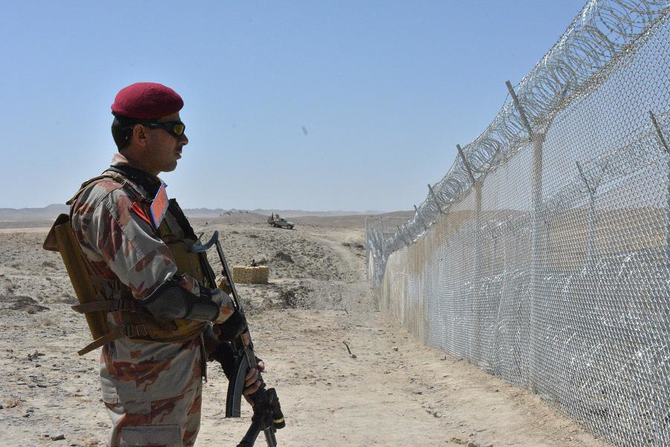
DERA ISMAIL KHAN: Militants killed three Pakistani soldiers close to the border with Afghanistan in the North Waziristan tribal region, where Pakistani Taliban fighters have been targeting the Pakistan military, security sources told Reuters.
The militants fired on a checkpost in Spinwam district, in the latest of a spate of attacks on security forces, government officials and suspected collaborators in North Waziristan. The Pakistani military said it was looking into the report.
The rash of violence in Pakistan’s tribal lands has coincided with the Afghan Taliban’s offensive against the government in Kabul, as the United States hastens its departure from Afghanistan.
Afghanistan’s government has regularly accused Pakistan’s military of providing covert support for the Afghan Taliban, which the Pakistani government denies, saying Afghanistan has provided safe havens to anti-Pakistani militants.
The Pakistan government has said any peace deal with the Afghan Taliban should ensure groups, like the Pakistan Taliban, do not use Afghanistan as a safe haven for attacks on Pakistan once Western forces withdraw.
On June 30, two soldiers were killed in the Dwatoi district of North Waziristan, after militants opened fire from across the Afghanistan border, Pakistan’s military said.
On June 20, a Pakistan soldier was killed in another attack in Spinwam district. In May, militants ambushed and killed four Pakistani soldiers fencing the disputed border with Afghanistan in the southwest province of Balochistan..
In April, a car bomb at a luxury hotel in Quetta, the provincial capital of Balochistan, killed four people in an attack later claimed by the Pakistani Taliban that was meant to target the Chinese ambassador to Pakistan. And in March, a blast killed three Pakistani soldiers near the Chaman border crossing between Afghanistan and Pakistan.

Militants kill three Pakistani soldiers near Afghan border
https://arab.news/r3tbr
Militants kill three Pakistani soldiers near Afghan border
- Militants fired on checkpost in latest of spate of attacks on security forces, government officials and suspected collaborators in North Waziristan
- Rash of violence in Pakistan’s tribal lands has coincided with the Afghan Taliban’s offensive against the government in Kabul
Pakistan approves upgrades to national ID cards in push to strengthen digital ecosystem
- The amendments allow for QR-based verification, authentication controls, biometric expansion, and card format updates
- The measures advance integrated digital governance through National Data Exchange Layer and broader digital ID ecosystem
ISLAMABAD: Pakistan has notified amendments to the National Identity Card and Pakistan Origin Card rules and introduced QR-based verification and stronger fraud controls, the National Database and Regulatory Authority (NADRA) said on Tuesday, amid efforts to strengthen the country’s digital ecosystem.
The amendments modernize Pakistan’s identity document framework by legally embedding QR-based verification, strengthening authentication controls across digital services, expanding biometric recognition and updating card formats for key citizen categories.
A core reform is the statutory introduction of the Quick Response (QR) code as a defined security and verification feature, authorizing the use of “QR code or any other technological feature” in lieu of current microchip enabling NADRA to adopt evolving verification technologies without repeated rule amendments.
This QR-enabled capability directly strengthens Pakistan’s Digital ID ecosystem and supports interoperability through the National Data Exchange Layer, according to the national database regulator.
“This establishes a robust legal basis for quick and secure verification of identity credentials in both offline and online environments,” NADRA said.
“This will also enable all citizens to carry similar card instead of currently prevalent two types of national identity cards one of which is with microchip and the other without.”
Pakistani state media reported in August that the country was developing digital identities of all its citizens to enable secure and efficient payments. The measures came as part of a broader effort to digitize the economy for greater transparency.
QR-based credentials allow rapid front-end validation of identity attributes in service delivery settings, while also enabling back-end systems to confirm authenticity and status through trusted exchanges. This is expected to improve speed, transparency and consistency of identity verification across government entities and regulated sectors, reduce manual handling, and lower the risk of fraud and impersonation, according to NADRA.
The amendments also strengthen the enforcement effect of card suspension. The Rules now clarify that where a card is suspended, all verification, authentication and related services linked to that card shall stand suspended forthwith. This closes a key risk area by ensuring that once a card is suspended, it cannot continue to be used through digital verification channels or institutional authentication processes.
“The amendments also introduce standardized identification for residents of Azad Jammu and Kashmir by requiring an inscription indicating ‘Resident of Azad Jammu and Kashmir’ in the manner specified by the Authority, thereby ensuring uniform geographic identification on the document,” NADRA said.
“Overall, these amendments strengthen the legal and technological foundations of Pakistan’s identity system by enabling secure QR-based verification, reinforcing the integrity of digital authentication services, improving biometric assurance,” it said. “They also advance readiness for integrated digital governance by supporting structured interoperability through the National Data Exchange Layer and a broader Digital ID ecosystem.”


