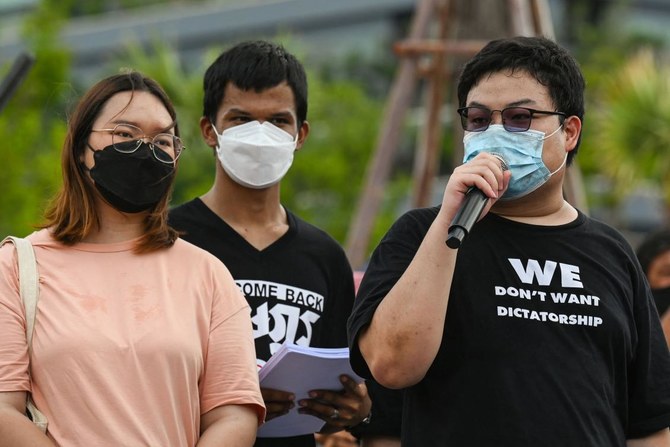
BANGKOK: Pro-democracy protesters took to the streets of Thailand’s capital on Thursday, marking the anniversary of the overthrow of the country’s absolute monarchy by renewing their demands that the government step down, the constitution be amended and the monarchy become more accountable.
The protesters defied a ban on large gatherings instituted to fight a coronavirus surge that shows little sign of abating. It was their first large protest after a hiatus of about three months caused by the pandemic and the jailing of protest leaders, who have since been released on bail.
The government of Prime Minister Prayuth Chan-ocha is facing widespread criticism that it botched pandemic recovery plans by failing to secure adequate vaccine supplies.
On June 24, 1932, a group of progressive army officers and civil servants proclaimed constitutional rule and the transition to parliamentary democracy, ending Thailand’s absolute monarchy. The anniversary in recent years has become an occasion for pro-democracy rallies.
Protesters gathered early Thursday by Bangkok’s Democracy Monument, a traditional demonstration venue, to light candles and read out the 1932 proclamation of the end of the absolute monarchy.
Several hundred then marched to Parliament, which is due to vote on several amendments to the constitution. The proposed changes, however, fall far short of those sought by the protesters, which include restoring more power to political parties and elected office holders.
“We come out today to insist on the principle that the constitution must come from the people,” said Jatupat Boonpattararaksa, a protest leader also known as Pai Dao Din.
The student-led pro-democracy movement sprung up last year, largely in reaction to the continuing influence of the military in government and hyper-royalist sentiment. The army in 2014 overthrew an elected government, and Prayuth, the coup leader, was named prime minister after a 2019 general election put in power a military-backed political party. Critics say the constitution enacted during military rule skewed election rules to favor the army’s proxy party.
The movement was able to attract crowds of as many as 20,000-30,000 people in Bangkok in 2020 and had followings in major cities and universities. However, a coronavirus surge late last year caused it to temporarily suspend activities and lose momentum.
The movement became controversial as its leaders focused on the monarchy in their speeches and activities. They charged that the king holds power and influence beyond that allowed under the constitution.
Since becoming king in 2016, Maha Vajiralongkorn has gained more direct control over the vast fortune of the royal palace — estimated to exceed $30 billion — as well as command of some key military units in the capital.
During the same time, memorials, statues and other symbols associated with the 1932 revolution have been removed.
The monarchy is widely considered to be an untouchable bedrock element of Thai nationalism. Defaming key royals is punishable under a lese majeste law by up to 15 years in prison per count. Many people still revere the monarchy, and the military, a major power in Thai society, considers its defense a key priority.
The government responded to the protesters’ criticism of the monarchy by charging leaders under the lese majeste law.
Parit Chiwarak, among those jailed, said Thursday the protesters are standing by their original demands but perhaps shifting their focus.
“We still demand the monarchy’s reform. But this year Prayuth must be ousted,” said Parit, who is better known by the nickname Penguin.


Thai pro-democracy activists march against government
https://arab.news/czzd5
Thai pro-democracy activists march against government

- The protesters defied a ban on large gatherings instituted to fight a coronavirus surge that shows little sign of abating
- Several hundred marched to Parliament, which is due to vote on several amendments to the constitution


Tug of war: how US presidents battle Congress for military powers
- The last official declaration of war by Congress was as far back as World War II
WASHINGTON, United States: Donald Trump’s unleashing of operation “Epic Fury” against Iran has once more underscored the long and bitter struggle between US presidents and Congress over who has the power to decide on foreign military action.
In his video address announcing “major combat” with the Islamic republic, Trump didn’t once mention any authorization or consultation with the US House of Representatives or Senate.
In doing so he sidelined not only Democrats, who called for an urgent war powers vote, but also his own Republican party as he asserts his dominance over a largely cowed legislature.
A US official said Secretary of State Marco Rubio had called top congressional leaders known as the “Gang of Eight” to give them a heads up on the Iran attack — adding that one was unreachable.
Rubio also “laid out the situation” and consulted with the same leaders on Tuesday in an hour-long briefing, the US official said.
According to the US Constitution, only Congress can declare war.
But at the same time the founding document of the United States first signed in 1787 says that the president is the “commander in chief” of the military, a definition that US leaders have in recent years taken very broadly.
The last official declaration of war by Congress was as far back as World War II.
There was no such proclamation during the unpopular Vietnam War, and it was then that Congress sought to reassert its powers.
In 1973 it adopted the War Powers Resolution, passed over Richard Nixon’s veto, to become the only lasting limit on unilateral presidential military action abroad.
The act allows the president to carry out a limited military intervention to respond to an urgent situation created by an attack against the United States.
In his video address on Saturday, Trump evoked an “imminent” threat to justify strikes against Iran.
- Sixty days -
Yet under this law, the president must still inform Congress within 48 hours.
It also says that if the president deploys US troops for a military action for more than 60 days, the head of state must then obtain the authorization of Congress for continued action.
That falls short of an official declaration of war.
The US Congress notably authorized the use of force in such a way after the September 11, 2011 attacks on the United States by Al-Qaeda. Presidents have used it over the past two decades for not only the 2001 invasion of Afghanistan but a series of operations in several countries linked to the “War on Terror.”
Trump is far from the first US president to launch military operations without going through Congress.
Democrat Bill Clinton launched US air strikes against Kosovo in 1999 as part of a NATO campaign, despite the lack of a green light from skeptical lawmakers.
Barack Obama did the same for airstrikes in Libya in 2011.
Trump followed their example in his first term in 2018 when he launched airstrikes in Syria along with Britain and France.
But since his return to power the 79-year-old has sought to push presidential power to its limits, and that includes in the military sphere.
Trump has ordered strikes on alleged drug trafficking boats in Latin America without consulting Congress, and in June 2025 struck Iran’s nuclear facilities.
Perhaps the most controversial act was when he ordered the capture of Venezuelan president Nicolas Maduro in a lightning military raid on January 3.
Republicans however managed to knock down moves by Democrats for a rare war powers resolution that would have curbed his authority over Venezuela operations.
Trump has meanwhile sought to extend his powers over the home front. Democrats have slammed the Republican for deploying the National Guard in several US cities in what he calls a crackdown on crime and immigration.