

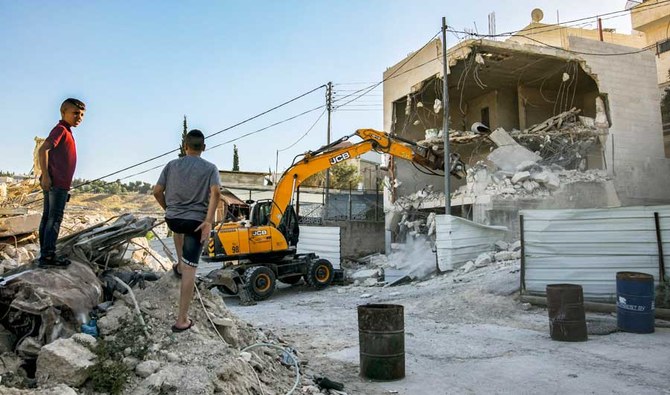
Palestinian mother of 3 to be homeless after Israeli court clears demolition

A review by the Israeli military in 2004 questioned the effectiveness of home domolitions, leading the military to halt such demolitions for nearly a decade. (AFP)
Short Url
Updated 24 June 2021
Follow

Palestinian mother of 3 to be homeless after Israeli court clears demolition

  • Israeli group representing her says husband has history of mental illness

JERUSALEM, WASHINGTON: Israel’s Supreme Court on Wednesday upheld the decision to destroy the family home of a detained Palestinian accused of a deadly shooting.

It rejected a petition by his estranged wife, who lives in the house with their children and says she knew nothing about the attack.
The case drew attention to Israel’s policy of demolishing the family homes of attackers after they have been killed or arrested.
Israeli officials say the demolitions deter future attacks, while rights groups view it as a form of collective punishment.
The US State Department has urged a halt to punitive home demolitions.
An internal review by the Israeli military in 2004 reportedly questioned its effectiveness as a deterrent, leading the military to largely halt such demolitions for nearly a decade.
It resumed the practice in 2014 after three Israeli teenagers were kidnapped and killed in the West Bank.
Israel says Muntasser Shalaby carried out a May 2 drive-by shooting in the occupied West Bank that killed an Israeli and wounded two others. He was arrested days after the attack.
His wife, Sanaa Shalaby, said they were estranged for several years and that he spent most of his time in Santa Fe, New Mexico, where he had married three other women in unofficial Islamic ceremonies. The entire family has US citizenship.
Sanaa said he would return to the West Bank for a month or two every year to visit their three children, aged 17, 12 and 9, who live with her in the home in the village of Turmus Ayya.
HaMoked, an Israeli rights group representing her, said he had a history of mental illness.
In upholding the demolition order, the Supreme Court noted that Muntasser had lived in the home continuously from 2006-2012, before their estrangement, and had resided there for weeks before the attack. It said the petitioners did not present sufficient evidence to show he had suffered from mental illness.

FASTFACT

The ‘disappointing’ judgment would allow the military to expand the use of punitive home demolitions.

Jessica Montell, the executive director of HaMoked, said the “disappointing” judgment would allow the military to expand the use of punitive home demolitions.
Her group is weighing whether to request another hearing and says the court is unlikely to grant one. She said the house could be demolished anytime after an interim injunction expires on June 30.
“If Mrs. Shalaby’s legal recourse has been exhausted, the diplomatic recourse is crucial: Is the US government going to allow this blatant collective punishment against a US citizen mother and three children?”
The State Department did not immediately respond to a request for comment on the ruling. Earlier this month, it called on Israel and the Palestinians to refrain from any actions that undermine efforts to revive the peace process, including punitive home demolitions.
“The home of an entire family should not be demolished for the actions of one individual,” it said.

Democrats’ stance
A new poll on American attitudes toward a core conflict in the Middle East finds about half of Democrats want the US to do more to support the Palestinians, showing that a growing rift among Democratic lawmakers is also reflected in the party’s base.
The poll from The Associated Press-NORC Center for Public Affairs Research finds differences within both the Democratic and the Republican parties on the US approach toward Israel and the Palestinians, with liberal Democrats wanting more support for the Palestinians and conservative Republicans seeking even greater support for the Israelis.
The survey also examined Americans’ opinions on the Biden administration’s handling of the Israel-Palestinian conflict.
The survey was conducted about three weeks into a ceasefire following a devastating 11-day war last month between Israel and the Gaza Strip’s Hamas militant rulers. The fighting killed at least 254 Palestinians and 13 people in Israel.
The poll shows Americans overall are divided over US policy toward Israel and the Palestinians. It also shows more Americans disapprove of President Joe Biden’s approach to the conflict than approve of it.
Among Democrats, 51 percent say the US is not supportive enough of the Palestinians. The sentiment jumps to 62 percent among Democrats who describe themselves as liberal.
On the other hand, 49 percent of Republicans say the US is not supportive enough of the Israelis, a number that rises to 61 percent among those who say they’re conservative.
Paul Spelce, a 26-year-old Democratic-leaning independent voter and supporter of Palestinian statehood, is a member of a heavily religious Texas Republican family whose support for Israel is ingrained with their Christian faith.
Spelce, of Austin, says he followed news of last month’s Gaza war and the US response closely on the radio as he helped deliver mail.
“I started paying a lot more attention,” said Spelce, who said he disapproved of Biden’s handling of the conflict and thinks the US is too supportive of Israelis and not supportive enough of the Palestinians.
“I don’t think Biden’s word was that strong,” Spelce said. “And I don’t think, you know, this administration ... can actually do anything” regarding the conflict.
Overall, the poll shows that 29 percent of Americans say the US is too supportive of the Israelis, 30 percent say it’s not supportive enough and 36 percent say it’s about right.


Iran vows fast trials over protests after Trump threat

Updated 2 sec ago
Follow

Iran vows fast trials over protests after Trump threat

Paris, France: Iran on Wednesday vowed fast-track trials for people arrested over a massive wave of protests, after US President Donald Trump threatened “very strong action” if the Islamic republic goes ahead with hangings.
In Tehran, authorities held a funeral ceremony for over 100 members of the security forces and other “martyrs” killed in the demonstrations, which authorities have branded as “riots” while accusing protesters of waging “acts of terror.”
The protest movement across Iran, initially sparked by economic grievances, has turned into one of the biggest challenges yet to the clerical leadership since it took power in 1979.
Demonstrators have defied the authorities’ zero-tolerance for dissent by turning out in protests all around the country, even as authorities insist they have regained the upper hand.
Iran’s judiciary chief Gholamhossein Mohseni Ejei said on a visit to a prison holding protest detainees that “if a person burned someone, beheaded someone and set them on fire then we must do our work quickly,” in comments broadcast by state television.
Iranian news agencies also quoted him as saying the trials should be held in public and said he had spent five hours in a prison in Tehran to examine the cases.
Footage broadcast by state media showed the judiciary chief seated before an Iranian flag in a large, ornate room in the prison, interrogating a prisoner himself.
The detainee, dressed in grey clothing and his face blurred, is accused of taking Molotov cocktails to a park in Tehran.

- Blackout -

Trump on Tuesday said in a CBS News interview that the United States would act if Iran began hanging protesters.
“We will take very strong action if they do such a thing,” said the American leader, who has repeatedly threatened Iran with military intervention.
“When they start killing thousands of people — and now you’re telling me about hanging. We’ll see how that’s going to work out for them,” Trump said.
Iranian authorities called the American warnings a “pretext for military intervention.”
Rights groups accuse the government of fatally shooting protesters and masking the scale of the crackdown with an Internet blackout imposed on January 8.
Internet monitor Netblocks said in a post to X on Wednesday that the blackout had now lasted 132 hours.
Some information has trickled out of Iran however. New videos on social media, with locations verified by AFP, showed bodies lined up in the Kahrizak morgue just south of the Iranian capital, with the corpses wrapped in black bags and distraught relatives searching for loved ones.

- Calls to halt executions -

Iranian prosecutors have said authorities would press capital charges of “waging war against God” on some detainees.
According to state media, hundreds of people have been arrested.
State media has also reported on the arrest of a foreign national for espionage in connection with the protests.
No details were given on the person’s nationality or identity.
The US State Department on its Farsi language X account said 26-year-old protester Erfan Soltani had been sentenced to be executed on Wednesday.
“Erfan is the first protester to be sentenced to death, but he won’t be the last,” the State Department said, adding more than 10,600 Iranians had been arrested.
Rights group Amnesty International called on Iran to immediately halt all executions, including Soltani’s.
Norway-based NGO Iran Human Rights said it had confirmed 734 people killed during the protests, including nine minors, but warned the death toll was likely far higher.
“The real number of those killed is likely in the thousands,” IHR’s director Mahmood Amiry-Moghaddam said.
Iranian state media has said dozens of members of the security forces have been killed, with their funerals turning into large pro-government rallies.

- Khamenei in hiding -

At Wednesday’s funeral ceremony in Tehran, thousands of people waved flags of the Islamic republic as prayers were read out for the dead outside Tehran University, according to images broadcast on state television.
“Death to America!” read banners held up by people attending the rally, while others carried photos of supreme leader Ayatollah Ali Khamenei.
Another image could be seen at the rally showing Trump’s assassination attempt, captioned: “This time it will not miss the target.”
It appeared to be referring to the assassination attempt against Trump during a campaign rally in 2024.
Amir, an Iraqi computer scientist, returned to Baghdad from Iran on Monday and described dramatic scenes in Tehran during protests on Thursday night.
“My friends and I saw protesters in Tehran’s Sarsabz neighborhood amid a heavy military presence. The police were firing rubber bullets,” he told AFP in Iraq.
In power since 1989 and now aged 86, Khamenei has faced significant challenges, most recently the 12-day war in June against Israel, which forced him to go into hiding.
Analysts have cautioned that it is premature to predict the immediate demise of the theocratic system, pointing to the repressive levers the leadership controls, including the Revolutionary Guard Corps, which is charged with safeguarding the Islamic revolution.