



RAWALPINDI: A Pakistani education specialist and entrepreneur, Mariam Nusrat Adil, joined the ranks of Pakistani Forbes honorees last week, making it to the “Forbes Next 1000 List” for using the “power of video games to educate, engage and empower people.”
The list celebrates small startups like Adil’s Gaming Revolution for International Development (GRID) which have under $10 million in revenue or funding.
“I feel immensely grateful and humbled to be on the Forbes list,” Adil told Arab News in a phone interview.
“Moments like these are a testament of the passion, purpose, and perseverance that my team and I have poured into GRID but they are also the perfect refueling stations along the entrepreneurial journey,” the founder said. “It’s a time to pause, celebrate the win, and then return to our mission, with renewed commitment and conviction. This is just the beginning, and we are thrilled about the potential of our journey.”
GRID, which is run primarily by a team of Pakistan-based game developers and designers, creates low-cost mobile games that inspire positive behavior change. The company raised $75,000 in pre-seed funding from 11 Tribes Ventures and is backed by Ocean Accelerator.
In the last nearly seven years, the company has created games to educate people on reproductive health, climate change, pandemics, animal welfare, and STEM learning. It has several new games in the pipeline that seek to enhance awareness about child abuse, financial literacy, and skills for the future. Under its not-for-profit arm, the organization has developed eight portfolio games, in four languages.
“Having grown up playing games such as Sim City, I knew games leave an impression on our brains that transcend the boundaries of the virtual world,” Adil said. “I wondered to myself that if games on building cities can teach urban planning, can games focusing on environmental awareness promote climate action, those about women’s rights promote equality, or those building humane education improve animal welfare?”
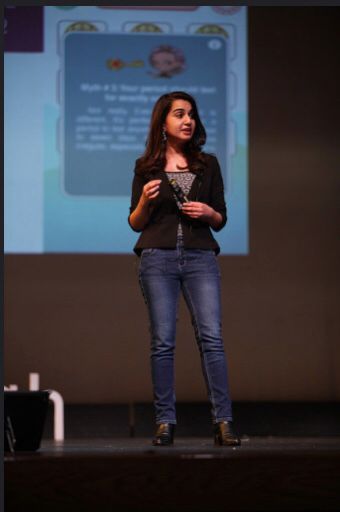
In this undated photo, Mariam Nusrat Adil speaks at a TedX event in Washington DC, United States (Mariam Nusrat Adil)
Adil said she aspired to develop video games that were “purposeful.”
“These are video games that have a purpose beyond entertainment,” she said. “They have immense potential to influence industries like education, marketing, and training, though we do not see them being mainstreamed in these industries.”
GRID also plans to release a program called Breshna which will allow people to create games without any coding experience at “lightning speeds.” The word “breshna” means lightning in Pashto, Adil’s mother tongue.
“Breshna empowers anyone, with no coding or design experience, to create their own video games for educational, marketing, and training purposes,” she said. “Whether it’s a teacher making a history quiz, a not-for-profit leader making a brochure on animal compassion or a founder making a pitch deck, they can all leverage Breshna to create fun and interactive video games to engage their audience.”

Mariam Nusrat Adil (first from right) shares the stage with former US president Bill Clinton (third from right) at a conference that took place from March 6-8, 2015, at the University of Miami, Florida. (Photo courtesy: Mariam Nusrat Adil)
In addition to GRID, Adil has also worked at the World Bank since 2010, with a focus on education. Her job has taken her across South Asia, Sub-Saharan Africa, and the Middle East. She has master’s degrees in economics from the Lahore University of Management Sciences (LUMS) in Pakistan and the George Washington University in the United States.
Adil is originally from Islamabad and currently lives in the US though she aspires to give back to her home country.

Mariam Nusrat Adil in an undated photo (Mariam Nusrat Adil)
“Paying it forward is something that is deeply embedded in our organization’s DNA, and I owe a significant portion of my journey and success to my home country,” Adil said. “I want GRID to demonstrate that Pakistan is rich in development and design talent. Global tech companies have an opportunity to tap this high-quality talent and develop innovative solutions in a capital-efficient manner.”


