Rights groups call for probe into Iran’s President-elect Raisi for crimes against humanity

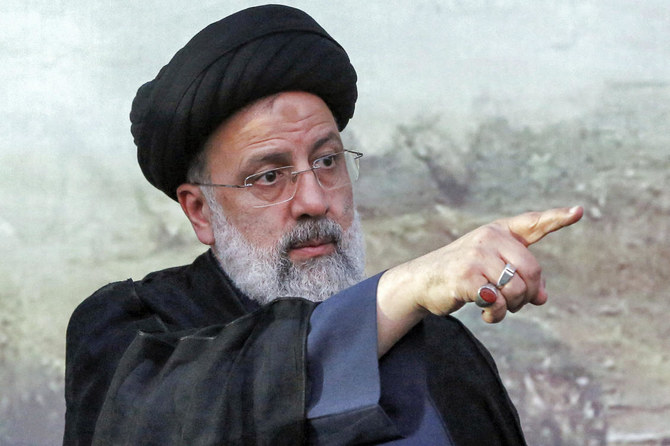
In this file photo taken on June 06, 2021 Iranian presidential candidate Ebrahim Raisi gestures during an election campaign rally in the city of Eslamshahr. (AFP)
Short Url
Updated 20 June 2021
Follow

Rights groups call for probe into Iran’s President-elect Raisi for crimes against humanity

  • Iran’s new leader will control all regime’s branches, fill Cabinet with radicals: Expert

JEDDAH: Amnesty International and Human Rights Watch said Ebrahim Raisi’s election as Iran’s new president was a blow for human rights and called for him to be investigated over his role in the extrajudicial executions of thousands of political prisoners in 1988.

“That Ebrahim Raisi has risen to the presidency instead of being investigated for the crimes against humanity, enforced disappearance and torture, is a grim reminder that impunity reigns supreme in Iran,” said London-based Amnesty Secretary-General Agnès Callamard, citing the group's report

“In 2018, our organization documented how Ebrahim Raisi had been a member of the ‘death commission’ which forcibly disappeared and extrajudicially executed in secret thousands of political dissidents in Evin and Gohardasht prisons near Tehran in 1988. The circumstances surrounding the fate of the victims and the whereabouts of their bodies are, to this day, systematically concealed by the Iranian authorities, amounting to ongoing crimes against humanity.”

The report also said: “‘As Head of the Iranian Judiciary, Ebrahim Raisi has presided over a spiralling crackdown on human rights which has seen hundreds of peaceful dissidents, human rights defenders and members of persecuted minority groups arbitrarily detained.

“We continue to call for Ebrahim Raisi to be investigated for his involvement in past and ongoing crimes under international law, including by states that exercise universal jurisdiction,” she added.

Opinion

This section contains relevant reference points, placed in (Opinion field)

New York-based Human Rights Watch (HRW) echoed this. “Iranian authorities paved the way for Ebrahim Raisi to become president through repression and an unfair election,” Michael Page, deputy Middle East director at HRW, said.

“As head of Iran’s repressive judiciary, Raisi oversaw some of the most heinous crimes in Iran’s recent history, which deserve investigation and accountability rather than election to high office.”

Dr. Majid Rafizadeh, a Harvard-educated Iranian-American political scientist, told Arab News “With Raisi’s victory, Iran’s hard-liners will be controlling all the regime’s branches — the executive, legislative and the judiciary. The last time the hard-liners were in such a position was during Mahmoud Ahmadinejad’s presidency. Raisi will most likely choose members of radical organizations such as the Iranian Revolutionary Guard Corps, the Quds Force, the Ministry of Intelligence, and paramilitary groups Basij to fill his Cabinet.”  

Maryam Rajavi, president-elect of the Paris-based National Council of Resistance of Iran, said: “Ebrahim Raisi, the henchman of the 1988 massacre and murderer of the Mujahedin-e-Khalq, is Khamenei’s final bid to preserve his regime. Weak, crisis-riddled, and rattled by looming uprisings, Khamenei purged all rivals to install Raisi as president, one of the vilest criminals against humanity since World War II.”

“There is no longer any justification for the international community to deal with, engage, or appease a regime whose president is a notorious criminal,” said Rajavi.

Reza Pahlavi, son of deposed shah Mohammad Reza Pahlavi and heir to the throne before the 1979 Islamic revolution, tweeted that Iranians had shown “unity and solidarity” by “boycotting and saying no to the authoritarian regime in Iran”. 

Hadi Ghaemi, executive director of the New York-based Center for Human Rights in Iran, said that after a poll that was “not an election (but a) selection,” Raisi should not be absolved of his “long record of gross human rights violations.”

Describing him as a “major rights violator,” he said that as well as the 1988 killings, in two years as overall judiciary chief he “has been responsible for countless, severe violations of citizens’ rights.”

Dressed in a black turban and cleric’s coat, Raisi casts himself as an austere and pious figure and an corruption-fighting champion of the poor.

Critics charge the election was skewed in his favor as strong rivals were disqualified, but to his loyal supporters he is Iran’s best hope for standing up to the West and bringing relief from a deep economic crisis.

Raisi is not renowned for great charisma but, as head of the judiciary, has driven a popular campaign to prosecute corrupt officials.

Raisi is set to take over from moderate Hassan Rouhani in August.


(With AFP)


Battle for the Nile
How will Egypt be impacted by Ethiopia filling its GERD reservoir ?

Enter


keywords

Israeli strikes kill 3 people in Gaza, hospital says

Updated 3 sec ago
Follow

Israeli strikes kill 3 people in Gaza, hospital says

DEIR AL-BALAH: Israeli military strikes on Monday killed three people west of Gaza City, according to the hospital where the casualties arrived.
Shifa Hospital reported the deaths amid the months-old ceasefire that has seen continued fighting. The Israeli army said Monday it is striking targets in response to Israeli troops coming under fire in the southern city of Rafah, which it says was a violation of the ceasefire. The army said it is striking targets “in a precise manner.”
The four-month-old U.S-backed ceasefire followed stalled negotiations and included Israel and Hamas accepting a 20-point plan proposed by US President Donald Trump aimed at ending the war unleashed by Hamas’ Oct. 7, 2023, attack into Israel. At the time, Trump said it would lead to a “Strong, Durable, and Everlasting Peace.”
Hamas freed all the living hostages it still held at the outset of the deal in exchange for thousands of Palestinian prisoners held by Israel and the remains of others.
But the larger issues the agreement sought to address, including the future governance of the strip, were met with reservations, and the US offered no firm timeline.
Top UN official concerned over Israel’s West Bank decision
The United Nations top official on Monday expressed concern about the Israeli security cabinet’s decision to deepen the country’s control over the occupied West Bank.
Secretary-General Antonio Guterres is “gravely concerned” and warned that the Israeli decision could erode the prospect of a two-state solution, spokesperson Stéphane Dujarric said in a statement.
“Such actions, including Israel’s continued presence in the Occupied Palestinian Territory are not only destabilizing but – as recalled by the International Court of Justice – unlawful,” he said.
Israel ‘s security cabinet on Sunday approved measures that aim to deepen Israeli control over the occupied West Bank and weaken the already limited powers of the Palestinian Authority.
Israel’s far-right Finance Minister Bezalel Smotrich said the measures would make it easier for Jewish settlers to force Palestinians to give up land, adding that “we will continue to bury the idea of a Palestinian state.”
Israel captured the West Bank, as well as Gaza and east Jerusalem, in the 1967 Mideast war. The Palestinians want all three territories for a future state.
Rafah crossing improving, official says
The Palestinian official set to oversee day-to-day affairs in Gaza said on Monday that passage through the Rafah crossing with Egypt is starting to improve after a chaotic first week of reopening marked by confusion, delays and a limited number of crossings.
Ali Shaath, head of the National Committee for the Administration of Gaza, told Egypt’s Al-Qahera News that operations at the crossing were improving on Sunday. He said 88 Palestinians were scheduled to travel through Rafah on Monday, more than have crossed in the initial days since reopening. Israel did not immediately confirm the figures.
The European Union border mission at the crossing said in a statement Sunday that 284 Palestinians had crossed since reopening. Travelers included people returning after having fled the war and medical evacuees and their escorts. In total, 53 medical evacuees departed during the first five days of operations.
That remains well below the agreed target of 50 medical evacuees exiting and 50 returnees entering daily, negotiated by Israeli, Egyptian, Palestinian and international officials.
Shaath and other members of the committee remain in Egypt, without Israeli authorization to enter the war-battered enclave.
The Rafah crossing opened last week for the first time since mid-2024, one of the main requirements for the ceasefire between Israel and Hamas. It was closed Friday and Saturday because of confusion around operations.
Palestinian officials say nearly 20,000 people are seeking to leave Gaza for medical care unavailable in its largely destroyed health system.
Palestinians who returned to Gaza in the first days after the crossing reopened described hourslong delays and invasive searches by Israeli authorities and an Israeli-backed Palestinian armed group, Abu Shabab. Israel denied mistreatment.
Gaza’s Health Ministry said on Monday that five people were killed over the previous 24 hours, bringing the death toll to 581 since the October ceasefire. The truce led to the return of the remaining hostages — both living captives and bodies — from the 251 abducted during the Oct. 7, 2023, attack that triggered the war.
Hamas-led militants killed around 1,200 people, mostly civilians, in the attack. Israel’s military offensive has since killed over 72,000 Palestinians, according to the ministry, which operates under the Hamas-run government and is staffed by medical professionals. The UN and independent experts consider it the most reliable source on war casualties.