UN re-elects Antonio Guterres as secretary-general

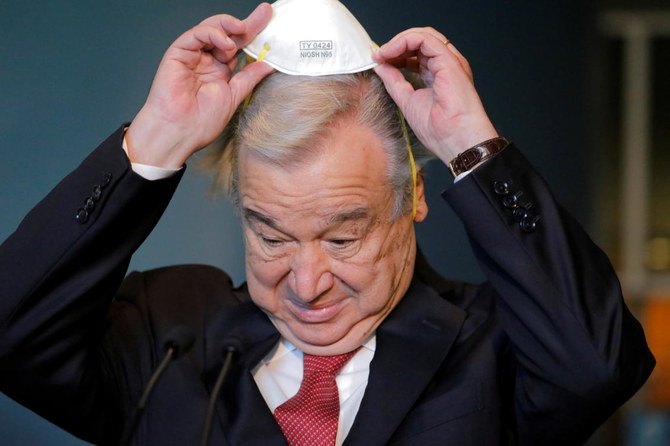
UN Secretary-General Antonio Guterres puts on a face mask after addressing the media as UN General Assembly appointed him for a second five-year term in New York City. (Reuters)
Short Url
Updated 18 June 2021
Follow

UN re-elects Antonio Guterres as secretary-general

  • Ambassadors burst into applause as Assembly President announced Guterres’ re-election by “acclamation,”
  • The General Assembly appoints the secretary-general on the recommendation of the Security Council

UNITED NATIONS: The UN General Assembly unanimously elected Antonio Guterres to a second term as secretary-general on Friday.
Guterres was given another five years at the helm of the 193-member organization at a time a deeply divided world faces numerous conflicts, the growing impact of climate change, and a pandemic still circling the globe.
Ambassadors in the assembly chamber burst into applause as Assembly President Volkan Bozkir announced Guterres’ re-election by “acclamation,” without a vote. Just before the announcement, Estonia’s UN Ambassador Sven Jurgenson, the current Security Council president, read a resolution adopted by the 15-member council recommending Guterres for a second term.
Under the UN Charter, the General Assembly appoints the secretary-general on the recommendation of the Security Council.
Guterres was the only candidate nominated by a UN member state, his home country Portugal where he previously served as prime minister, and the country’s current president, Marcelo Rebelo de Sousa, was in the assembly chamber to watch the event.
Immediately after his re-election, Guterres took the oath of office and delivered an address urging UN member nations “to do everything we can to overcome current geostrategic divides and dysfunctional power relations.”
“There are too many asymmetrics and paradoxes,” he said. “They need to be addressed head on.”
Guterres expressed hope that “what we are living through today in terms of mistrust is, I hope, an aberration but it cannot become the norm.”
He pledged to “give it my all to ensure the blossoming of trust between and among nations, large and small, to build bridges and to engage relentlessly in confidence building” — and to “seek to inspire hope that we can turn things around, that the impossible is possible.”
Traditionally, candidates for the UN’s top job have been nominated by a UN member state, but that is not a requirement in the UN Charter or in a resolution adopted by the General Assembly in 2015.
That measure made the previously largely secretive selection of the secretary-general more open and transparent, allowing member states for the first time to see basic information about all candidates, including their resumes, and to question them at open sessions.
Guterres, a former UN refugee chief, was elected by the assembly to succeed Ban Ki-moon after a hotly contested and transparent race in October 2016 that initially included 13 candidates — seven women and six men. Guterres took office on Jan. 1, 2017.
This year, seven individuals submitted applications to be secretary-general without backing from any government, including most recently former Ecuadorian President Rosalia Arteaga.


Only 4% women on ballot as Bangladesh prepares for post-Hasina vote

Updated 19 min 5 sec ago
Follow

Only 4% women on ballot as Bangladesh prepares for post-Hasina vote

  • Women PMs have ruled Bangladesh for over half of its independent history
  • For 2026 vote, only 20 out of 51 political parties nominated female candidates

DHAKA: As Bangladesh prepares for the first election since the ouster of its long-serving ex-prime minister Sheikh Hasina, only 4 percent of the registered candidates are women, as more than half of the political parties did not field female candidates.

The vote on Feb. 12 will bring in new leadership after an 18-month rule of the caretaker administration that took control following the student-led uprising that ended 15 years in power of Hasina’s Awami League party.

Nearly 128 million Bangladeshis will head to the polls, but while more than 62 million of them are women, the percentage of female candidates in the race is incomparably lower, despite last year’s consensus reached by political parties to have at least 5 percent women on their lists.

According to the Election Commission, among 1,981 candidates only 81 are women, in a country that in its 54 years of independence had for 32 years been led by women prime ministers — Hasina and her late rival Khaleda Zia.

According to Dr. Rasheda Rawnak Khan from the Department of Anthropology at Dhaka University, women’s political participation was neither reflected by the rule of Hasina nor Zia.

“Bangladesh has had women rulers, not women’s rule,” Khan told Arab News. “The structure of party politics in Bangladesh is deeply patriarchal.”

Only 20 out of 51 political parties nominated female candidates for the 2026 vote. Percentage-wise, the Bangladesh Socialist Party was leading with nine women, or 34 percent of its candidates.

The election’s main contender, the Bangladesh Nationalist Party, whose former leader Zia in 1991 became the second woman prime minister of a predominantly Muslim nation — after Pakistan’s Benazir Bhutto — was the party that last year put forward the 5 percent quota for women.

For the upcoming vote, however, it ended up nominating only 10 women, or 3.5 percent of its 288 candidates.

The second-largest party, Jamaat-e-Islami, has not nominated a single woman.

The 4 percent participation is lower than in the previous election in 2024, when it was slightly above 5 percent, but there was no decreasing trend. In 2019, the rate was 5.9 percent, and 4 percent in 2014.

“We have not seen any independent women’s political movement or institutional activities earlier, from where women could now participate in the election independently,” Khan said.

“Real political participation is different and difficult as well in this patriarchal society, where we need to establish internal party democracy, protection from political violence, ensure direct election, and cultural shifts around female leadership.”

While the 2024 student-led uprising featured a prominent presence of women activists, Election Commission data shows that this has not translated into their political participation, with very few women contesting the upcoming polls.

“In the student movement, women were recruited because they were useful, presentable for rallies and protests both on campus and in the field of political legitimacy. Women were kept at the forefront for exhibiting some sort of ‘inclusive’ images to the media and the people,” Khan said.

“To become a candidate in the general election, one needs to have a powerful mentor, money, muscle power, control over party people, activists, and locals. Within the male-dominated networks, it’s very difficult for women to get all these things.”