

Guterres says Pakistan ‘fundamental partner’ of United Nations

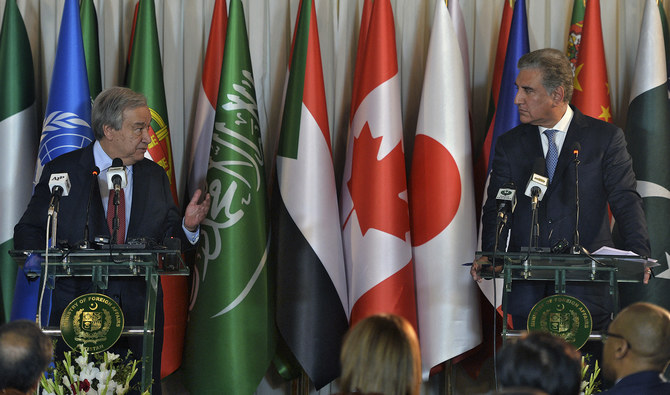
United Nations Secretary-General Antonio Guterres, left, and Pakistan's Foreign Minister Shah Mehmood Qureshi speak during a joint press conference at the Foreign Ministry in Islamabad, Pakistan, on February 16, 2020. (AFP/File)
Short Url
Updated 20 March 2021
Follow

Guterres says Pakistan ‘fundamental partner’ of United Nations

  • Antonio Guterres took over the top slot at the world body in January 2017 and plans to contest for another term in the office
  • Pakistani foreign minister said his country wanted a strong UN that could ‘meet the expectations of its member states’

ISLAMABAD: UN Secretary General Antonio Guterres on Friday described Pakistan as a “fundamental partner of the United Nations” while praising Islamabad’s contribution to the effective functioning of the world organization. 

According to an official handout circulated by the foreign office of Pakistan, Guterres made the statement during a phone call to the country’s foreign minister Shah Mahmood Qureshi. 

Together the two leaders discussed a wide range of issues including the coronavirus pandemic and its economic impact, equitable vaccine distribution for developing countries, UN peacekeeping, the Kashmir dispute, and Afghan peace process. 

Qureshi affirmed Pakistan’s commitment to multilateralism while emphasizing the importance of a strong UN playing a central role "for the delivery of its mandates that meet the expectations of member states.” 

He also lauded Guterres for his leadership role during challenging times and expressed his country’s full support for his re-appointment for another five-year tenure. 

The UN secretary general replaced South Korea’s Ban Ki-moon on January 1, 2017 and will be contesting once again for the top slot at the world body during the course of this year. 

Guterres briefed the foreign minister on UN efforts with regard to the situation in Afghanistan. 

Qureshi also underscored Pakistan’s contributions to the Afghan peace process while warning against the role of “spoilers” in that country. 


Pakistan, seven Muslim nations back Palestinian technocratic body, stress Gaza-West Bank unity

Updated 15 January 2026
Follow

Pakistan, seven Muslim nations back Palestinian technocratic body, stress Gaza-West Bank unity

  • The National Committee for the Administration of the Gaza Strip was announced on January 14
  • Muslim nations call for consolidation of the ceasefire and unimpeded humanitarian aid into Gaza

ISLAMABAD: Pakistan and seven other Muslim-majority countries on Thursday welcomed the formation of a temporary Palestinian technocratic body to administer Gaza, stressing that it must manage daily civilian affairs while preserving the institutional and territorial link between the Gaza Strip and the West Bank amid the ongoing peace efforts.

In a joint statement, the foreign ministers of Pakistan, Egypt, Jordan, Saudi Arabia, Qatar, Türkiye, Indonesia and the United Arab Emirates said the newly announced National Committee for the Administration of the Gaza Strip would play a central role during the second phase of a broader peace plan aimed at ending the war and paving the way for Palestinian self-governance.

“The Ministers emphasize the importance of the National Committee commencing its duties in managing the day-to-day affairs of the people of Gaza, while preserving the institutional and territorial link between the West Bank and the Gaza Strip, ensuring the unity of Gaza, and rejecting any attempts to divide it,” the statement said.

The committee, announced on Jan. 14, is a temporary transitional body established under United Nations Security Council Resolution 2803 and is to operate in coordination with the Palestinian Authority, the ministers said.

The statement said the move forms part of the second phase of US President Donald Trump’s Comprehensive Peace Plan for Gaza, which the ministers said they supported, praising Trump’s efforts to end the war, ensure the withdrawal of Israeli forces and prevent the annexation of the occupied West Bank.

The top leaders of all eight Muslim countries attended a meeting with Trump in New York last September, shortly before he unveiled the Gaza peace plan.

The ministers also called for the consolidation of the ceasefire, unimpeded humanitarian aid into Gaza, early recovery and reconstruction and the eventual return of the Palestinian Authority to administer the territory, leading to a just and sustainable peace based on UN resolutions and a two-state solution on pre-1967 lines with East Jerusalem as the Palestinian capital.