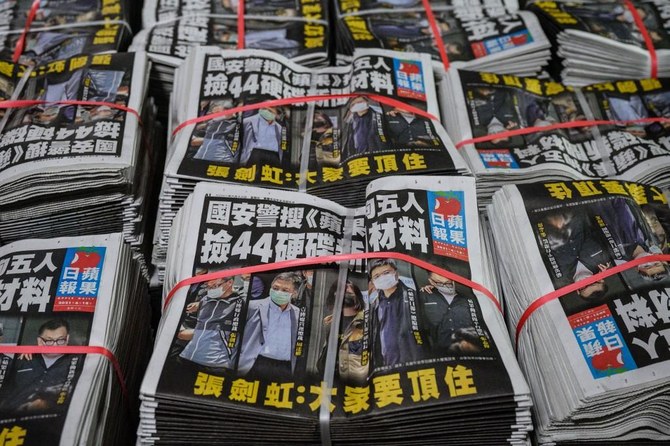
HONG KONG: Hong Kong pro-democracy newspaper Apple Daily increased its print run more than fivefold to 500,000 copies as residents lined up Friday to buy the paper in a show of support for beleaguered press freedoms, a day after police arrested five top editors and executives.
The raid on the paper’s offices by hundreds of police and security agents — along with the freezing of $2.3 million worth of its assets — marked the first time a sweeping national security law has been used against the media. It was the latest sign of a widening crackdown on civil liberties in the semi-autonomous city, which has long cherished freedoms that don’t exist elsewhere in China.
Police said the editors were arrested on suspicion of foreign collusion to endanger national security, based on over 30 articles that authorities said had called for international sanctions against China and Hong Kong.
On Friday, the National Security Department charged two men with collusion with a foreign country to endanger national security, according to a government statement. The two will appear in court on Saturday.
It did not name them, but the South China Morning Post newspaper cited an unnamed source saying they are Apply Daily’s chief editor Ryan Law and Cheung Kim-hung, the CEO of Apple Daily’s publisher Next Digital. The other three were being detained for investigation.
With anti-government protests silenced, most of the city’s prominent pro-democracy activists in jail and many others fleeing abroad, people snapped up copies at newsstands and in convenience stores.
“There are lots of injustices in Hong Kong already. I think there are a lot of things we cannot do anymore,” said resident Lisa Cheung. “Buying a copy is all what we can do. When the law cannot protect Hong Kong people anymore, we are only left to do what we can.”
The front page of Friday’s edition splashed images of the five editors and executives led away in handcuffs. Police also confiscated 44 hard drives worth of news material. A quote from Cheung, the arrested CEO of Next Digital, said “Hang in there, everyone.”
Another resident, William Chan, said he bought a copy of the paper as a show of support.
“It was such a groundless arrest and suppressed freedom of the press,” he said.
The national security law was imposed after massive protests in 2019 challenged Beijing’s rule by calling for broader democratic freedoms. It outlaws subversion, secession, terrorism and collusion with foreign countries. The maximum penalty for serious offenders is life imprisonment.
Security Minister John Lee had on Thursday warned other journalists to distance themselves from those under investigation at Apple Daily. He said those arrested had used journalistic work to endanger national security and that anyone who was “in cahoots” with them would pay a hefty price.
The United States, which has imposed sanctions against Hong Kong and Chinese officials over the crackdown, strongly condemned the arrests and called for the immediate release of the five arrested.
“We are deeply concerned by Hong Kong authorities’ selective use of the national security law to arbitrarily target independent media organizations,” State Department spokesman Price said, adding that the suspected foreign collusion charges appear to be politically motivated.
“As we all know, exchanging views with foreigners in journalism should never be a crime,” he said.
British Foreign Secretary Dominic Raab said in a tweet that freedom of the press is one of the rights China had promised to protect for 50 years when Britain handed over Hong Kong in 1997.
“Today’s raids & arrests at Apple Daily in Hong Kong demonstrate Beijing is using the National Security Law to target dissenting voices, not tackle public security,” Raab said.
European Union spokesperson Nabila Massrali said that the arrests “further demonstrate how the National Security Law is being used to stifle media freedom and freedom of expression in Hong Kong.” Media freedom and pluralism are fundamental to Hong Kong’s success under the “one country, two systems” framework, she said.
In Beijing, Foreign Ministry spokesperson Zhao Lijian rejected the foreign criticism and defended the government’s action, repeating China’s insistence that the national security targets only a “small group of anti-China elements who disrupted Hong Kong and endangered the national security of the country.”
“No right or freedom, including freedom of the press, can break through the bottom line of national security,” Zhao told reporters at a daily briefing.
“Hong Kong is China’s Hong Kong, Hong Kong affairs are purely China’s internal affairs, and no country, organization or individual has the right to intervene,” he said.
Apple Daily has pledged to readers that it will continue its reporting, and on Thursday night invited members of the media to its printing presses to watch its Friday edition roll off the press in a show of commitment.
Its founder Jimmy Lai is currently serving a 20-month prison sentence on charges of playing a part in unauthorized protests in 2019, and faces further charges under the national security law that could potentially put him away for life.
The paper’s average daily circulation has been around 86,000 copies.


![]()

Hong Kong newspaper increases print fivefold after arrests
Short Url
https://arab.news/zqfa4
Hong Kong newspaper increases print fivefold after arrests
- Hong Kong's Apple Daily prints increased fivefold after the police arrested five top editors and executives.
- On Thursday, police raided the offices of the pro-democracy newspaper, arrested five people and froze $2.3 million worth of assets.


Latest updates


© 2026 SAUDI RESEARCH & PUBLISHING COMPANY, All Rights Reserved And subject to Terms of Use Agreement.