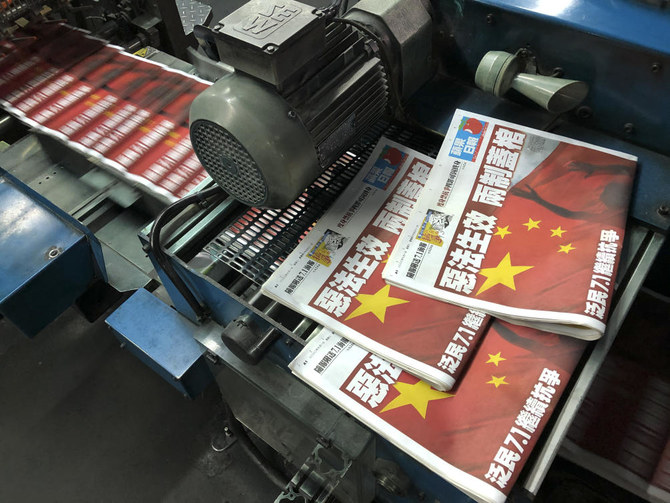
HONG KONG: The arrest of five senior executives over content published in Hong Kong’s pro-democracy Apple Daily newspaper is a stark warning to all media outlets on the reach of a new national security law, analysts and industry figures say.
It was the first time articles published in Hong Kong have sparked arrests under the new law that cracks down on dissent in the international business and media hub.
Hong Kong’s historical status as a press freedom bastion has been on shaky ground for years. But Thursday’s police raid against Apple Daily was a watershed moment.
Some 500 officers descended on the paper’s newsroom, bundling computers and notepads into evidence bags.
Five executives, including its editor and publisher, were being arrested for “collusion with foreign forces,” one of the new offenses under a national security law China imposed on Hong Kong last year.
Justifying the arrests, Senior Superintendent Steve Li said the contents of 30 articles calling for international sanctions were evidence of “conspiracy” to undermine China’s national security.
Li warned Hong Kongers not to share the articles even as he refused to say which ones were now deemed illegal.
Some, he confirmed, were published before the security law was enacted in June last year, although it is not supposed to be retroactive.
For reporters and publishers across the city, the message was clear: what one writes or prints could lead to a knock on the door from the national security police.
“It’s very heartbreaking,” said Bao Choy, a local reporter who was recently prosecuted over an investigation into the police’s failure to stop an attack by government loyalists on pro-democracy protesters during political unrest in 2019.
“We are walking into a very dark tunnel, it’s kind of endless at this point. I’m not optimistic about the future of journalism in Hong Kong,” she said.
Hong Kong and Chinese officials insisted the arrests were not an attack on the media.
Security secretary John Lee portrayed Apple Daily as an outlier, a “criminal syndicate” that was different to other media.
“This action has nothing to do with normal journalism work,” he said.
“It is aimed at suspected use of journalism as a tool to commit acts that endanger national security. Normal journalists are different from them. Don’t get involved with them, and keep a distance from them.”
Lee’s comments did little to alleviate already heightened concerns that Hong Kong’s days as a media hub are numbered.
Sharron Fast, a lecturer at the University of Hong Kong’s journalism school, said Lee’s words were both “ominous” and opaque.
“There was no clarity at all provided on what amounts to a conspiracy to collude with foreign forces in the context of reporting on developments concerning sanctions and boycotts,” she said.
The Hong Kong Journalists Association said Lee’s words had “spread fear and panic among journalists.”
It said the security law was now “a weapon to prosecute media executives and journalists for publishing reports and articles that are deemed as a threat to national security.”
The city’s Foreign Correspondents Club said the arrests “will serve to intimidate independent media in Hong Kong and will cast a chill over the free press.”
Multiple international media companies, including AFP, have regional headquarters in Hong Kong, attracted to the business-friendly regulations and free speech provisions written into the city’s mini-constitution.
But many are now questioning whether they have a future there.
The New York Times moved its Asia hub last year to South Korea after the law was enacted, and others have drawn up contingency plans.
The Washington Post also chose Seoul for a new Asia hub.
Visas are taking much longer to obtain while Beijing’s state media and senior officials have penned increasingly angry denunciations of the western media’s coverage.
Hong Kong’s leaders say they remain committed to allowing an independent media although the city has steadily plunged down an annual press freedom ranking by Reporters Without Borders, from 18th place in 2002 to 80th this year.
Mainland China languishes 177th out of 180, above only Turkmenistan, North Korea and Eritrea.
It is not clear how long Apple Daily can survive with its owner Jimmy Lai in jail, five executives arrested and most of the company’s assets now frozen.
“The writing is on the wall for Apple Daily,” Steve Tsang, director of the China Institute at London’s School of Oriental and African Studies, said.
“Whatever formal justification may be put for the raid on Apple premises and for the arrests, I think the real objective is to make it impossible for Apple to continue to publish in Hong Kong,” he added.


![]()

Hong Kong media reel as security law targets democracy paper’s reporting
Short Url
https://arab.news/6stwv
Hong Kong media reel as security law targets democracy paper’s reporting
- Hong Kong’s historical status as a press freedom bastion has been on shaky ground for years
- Hong Kong and Chinese officials insisted the arrests were not an attack on the media


Latest updates


Recommended


© 2026 SAUDI RESEARCH & PUBLISHING COMPANY, All Rights Reserved And subject to Terms of Use Agreement.