

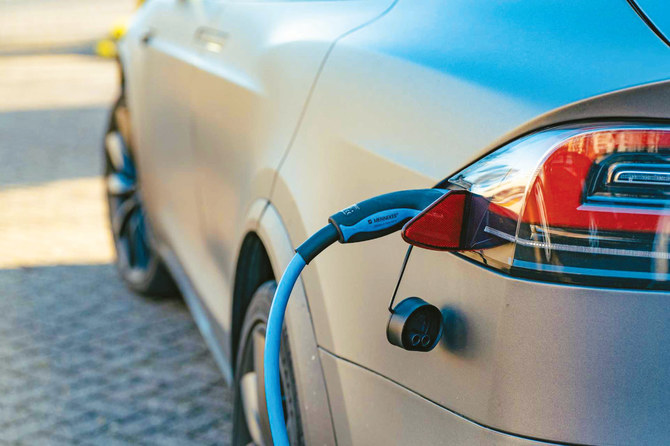
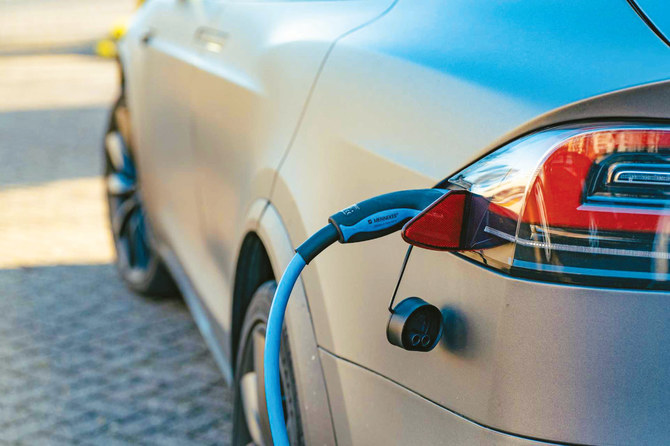
Egypt to start electric car production from mid-2022

El Nasr CEO Hani El-Khouly said that three types of electric car models made by the company will be available in Egypt, based on battery capacity. (Supplied)
Short Url
Updated 18 June 2021
Follow

Egypt to start electric car production from mid-2022

  • Thirteen electric vehicles will be tested on Egyptian streets from next month

CAIRO: Egypt will begin testing electric cars on the country’s streets from July, ahead of plans to launch full-scale production of the vehicles from mid-2022.

Thirteen imported electric vehicles will be tested on Egyptian streets from next month, Hisham Tawfik, minister of the Egyptian public enterprise sector, said while attending the launch of the Nasr E70 electric car.

Nine of the electric cars will be tested by drivers nominated by Uber, the global ride-hailing company, he added.

The Nasr E70 is scheduled to start production in mid-2022 with the El Nasr Automotive Manufacturing Company, an affiliate of the Ministry of Public Enterprise Sector’s Metallurgical Industries Company.

Tawfik said that the ministry began studying the electric car production project in mid-2019 as part of efforts to reform and develop its affiliated companies, including the revival of El Nasr Automotive Company.

FASTFACT

E70

The Nasr E70 is scheduled to start production in mid-2022 with the El Nasr Automotive Manufacturing Company.

The project is in line with the global move toward electric cars and aligns with President Abdel Fattah El-Sisi’s directives to localize the manufacture of vehicles used for clean energy.

The Dongfeng Corporation, one of the largest automobile producers in China, is partnering in the production of the Nasr E70 vehicle, the minister said.

An agreement between El-Nasr and Dongfeng was signed in June 2020 following months of negotiations.

The Ministry of Public Enterprise Sector recently released images of the first electric car of its kind in the country.

El Nasr CEO Hani El-Khouly said that three types of electric car models will be available in Egypt, based on battery capacity.

Batteries initially will be made in China, with production later shifting to Egypt.

Trials of the imported cars will continue for up to four months under a range of Egyptian conditions and with different drivers.

The Nasr E70 can reach a speed of 145 kilometers per hour and travel up to 400 km on a single charge.

El-Khouly said that a delegation from China will arrive in Egypt in July to follow up on the tests.

Government subsidy of the car will total about EGP50,000 ($13,333) to support the local market, he said.



First EU–Saudi roundtable on critical raw materials reflects shared policy commitment

Updated 16 January 2026
Follow

First EU–Saudi roundtable on critical raw materials reflects shared policy commitment

RIYADH: The EU–Saudi Arabia Business and Investment Dialogue on Advancing Critical Raw Materials Value Chains, held in Riyadh as part of the Future Minerals Forum, brought together senior policymakers, industry leaders, and investors to advance strategic cooperation across critical raw materials value chains.

Organized under a Team Europe approach by the EU–GCC Cooperation on Green Transition Project, in coordination with the EU Delegation to Saudi Arabia, the European Chamber of Commerce in the Kingdom and in close cooperation with FMF, the dialogue provided a high-level platform to explore European actions under the EU Critical Raw Materials Act and ResourceEU alongside the Kingdom’s aspirations for minerals, industrial, and investment priorities.

This is in line with Saudi Vision 2030 and broader regional ambitions across the GCC, MENA, and Africa.

ResourceEU is the EU’s new strategic action plan, launched in late 2025, to secure a reliable supply of critical raw materials like lithium, rare earths, and cobalt, reducing dependency on single suppliers, such as China, by boosting domestic extraction, processing, recycling, stockpiling, and strategic partnerships with resource-rich nations.

The first ever EU–Saudi roundtable on critical raw materials was opened by the bloc’s Ambassador to the Kingdom, Christophe Farnaud, together with Saudi Deputy Minister for Mining Development Turki Al-Babtain, turning policy alignment into concrete cooperation.

Farnaud underlined the central role of international cooperation in the implementation of the EU’s critical raw materials policy framework.

“As the European Union advances the implementation of its Critical Raw Materials policy, international cooperation is indispensable to building secure, diversified, and sustainable value chains. Saudi Arabia is a key partner in this effort. This dialogue reflects our shared commitment to translate policy alignment into concrete business and investment cooperation that supports the green and digital transitions,” said the ambassador.

Discussions focused on strengthening resilient, diversified, and responsible CRM supply chains that are essential to the green and digital transitions.

Participants explored concrete opportunities for EU–Saudi cooperation across the full value chain, including exploration, mining, and processing and refining, as well as recycling, downstream manufacturing, and the mobilization of private investment and sustainable finance, underpinned by high environmental, social, and governance standards.

From the Saudi side, the dialogue was framed as a key contribution to the Kingdom’s industrial transformation and long-term economic diversification agenda under Vision 2030, with a strong focus on responsible resource development and global market integration.

“Developing globally competitive mineral hubs and sustainable value chains is a central pillar of Saudi Vision 2030 and the Kingdom’s industrial transformation. Our engagement with the European Union through this dialogue to strengthen upstream and downstream integration, attract high-quality investment, and advance responsible mining and processing. Enhanced cooperation with the EU, capitalizing on the demand dynamics of the EU Critical Raw Materials Act, will be key to delivering long-term value for both sides,” said Al-Babtain.

Valere Moutarlier, deputy director-general for European industry decarbonization, and directorate-general for the internal market, industry, entrepreneurship and SMEs at European Commission, said the EU Critical Raw Materials Act and ResourceEU provided a clear framework to strengthen Europe’s resilience while deepening its cooperation with international partners.

“Cooperation with Saudi Arabia is essential to advancing secure, sustainable, and diversified critical raw materials value chains. Dialogues such as this play a key role in translating policy ambitions into concrete industrial and investment cooperation,” she added.