Pakistan’s election regulatory body alarmed by electoral reforms bill

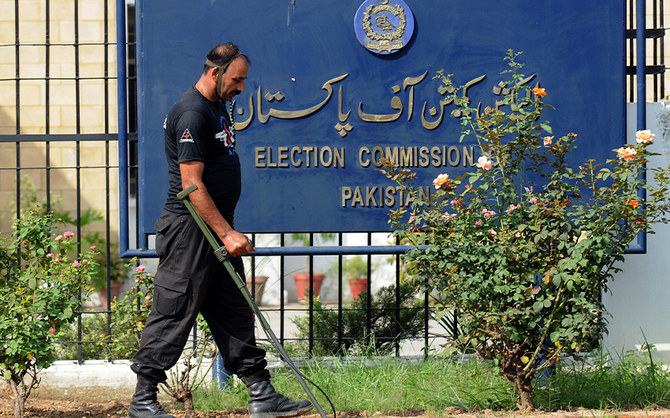
A Pakistan anti-terrorist force personal uses a metal detector to check the area of the Election Commission of Pakistan in Islamabad on August 26, 2008. (AFP/File)
Short Url
Updated 16 June 2021
Follow

Pakistan’s election regulatory body alarmed by electoral reforms bill

  • The Election Commission of Pakistan does not support 28 out of 62 proposed amendments to the system
  • The ECP believes the proposed amendments will dilute its constitutional powers and shift some of its authority to other federal institutions

ISLAMABAD: The Election Commission of Pakistan (ECP) has expressed its reservations over a bill passed by the National Assembly to reform the country’s electoral system, reported the local media on Wednesday.
“The extent of the ECP’s concern over the new electoral reforms bill can be gauged from the fact that ... it does not support 28 of the total 62 proposed amendments,” Dawn said in a news report.
The issue was taken up in a meeting chaired by the country’s chief election commissioner Sikandar Sultan Raja.
It was pointed out during the meeting that the ECP had recorded its objections to the bill, though its observations were ignored by the relevant parliamentary committee.
“The ECP ... fears the proposed amendments will dilute its constitutional powers and shift to NADRA [National Database Registration Authority] which is part of the federal government and not an independent body like the ECP,” Dawn reported.
According to a document compiled by the country’s election regulatory authority for internal circulation, the ECP maintains it is not possible to give voting rights to overseas Pakistanis in the absence of a parliamentary legislation.
It has also objected to the use of electronic voting machines until their performance and accuracy were established and it became clear they could be employed to conduct free and fair elections.
ECP officials have also refused to support the idea of delimiting constituencies based on the number of votes instead of population density as stated in the constitution.
Other than that, the electoral body has rejected an amendment which seeks to use NADRA’s data of registered IDs as electoral roll.
“ECP says the proposed amendment seeks to give the right of correction in the electoral roll to NADRA by taking it away from ECP which is mandated by the constitution to make any correction in the rolls as and when required,” the newspaper added.
Pakistan’s election commission is an independent, autonomous and permanent constitutional body that organizes federal and provincial elections.
It is also responsible for delimitation of constituencies and preparation of electoral rolls, according to Pakistan’s constitution.


Pakistan offers Arabian Sea trade routes to Russia, Central Asia, minister says

Updated 11 sec ago
Follow

Pakistan offers Arabian Sea trade routes to Russia, Central Asia, minister says

  • Islamabad pitches transit corridors linking Eurasia to global shipping lanes
  • Government invites foreign investment in Sukkur–Hyderabad M-6 motorway

ISLAMABAD: Pakistan is offering overland trade routes to Russia and landlocked Central Asian states through its Arabian Sea ports, Communications Minister Abdul Aleem Khan said on Thursday, positioning the country as a strategic transit hub as regional supply chains shift toward alternative corridors.

Pakistan has long sought to leverage its geography to connect landlocked Central Asian economies to warm-water ports, a strategy that has gained importance in recent years as countries explore routes that bypass traditional maritime chokepoints and longer shipping lanes. Islamabad promotes its ports at Karachi and Gwadar as gateways linking South Asia, the Middle East and Eurasia.

Speaking at the 88th session of the UN Economic Commission for Europe (UNECE) Inland Transport Committee in Geneva, Khan said Pakistan’s growing integration into Eurasian connectivity networks marked a new phase in regional trade cooperation.

“Pakistan’s strategic integration into the Belarus, Russia, and Central Asia corridors represents the dawn of a new era in regional connectivity,” he said, adding the country was providing “high-efficiency trade routes for Russia and landlocked Central Asian Republics.”

The minister said six land corridors were now facilitating transit trade, including routes via Türkiye, Azerbaijan and Iran, as well as China-Kazakhstan connectivity and Trans-Afghan links connecting Central Asian states to the Arabian Sea. He added that the Quadrilateral Traffic in Transit Agreement (QTTA) route could also expand northward.

He cited the transit of a Kazakh cargo shipment to the United Arab Emirates via Pakistan in June 2024 as proof of the country’s logistical viability for intercontinental trade.

Khan also pointed to more than 1,800 international TIR road-transit shipments — a UN customs system that allows sealed cargo trucks to cross borders without repeated inspections — as evidence of Pakistan’s operational readiness.

Central to Islamabad’s investment pitch was the proposed Sukkur–Hyderabad (M-6) motorway, a planned highway in southern Pakistan that would complete the country’s main north-south trade corridor linking ports on the Arabian Sea with inland and regional markets. Khan described it as a key missing link in Pakistan’s north-south transport backbone and an opportunity for foreign investors.

He said the project offered “nearly 30 percent guaranteed equity” and would significantly strengthen regional connectivity while generating predictable returns.

Pakistan has increasingly promoted infrastructure built under the China-Pakistan Economic Corridor (CPEC) as the backbone of its connectivity ambitions, arguing that improved road and logistics networks could transform the country into a transit economy rather than solely a destination market.

The government has also allocated a 100-acre terminal at Gwadar Port for Central Asian states and expanded visa-on-arrival access for citizens of 126 countries to facilitate business travel, according to the communications ministry.

Officials say digitalization of transport data and coordination with regional partners including Uzbekistan and Kazakhstan are aimed at making cross-border trade faster and compliant with international conventions.

Khan said the goal was to position Pakistan not merely as a transit territory but as “a proactive hub for global economic activity and a catalyst for a regional trade revolution.”