
NEW YORK: Reuters and the Minneapolis Star Tribune each won a Pulitzer Prize on Friday for journalism about racial inequities in US policing, while the New York Times and the Atlantic were honored for chronicling the COVID-19 pandemic, the two topics that dominated last year’s headlines.
The Star Tribune won the 2021 Pulitzer Prize for breaking news reporting for what the board called its “urgent, authoritative and nuanced” coverage of the murder of George Floyd at the hands of the police last May, while Reuters and the Atlantic shared the award for explanatory reporting.
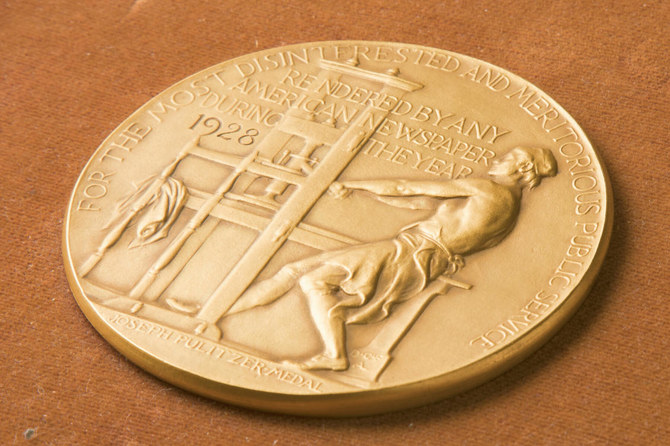
The Pulitzer Prizes are the most prestigious awards in American journalism and have been handed out since 1917, when newspaper publisher Joseph Pulitzer established them in a bequest to New York’s Columbia University in his will.
In 2020, “the nation’s news organizations faced the complexity of sequentially covering a global pandemic, a racial reckoning and a bitterly contested presidential election,” Mindy Marques, co-chair of the Pulitzer Board, said at the announcement ceremony, which was broadcast online.
The board cited Reuters reporters Andrew Chung, Lawrence Hurley, Andrea Januta, Jaimi Dowdell and Jackie Botts for the “pioneering data analysis” of their ‘Shielded’ series, which showed how an obscure legal doctrine of ‘qualified immunity’ shielded police who use excessive force from prosecution.
Reuters Editor-in-Chief Alessandra Galloni said in a statement that the series shaped the debate over how to reform American policing.
“In a year of tumultuous protest over police killings of Black Americans, ‘Shielded’ was a work of tremendous moral force about the intractable problem facing the world’s most powerful democracy, the legacy of racial injustice,” her statement said.
The Pulitzer Prize for Reuters, a unit of Thomson Reuters , was the newsroom’s ninth since 2008, and sixth in the last four years.
The Reuters team shared the explanatory reporting award with The Atlantic’s Ed Yong, who was praised by the board for “a series of lucid, definitive pieces on the COVID-19 pandemic.”
Teenager who recorded the murder of George Floyd in a clear and unrelenting single shot with her cellphone was recognized on Friday by the arbiters of the highest honors in US journalism.
The Pulitzer Board awarded Darnella Frazier a special citation for a video she said has haunted her ever since, showing Floyd's death beneath the knee of Derek Chauvin, a white Minneapolis policeman. Chauvin was convicted of murdering Floyd in a trial during which Frazier's video was played repeatedly.
PULITZERS HONOR DARNELLA FRAZIER FOR CELLPHONE VIDEO OF GEORGE FLOYD MURDER
The citation at the 2021 Pulitzer Prize ceremony is a rare instance of the board recognizing the journalistic achievement of someone with no professional experience in the field, a striking distinction in the genre sometimes known as citizen journalism.
Frazier, 18, was recognized for recording a “transformative video that jolted viewers and spurred protests against police brutality around the world, Mindy Marques,” co-chair of the Pulitzer Board, said at Friday's online announcement ceremony.
Frazier's video shows Chauvin kneeling on the neck of Floyd, a 46-year-old Black man in handcuffs, for about 9 minutes while arresting him on suspicion of using a fake $20 bill on May 25, 2020. Floyd begs for his life before dying on the Minneapolis road.
Frazier has rarely discussed the video she made, but she testified for the prosecution at Chauvin's murder trial this year, where members of Floyd's family were sometimes seen averting their gaze each time her video was replayed.
She told jurors that she was taking her nine-year-old cousin to buy snacks when she saw “a man terrified, scared, begging for his life,” and so pulled out her cellphone and hit record. She uploaded the video to Facebook later that night, where it would be watched by millions of people around the world.
A SINGLE CASE
Reuters’ series of policing stories were sparked by a single case — and took a lengthy, complex data analysis to complete.
In April 2017, the US Supreme Court declined to revive an unarmed suspect’s lawsuit accusing a Houston officer of unconstitutional excessive force for shooting him in the back. Reuters Supreme Court reporters Chung and Hurley teamed up with data reporters Januta, Dowdell and Botts. They analyzed hundreds of cases and found that since 2005, the courts have shown an increasing tendency to grant immunity in excessive force cases. They then chronicled in detail the cases of a range of police-violence victims who had been denied justice even after courts found that officers had acted too violently.
The first Reuters story was published just a few weeks before the murder of Floyd, a 46-year-old Black man who died in handcuffs as a white Minneapolis police officer knelt on his neck. The reporting had broad impact on the national conversation about the problems of US policing.
“The data that we came up with was cited in almost every major news organization in the immediate aftermath of the George Floyd killing,” said Hurley, adding it has also been cited in court filings and informally by judges.
SPECIAL CITATION
Many of the 2021 Pulitzer Prizes went for coverage of policing and the global protest movement that erupted after Floyd’s murder: the Associated Press won the breaking news photography award for its images of the protests, while Robert Greene of the Los Angeles Times won for editorial writing for his work on bail reform and prisons.
The board also said it was awarding a “special citation” to Darnella Frazier, the teenaged bystander who recorded video of Floyd’s murder on her cellphone, which it said highlighted “the crucial role of citizens in journalists’ quest for truth and justice.”
The New York Times won the public service journalism honor, often seen as the most coveted of the 22 prizes, for its “prescient and sweeping coverage of the coronavirus pandemic.” The Boston Globe won for investigative reporting for uncovering a systematic failure by state governments to share information about dangerous truck drivers that could have kept them off the road.
Friday’s announcement of the prizes, most worth $15,000 each, had been postponed from April amid the pandemic. The awards luncheon, which normally takes place soon after at Columbia University, has been postponed until autumn.
The Pulitzer Board also recognizes achievements in seven categories in the arts, and awarded its fiction prize to Louise Erdrich for her novel “The Night Watchman” about an effort to displace Native American tribes in the 1950s.