JERUSALEM: The new Israeli government set to end Benjamin Netanyahu’s 12-year tenure as prime minister signed its final coalition agreements on Friday, pointedly including term limits.
The coalition of parties from far-right to left is expected to focus mostly on economic and social issues rather than risk exposing internal rifts by trying to address major diplomatic issues such as the Israeli-Palestinian conflict.
Netanyahu, Israel’s longest-serving leader, will be succeeded on Sunday by a coalition that includes for the first time a party from Israel’s Arab minority.
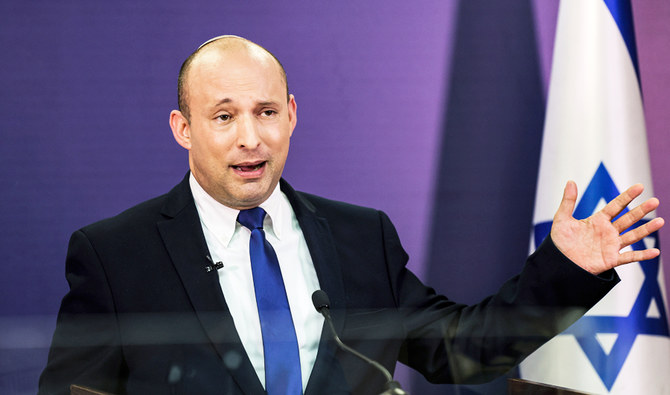
Under a power-sharing agreement, Naftali Bennett, of the ultra-nationalist Yamina (Rightwards) party, will serve as prime minister for two years.
Bennett on Friday said the coalition “brings to an end two and a half years of political crisis,” although it was unclear how long the coalition’s disparate elements would hold together.
He will then hand over to Yair Lapid of the centrist Yesh Atid (There is a Future) party.
Among the agreements outlined by parties in what Lapid described as a “unity government” are:
•Limiting the prime minister’s term of office to two terms, or eight years.
•An infrastructure push to include new hospitals, a new university and a new airport.
•Passing a two-year budget to help stabilize the country’s finances — the prolonged political stalemate has left Israel still using a pro-rated version of a base 2019 budget that was ratified in mid-2018.
•Maintaining the “status-quo” on issues of religion and state, with Bennett’s Yamina party to have a veto. Possible reforms include breaking up an ultra-Orthodox monopoly on overseeing which foods are kosher, and decentralizing authority over Jewish conversions.
•An “overall plan for transportation” in the Israeli- occupied West Bank.
•A general goal to “ensure Israel’s interests” in areas of the West Bank under full Israeli control.
•Allocating more than 53 billion shekels ($16 billion) to improve infrastructure and welfare in Arab towns, and curbing violent crime there.
•Decriminalizing marijuana and moving to regulate the market.
After a quarter-century at the highest levels of Israeli politics, no one expects the 71-year-old Netanyahu, dubbed the “King of Israel” by his supporters, to quietly retire to his private home in the seaside town of Caesarea.
As opposition leader and the head of the largest party in parliament, Netanyahu is expected to continue doing everything in his power to bring down the government.
His best hope for avoiding conviction on serious corruption charges is to battle them from the prime minister’s office, with a governing coalition that could potentially grant him immunity. But his domineering presence could continue to bind his opponents together.


Israel’s new government seals coalition deals as Netanyahu era nears end
https://arab.news/8r9wf
Israel’s new government seals coalition deals as Netanyahu era nears end

- Under a power-sharing agreement, Naftali Bennett, of the ultra-nationalist Yamina party, will serve as PM for two years


Israeli military says unintentionally struck UN agency truck in Gaza
- “Our teams are taking extraordinary risks every day to keep humanitarian operations and life-sustaining services running,” UNOPS Executive Director Jorge Moreira da Silva said in a statement, calling for an investigation into the incident
TEL AVIV: Israel’s military said on Friday that a “firing component” launched by its navy unintentionally struck a fuel truck belonging to a United Nations agency in Gaza the previous day, an incident that prompted the agency to publicly call for a full investigation.
The United Nations Office for Project Services, which oversees fuel distribution in Gaza, said that the empty fuel truck was struck on Thursday around 5 a.m. from the direction of the sea, causing damage to the vehicle. There were no injuries.
“Our teams are taking extraordinary risks every day to keep humanitarian operations and life-sustaining services running,” UNOPS Executive Director Jorge Moreira da Silva said in a statement, calling for an investigation into the incident.
“They should not have to do that under fire,” he said.
In response to Reuters questions, the Israeli military said that the incident occurred during defensive naval activity, and that a firing component deviated from its intended trajectory.
The fuel truck sustained “minor damage,” the military said in a statement. The military did not say what type of munitions had been fired, or what had been the navy’s intended target.
“The incident was reviewed, and lessons were learned accordingly,” it said, without providing further details.
The fuel truck had been on its way to the Kerem Shalom crossing when it was struck, and the truck’s movements had been coordinated with Israeli authorities in advance, UNOPS said.


