PARIS: French soldiers have killed a Malian jihadist suspected of being responsible for the kidnapping and deaths of two French journalists in 2013, Defense Minister Florence Parly said Friday.
Parly said French forces in the Sahel region killed “four terrorists” during an operation in northern Mali on June 5, including Bayes Ag Bakabo, the prime suspect in the deaths of RFI radio reporters Ghislaine Dupont and Claude Verlon.
“His neutralization means the end of a long wait,” Parly said, adding that Bakabo was in the village of Aguelhok and was preparing an attack against UN peacekeeping forces when he was killed.
Dupont and Verlon, both in their 50s and veteran journalists for RFI, were seized in the flashpoint northern Malian town of Kidal in November 2013 after interviewing a separatist Tuareg leader.
Their bullet-riddled bodies were found few hours later, with the Al-Qaeda in the Islamic Maghreb (AQIM) group later claiming the killings as revenge for France’s decision to intervene against jihadist groups in the country earlier that year.
A French investigation into the murders concluded that Bakabo, also a known drug trafficker, drove the pick-up truck used to kidnap the two journalists.
Parly expressed her “thoughts for the family and loved ones of Ghislaine Dupont and Claude Verlon.”
The exact circumstances of their deaths have never been revealed, and relatives charge that military secrecy has hampered efforts toward that end.
In November, Agnes Callamard, the UN Special Rapporteur on extrajudicial, summary or arbitrary executions, noted that “the alleged perpetrators have been named but are yet to be arrested and prosecuted.”
Callamard pressed the governments of France and Mali “to advance the investigation without further delay so that justice may be served.”
On Friday, Parly said the operation “illustrates one of the main priorities of France in the Sahel region: taking down the main heads of terrorist groups that are causing havoc in the region.”
The news of Bakabo’s death emerged just a day after French President Emmanuel Macron announced a drawdown of French troops in the Sahel region, who number 5,100 in bases across the arid and volatile region on the southern fringe of the Sahara desert.
Macron did not give figures for the drawdown, but he made clear he wanted future French involvement to be limited to counter-terror operations and be part of a multi-nation European force.
“The objective stays the same: France remains committed to the fight against international terrorism, besides Sahelian countries and for the security of Europe and French people,” Parly said.
The Sahel is seen by many Western politicians and experts as a major global security risk because of the growing strength of jihadist groups there, as well as its role as a crossroads for arms and people-smuggling.
Journalists covering the insurgency in the Sahel often find themselves targeted by armed groups, either because of their reporting or for their ransom value.
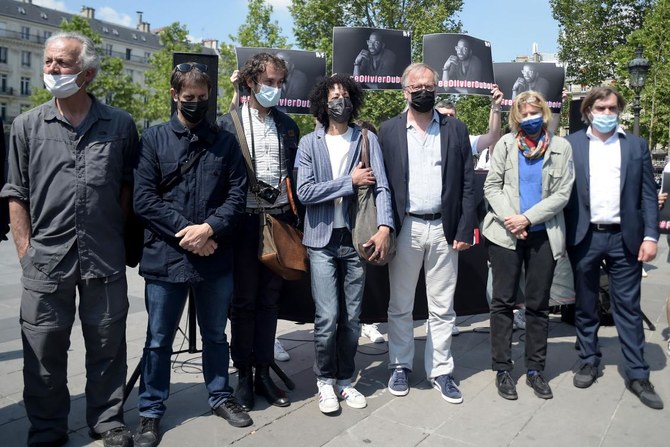
French reporter Olivier Dubois, 46, disappeared in April and is believed to be in the hands of the Group to Support Islam and Muslims (GSIM), the biggest jihadist alliance in the Sahel.
The 46-year-old freelancer was in the northern Malian town of Gao, where he had traveled to interview a Qaeda-linked jihadist commander.
Last year, French soldiers serving in the Barkhane force killed the head of AQIM, Abdelmalek Droukdel, in a major breakthrough, while regular air strikes target other senior commanders.
Another senior AQIM figure linked to the murder of the RFI journalists, Amada Ag Hama, was killed in a raid in northern Mali in May 2015.

French army kills Mali jihadist linked to journalist murders
Short Url
https://arab.news/9kw8r
French army kills Mali jihadist linked to journalist murders
- French forces in the Sahel region killed "four terrorists" during an operation in northern Mali on June 5
- Bayes Ag Bakabo was in Aguelhok village and preparing an attack against UN peacekeeping forces when he was killed
EU, India successfully conclude major trade deal: New Delhi
- Indian government officials say the pact, which was two decades in the making, will be unveiled Tuesday
- European Commission President Ursula von der Leyen and European Council president Antonio Costa appear as guests of honor at India’s Republic Day parade
NEW DELHI: India and the European Union have finalized a massive free trade deal, Indian government officials said on Monday, about two decades after negotiations were first launched.
Facing challenges from China and the United States, Brussels and New Delhi have sought closer ties, producing a pact that is to be unveiled in the Indian capital on Tuesday.
Feted Monday as guests of honor at India’s Republic Day parade, European Commission President Ursula von der Leyen and European Council president Antonio Costa are to meet Indian Prime Minister Narendra Modi for a summit.
“Official level negotiations are being concluded and both sides are all set to announce the successful conclusion” of talks at the Tuesday summit, Indian commerce secretary Rajesh Agrawal told AFP.
The EU has eyed India — the world’s most populous nation — as an important market for the future, while New Delhi sees the European bloc as an important source of much-needed technology and investment to rapidly upscale its infrastructure and create millions of new jobs.
’Mother of all deals’
Bilateral trade in goods reached 120 billion euros ($139 billion) in 2024, an increase of nearly 90 percent over the past decade, according to EU figures, with a further 60 billion euros ($69 billion) in trade in services.
India’s Commerce Minister Piyush Goyal has described the new pact as “the mother of all deals.”
“Final negotiations have been focused and fruitful, and we are now very optimistic that we will land this historic trade deal,” an EU official said Monday speaking on condition of anonymity.
Under the agreement, India is expected to ease market access for key European products, including cars and wine, in return for easier exports of textiles and pharmaceuticals, among other things.
“The EU stands to gain the highest level of access ever granted to a trade partner in the traditionally protected Indian market,” von der Leyen said on Sunday, adding that she expected exports to India to double.
“We will gain a significant competitive advantage in key industrial and agri-good sectors.”
Talks went down to the wire on Monday, focusing on a few sticking points, including the impact of the EU’s carbon border tax on steel, according to sources familiar with the discussions.
The accord comes as both Brussels and New Delhi have sought to open up new markets in the face of US tariffs and Chinese export controls.
India and the EU were also expected to conclude an accord to facilitate movement for seasonal workers, students, researchers and highly skilled professionals, and a security and defense pact.
“India and Europe have made a clear choice. The choice of strategic partnership, dialogue and openness,” von der Leyen wrote on social media. “We are showing a fractured world that another way is possible.”
New Delhi, which has relied on Moscow for key military hardware for decades, has tried to cut its dependence on Russia in recent years by diversifying imports and pushing its own domestic manufacturing base.
Europe is doing the same with regard to the United States.
Facing challenges from China and the United States, Brussels and New Delhi have sought closer ties, producing a pact that is to be unveiled in the Indian capital on Tuesday.
Feted Monday as guests of honor at India’s Republic Day parade, European Commission President Ursula von der Leyen and European Council president Antonio Costa are to meet Indian Prime Minister Narendra Modi for a summit.
“Official level negotiations are being concluded and both sides are all set to announce the successful conclusion” of talks at the Tuesday summit, Indian commerce secretary Rajesh Agrawal told AFP.
The EU has eyed India — the world’s most populous nation — as an important market for the future, while New Delhi sees the European bloc as an important source of much-needed technology and investment to rapidly upscale its infrastructure and create millions of new jobs.
’Mother of all deals’
Bilateral trade in goods reached 120 billion euros ($139 billion) in 2024, an increase of nearly 90 percent over the past decade, according to EU figures, with a further 60 billion euros ($69 billion) in trade in services.
India’s Commerce Minister Piyush Goyal has described the new pact as “the mother of all deals.”
“Final negotiations have been focused and fruitful, and we are now very optimistic that we will land this historic trade deal,” an EU official said Monday speaking on condition of anonymity.
Under the agreement, India is expected to ease market access for key European products, including cars and wine, in return for easier exports of textiles and pharmaceuticals, among other things.
“The EU stands to gain the highest level of access ever granted to a trade partner in the traditionally protected Indian market,” von der Leyen said on Sunday, adding that she expected exports to India to double.
“We will gain a significant competitive advantage in key industrial and agri-good sectors.”
Talks went down to the wire on Monday, focusing on a few sticking points, including the impact of the EU’s carbon border tax on steel, according to sources familiar with the discussions.
The accord comes as both Brussels and New Delhi have sought to open up new markets in the face of US tariffs and Chinese export controls.
India and the EU were also expected to conclude an accord to facilitate movement for seasonal workers, students, researchers and highly skilled professionals, and a security and defense pact.
“India and Europe have made a clear choice. The choice of strategic partnership, dialogue and openness,” von der Leyen wrote on social media. “We are showing a fractured world that another way is possible.”
New Delhi, which has relied on Moscow for key military hardware for decades, has tried to cut its dependence on Russia in recent years by diversifying imports and pushing its own domestic manufacturing base.
Europe is doing the same with regard to the United States.
© 2026 SAUDI RESEARCH & PUBLISHING COMPANY, All Rights Reserved And subject to Terms of Use Agreement.


