

Russia fines Facebook, Telegram over banned content

1 / 2
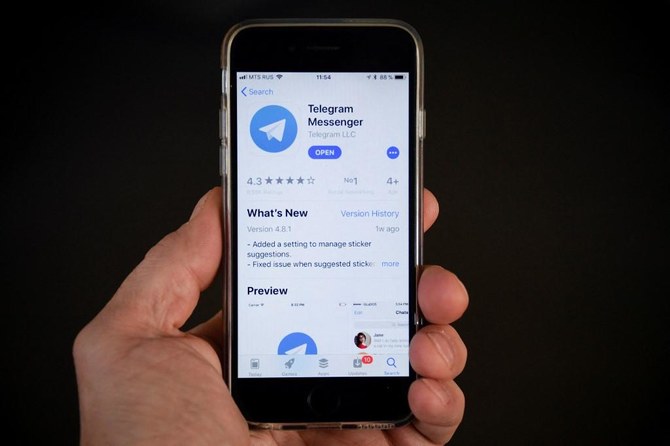
The move could be part of growing government efforts to tighten control over social media platforms amid political dissent. (File/AFP)
2 / 2
The Russian government’s efforts to tighten control of the Internet and social media date back to 2012. (File/AFP)
Short Url
Updated 11 June 2021
Follow

Russia fines Facebook, Telegram over banned content

  • Russia orders Facebook and Telegram to pay a fine of $236,000 and $139,000, respectively, for failing to remove banned content.
  • This is the second time both companies have been fined in recent weeks.

MOSCOW: Russian authorities on Thursday ordered Facebook and the messaging app Telegram to pay steep fines for failing to remove banned content, a move that could be part of growing government efforts to tighten control over social media platforms amid political dissent.

A Moscow court fined Facebook a total of 17 million rubles (roughly $236,000) and Telegram 10 million rubles ($139,000). It wasn’t immediately clear what type of content the platforms failed to take down.

It was the second time both companies have been fined in recent weeks. On May 25, Facebook was ordered to pay 26 million rubles ($362,000) for not taking down content deemed unlawful by the Russian authorities. A month ago, Telegram was also ordered to pay 5 million rubles ($69,000) for not taking down calls to protest.

Earlier this year, Russia’s state communications watchdog Roskomnadzor started slowing down Twitter and threatened it with a ban, also over its alleged failure to take down unlawful content. Officials maintained the platform failed to remove content encouraging suicide among children and containing information about drugs and child pornography.

The crackdown unfolded after Russian authorities criticized social media platforms that have been used to bring tens of thousands of people into the streets across Russia this year to demand the release of jailed Russian opposition leader Alexei Navalny, President Vladimir Putin’s most well-known critic. The wave of demonstrations has been a major challenge to the Kremlin.

Officials alleged that social media platforms failed to remove calls for children to join the protests. Putin has urged police to act more to monitor social media platforms and to track down those who draw children into “illegal and unsanctioned street actions.”

The Russian government’s efforts to tighten control of the Internet and social media date back to 2012, when a law allowing authorities to blacklist and block certain online content was adopted. Since then, a growing number of restrictions targeting messaging apps, websites and social media platforms have been introduced in Russia.

The government has repeatedly aired threats to block Facebook and Twitter, but stopped short of outright bans — probably fearing the move would elicit too much public outrage. Only the social network LinkedIn, which wasn’t very popular in Russia, has been banned by authorities for its failure to store user data in Russia.

In 2018, Roskomnadzor moved to block Telegram over its refusal to hand over encryption keys used to scramble messages, but failed to fully restrict access to the app, disrupting hundreds of websites in Russia instead. Last year, the watchdog officially withdrew the demands to restrict the app, which continued to be widely used despite the ban, including by government institutions.


Saudi Arabia strengthens global ranking in 2026 Soft Power Index

Updated 20 January 2026
Follow

Saudi Arabia strengthens global ranking in 2026 Soft Power Index

  • UAE maintains 10th place, Qatar climbs 2 spots

DUBAI: Saudi Arabia climbed three positions to 17th place in this year’s Soft Power Index, released on Tuesday by marketing consultancy Brand Finance.

Other Gulf nations also performed well, with the UAE maintaining its 10th-place ranking and Qatar and Bahrain each climbing two spots to No. 20 and No. 49, respectively, marking a rebound for the region after a softer showing in 2025.

The report indicates that the performance reflects sustained investment in proactive diplomacy, economic diversification and expanded initiatives across culture, tourism and sports.

It also comes at a time when several Western powers are recording declines in their rankings, highlighting the growing influence of Gulf states.

“The UAE remains a clear regional leader, while Saudi Arabia and Qatar have strengthened their global positions through focused economic diplomacy and international engagement,” said Savio D’Souza, managing director for the Middle East and Africa, Brand Finance.

Saudi Arabia and the UAE either maintained or improved their rankings across all key pillars, including familiarity, reputation and influence.

The Kingdom recorded notable gains, with increases of 25 points in the People & Values pillar and 12 points in the Culture & Heritage pillar.

“Although perceptions across some markets remain mixed, renewed upward movement in the rankings suggests that targeted, long-term soft power strategies are beginning to pay off,” D’Souza said.

Globally, the US retained its top position despite recording the steepest overall decline in its score, followed by China in second place. Japan rose to third place, overtaking the UK, which ranked fourth, while Germany placed fifth.

Brand Finance defines “soft power” as a “nation’s ability to influence the preferences and behaviors of various actors in the international arena (states, corporations, communities, publics, etc.) through attraction and persuasion rather than coercion.” 

Each nation is assessed across 55 individual metrics, producing an overall score out of 100 and a ranking from first to 193rd.