India’s Bihar state revises COVID-19 death count, up by 70 percent

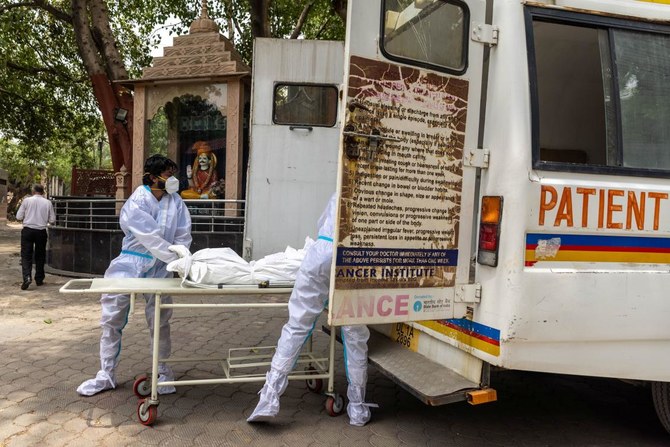
Health experts say many COVID-19 fatalities remain unrecorded in India, more so during the latest surge in April and May, when hospitals ran unbearably full and oxygen supplies were low. (Reuters)
Short Url
Updated 11 June 2021
Follow

India’s Bihar state revises COVID-19 death count, up by 70 percent

  • Officials says that 3,951 unreported fatalities had occurred in May
  • Overall, India’s cases and deaths have fallen steadily in the past weeks

NEW DELHI: The Indian state of Bihar has increased its COVID-19 death toll after the discovery of thousands of unreported cases, raising concerns that many more fatalities were not officially recorded.
The health department in Bihar, one of the poorest states, on Thursday revised its COVID-19 fatality count to more than 9,429 from 5,424 – a jump of more than 70 percent.
Officials said the 3,951 unreported fatalities had occurred in May and reflect “deaths reported at private hospitals, in transit to health facilities, under home isolation and those dying of post COVID-19 complications.”
Health experts say many COVID-19 fatalities remain unrecorded in India, more so during the latest surge in April and May, when hospitals ran unbearably full and oxygen supplies were low.
India’s federal ministers from the ruling Bharatiya Janata Party have dismissed reports of undercounting as exaggerated and misleading. In the past, states like Maharashtra and Tamil Nadu have also recalibrated death numbers.
Overall, India’s cases and deaths have fallen steadily in the past weeks.
The 91,702 cases added in the past 24 hours pushed India’s total to more than 29.3 million on Friday, second only to the United States. The Health Ministry also reported 3,403 fatalities in the past 24 hours, raising the overall death toll to 363,079.


Army chief says Switzerland can’t defend itself from full-scale attack

Updated 2 sec ago
Follow

Army chief says Switzerland can’t defend itself from full-scale attack

ZURICH: Switzerland cannot defend itself against a full-scale attack and must boost military spending given rising risks from Russia, the head of ​its armed forces said.
The country is prepared for attacks by “non-state actors” on critical infrastructure and for cyberattacks, but its military still faces major equipment gaps, Thomas Suessli told the NZZ newspaper.
“What we cannot do is defend against threats from a distance or even a full-scale ‌attack on ‌our country,” said Suessli, who is ‌stepping ⁠down ​at ‌the end of the year.
“It’s burdensome to know that in a real emergency, only a third of all soldiers would be fully equipped,” he said in an interview published on Saturday.
Switzerland is increasing defense spending, modernizing artillery and ground systems ⁠and replacing aging fighter jets with Lockheed Martin F-35As.
But the ‌plan faces cost overruns, while ‍critics question spending on artillery ‍and munitions amid tight federal finances.
Suessli said ‍attitudes toward the military had not shifted despite the war in Ukraine and Russian efforts to destabilize Europe.
He blamed Switzerland’s distance from the conflict, its lack of ​recent war experience and the false belief that neutrality offered protection.
“But that’s historically ⁠inaccurate. There are several neutral countries that were unarmed and were drawn into war. Neutrality only has value if it can be defended with weapons,” he said.
Switzerland has pledged to gradually raise defense spending to about 1 percent of GDP by around 2032, up from roughly 0.7 percent now – far below the 5 percent level agreed by NATO countries.
At that pace, the Swiss military would only be ‌fully ready by around 2050.
“That is too long given the threat,” Suessli said.