India to ease lockdown rules as coronavirus case numbers decline

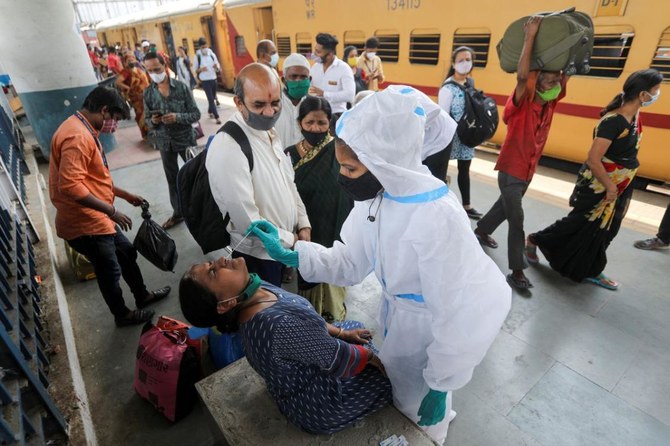
A health worker in personal protective equipment (PPE) collects a swab sample from a woman during a rapid antigen testing campaign for the coronavirus disease (COVID-19) in Mumbai. (File/Reuters)
Short Url
Updated 06 June 2021
Follow

India to ease lockdown rules as coronavirus case numbers decline

  • India has the world’s second-largest number of coronavirus infections after the United States
  • Scientists have warned of a third wave of the coronavirus

NEW DELHI: India reported 114,460 new coronavirus infections on Sunday, the lowest in two months, while the death toll increased by 2,677, as parts of the country prepared to ease movement restrictions.

India has the world’s second-largest number of coronavirus infections after the United States with total cases at 28.8 million, according to health ministry data. The country has suffered 346,759 deaths.

A second wave of the coronavirus that has largely battered the rural interiors of the country is yet to abate but New Delhi and other cities are working toward allowing more businesses to operate and movement rules to be relaxed from Monday onwards.

The western state of Maharashtra, which is India’s richest and has suffered the most infections during the second wave, plans to start this week easing in stages a strict lockdown imposed in April.

Scientists have warned of a third wave of the coronavirus that could hit India later in the year, likely impacting children more.

While the country has ramped up its vaccination drive in the past few weeks after a slow start, a majority of its 1.3 billion people are expected to remain unvaccinated by the time a potential third wave hits.


Voting passes peacefully in Nepal’s first election since September youth-led protests

Updated 6 sec ago
Follow

Voting passes peacefully in Nepal’s first election since September youth-led protests

KARMANDU: Voting was peaceful in Nepal’s first nationwide election Thursday since a violent, youth-led uprising forced the government from power in September.
Turnout was about 60 percent and only a few minor incidents were reported, according to Nepal’s acting Chief Election Commissioner Ram Prasad Bhandari.
Vote counting would begin immediately after the ballot boxes are collected and transported to counting centers across the Himalayan nation, which could be as early as Thursday night. Results were expected by the weekend. Helicopters will be used to ferry the boxes from polling stations in remote mountain villages in the northern region by Friday morning, Bhandari said.
The next administration is expected to inherit daunting challenges. It must deliver on changes demanded by last year’s protests, tackle entrenched corruption and carefully manage ties with its powerful neighbors, India and China.
“I came to vote mainly because of the protest and so many people gave their lives in the hope of a change, in hope of seeing better Nepal,” said Luniva, a first-time voter. “Hopefully, I want to see my country become better by all the sacrifices that have been made.”
Others shared similar hopes that the election could usher in positive change after months of political unrest.
Voters are directly electing 165 members to the House of Representatives, the lower chamber of Parliament. The remaining 110 seats in the 275-member body will be allocated through a proportional representation system, under which political parties nominate lawmakers based on their share of the vote.
The election is widely seen as a three-way contest, shaped by voter frustration over widespread corruption and demands for greater government accountability.
The National Independent Party, founded in 2022, is considered the front-runner, posing a strong challenge to two long-dominant parties: the Nepali Congress and the Communist Party of Nepal (Unified Marxist–Leninist).
The new party’s prime ministerial candidate is rapper-turned-politician Balendra Shah, who won the 2022 Katmandu mayoral race and emerged as a leading figure in the 2025 uprising that ousted former Prime Minister Khadga Prasad Oli.
Shah, 35, has rode a wave of public anger toward traditional political parties. He highlighted health and education for poor Nepalis as a key focus of his campaign.
The protests against corruption and poor governance were triggered by a social media ban before snowballing into a popular revolt against the government. Dozens were killed and hundreds injured when protesters attacked government buildings and police opened fire on them.
While the Congress and the Communists retain loyal voter bases, Shah’s party has drawn larger crowds on the campaign trail, highlighting its growing appeal among younger voters seeking an alternative.
There are about 19 million registered voters among the country’s nearly 30 million people, according to the Election Commission of Nepal.
Millions of Nepalis living overseas are unable to take part in the vote. An estimated 3 million citizens work abroad — largely in the Middle East, Southeast Asia and neighboring India — and cannot cast ballots because the country does not yet have a system allowing voting from abroad.