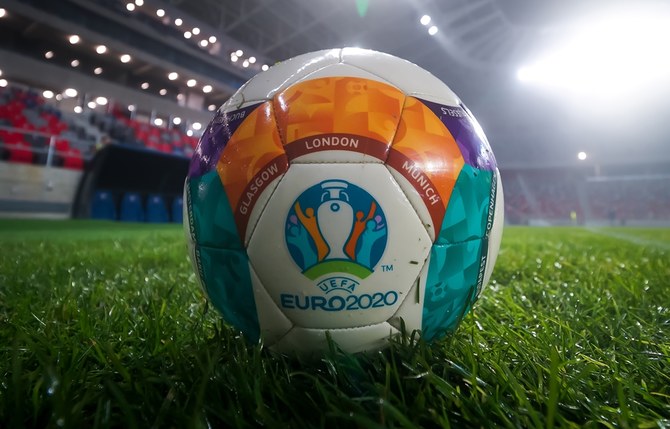
Police unveil hooligan-busting Euro 2020 hub

Fewer hooligans will travel to Euro 2020 amid Covid restrictions while European police Thursday unveiled a special operations hub in Netherlands where officers from 24 nations will monitor threats from Europol’s control room. (Shutterstock)
Short Url
Updated 10 June 2021
Follow

Police unveil hooligan-busting Euro 2020 hub

  • Officers from 24 participating nations across 11 countries will monitor threats from the Europol’s control room
  • A senior Dutch police officer, because of Covid rules, expect the number of hooligans to be limited

THE HAGUE: Fewer hooligans will travel to Euro 2020 because of Covid restrictions but they will be more difficult to trace, European police warned Thursday as they unveiled a special operations hub in the Netherlands.
Officers from each of the 24 nations playing in the tournament across 11 countries will spend the next month monitoring threats from the control room at the EU’s police agency Europol in The Hague.
Beneath giant screens, with desks arranged according to their countries’ Euro 2020 groups, the 40 or so officers will be able to quickly share information and prevent trouble.
“Until now it’s still quiet at the front, but we are alert,” Max Daniel, the senior Dutch police officer in charge of the operations center, told a press conference at Europol.
“Because of the Covid rules we expect not so high a number of supporters at all, so I think the number of hooligans will be limited as well,” he added.
“But still it’s very difficult for us because of the Covid rules. Most of them will travel by car, and there will be a lot more movements... because of the fact that we play in several countries.”
Europol chief Catherine De Bolle said this year’s tournament was a security challenge of “unprecedented complexity.”
“The operations center is prepared to react to any criminal threat which may endanger the smooth flow of the competition,” De Bolle added.
Europol said it would also be monitoring other types of threats and crime during the tournament, including cybercrime and match-fixing and even fake Covid travel certificates.
Enforcing local Covid regulations will remain the responsibility of host nations.
But if there was “special information about groups that are willing to organize parties around stadiums we will give them information,” said Dutch policeman Daniel.
Inside the control room, set up in a large auditorium inside Europol’s granite-grey HQ, officers from each country sit at desks monitoring and collating information.
A total of 40 officers will work in a shift system covering all the match days and also being on call during the night.
“Of course the focus is on the Covid-19 issues. But we mustn’t forget the fact that we still have to face the hooliganism,” said Romanian police officer Adrian Dinca, one of the coordinators.
“It has not disappeared, it is still there.”
Britain is one of the countries running the center along with Romania and the Netherlands, despite its departure from the EU and therefore from Europol.
The three UK home nations of England, Scotland and Wales are all taking part in the tournament, and the final is at London’s Wembley stadium on July 11.
“Brexit has no impact whatsoever on the really important business that we do with other countries,” said Adrian Roberts of the UK Football Policing Unit.
“If we were to lose that overnight because of the perception that Brexit means we can no longer share intelligence and information, we’d be taking a lot of steps backwards.”
To prevent trouble, the hub will work with police “spotters” in each of the countries who gain intelligence on hooligans, officials said.
If trouble kicks off, officers will set up a “crisis room” with the countries involved.
But which team do the police officers think will win the tournament?
“We don’t have intelligence on that yet!” said Dinca.


From Riyadh to Toronto: World Cup diplomacy in motion

Updated 12 sec ago
Follow

From Riyadh to Toronto: World Cup diplomacy in motion

  • FIFA World Cup can help drive Saudi-Canadian relations, ambassador says
  • Canada ready to ‘welcome the world,’ Jean-Philippe Linteau says

RIYADH: As Canada prepares to co-host the FIFA World Cup, its ambassador to Saudi Arabia says the tournament will be not only a celebration of football but also a platform to deepen ties between Ottawa and Riyadh.

“It’s such an honor for Canada to be the host this year of the FIFA World Cup with our friends from the United States and Mexico,” Jean-Philippe Linteau told Arab News.

“The World Cup is the most important sporting event in the world.”

Canada hosted the women’s World Cup in 2015 and now turns its attention to the men’s competition, highlighting what the envoy described as its growing footprint in global football.

“Canada is already one of the world’s most open countries. We welcome the world. Our population is multicultural. You come to Canada, you find a whole world among Canadians,” he said.

“Hosting this event is just a natural extension of our welcoming nature.”

Linteau said fans traveling to Canada would enjoy a safe and fun experience and that the tournament would continue to promote the country long after the final whistle.

“We hope that the world will come to Canada … and continue to come for years after that because it’s a great way to showcase our country and everything we have to offer.”

The ambassador praised the Kingdom’s growing role in international sport and its transformation under Vision 2030.

“Saudi Arabia is not just influential in global football. I would say in global sports in general, including esports. What the Kingdom has done has been noticed all over the world,” he said.

Linteau said he remembered when Erin Routliffe and Gaby Dabrowski won the women’s tennis doubles title at the WTA Finals in 2024.

“I was very proud to be here in Riyadh for that,” he said, describing the event as an example of Saudi Arabia’s ambition to become a global sports hub.

He also congratulated the Saudi football team on qualifying for the World Cup and expressed hope that the two nations might meet later in the tournament.

“While the Saudi team is not going to play in Canada for the first round, we hope that we’re going to meet in subsequent rounds for some matches,” he said.

“When it comes to sports, it’s a natural convening mechanism.”

Linteau highlighted Canada’s support for developing sports in the Kingdom, particularly in disciplines where it has recognized expertise.

“In Canada, we have two national sports — lacrosse and ice hockey. In both those cases, Canadians have been in the Kingdom to support the establishment of these teams,” he said.

“We were very proud to be part of that. You can’t start being good at a sport … you have to crawl and then you walk and then you run.”

Sport was a powerful diplomatic tool, he said.

“It helps to build people-to-people ties. It helps youth and others to connect with each other, to meet and to share experiences,” he said.

With Saudi Arabia hosting an increasing number of international tournaments, Linteau said he expected more Canadians to travel to the Kingdom and witness its transformation firsthand and that the hoped more Saudis would compete and succeed on the global stage, including in Canada.

Feb. 15 marks Canada’s National Flag Day, which the ambassador said was “a day of unity, a day where we celebrate our flag.”

“The World Cup will also be an opportunity where we come together to support our national team under the same flag.

“I look forward to Saudi and Canada meeting together, hopefully, in the FIFA World Cup.”