

Agriculture and manufacturing sectors helped Pakistan surpass GDP growth target — finance minister

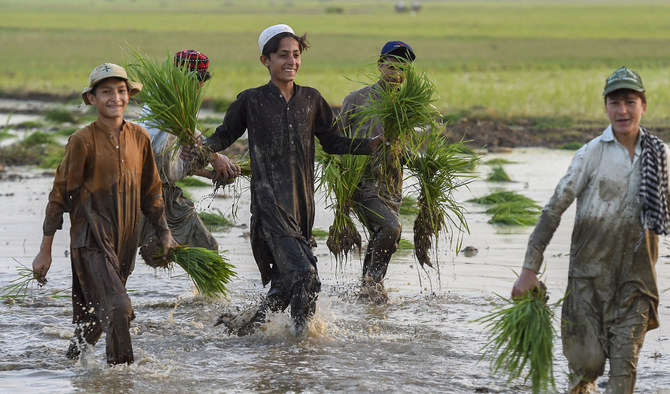
Youths plant rice seedlings in a paddy field near Mardan, Pakistan, on June 9, 2021. (AFP/File)
Short Url
Updated 10 June 2021
Follow

Agriculture and manufacturing sectors helped Pakistan surpass GDP growth target — finance minister

  • Tarin was unveiling Pakistan Economic Survey 2020-21, an annual performance report of the economy mainly focusing on macroeconomic indicators
  • Acknowledges the country’s economy needs to grow by about eight percent to fulfil growing demand for employment

KARACHI: Pakistani finance minister Shaukat Tarin said on Thursday the country was moving from stabilization to a growth phase due to measures adopted by the government - particularly in the agricultural and manufacturing sectors - which led the economy to grow by 3.94 percent in the current fiscal year.

Tarin was unveiling the Pakistan Economic Survey 2020-21 at a press conference in Islamabad on Thursday. The document is a comprehensive annual performance report of the country’s economy and mainly focuses on macroeconomic indicators.

“Agriculture and manufacturing sectors helped the economic growth, which was significantly higher than our original target of 2.1 percent,” Tarin told a news conference. "The government itself had set a growth target of 2.1 percent since the World Bank and the International Monetary Fund had predicted a lower rate of economic expansion. The government’s decision to provide incentives to manufacturing, textile and construction industries along with interventions in the agriculture sector helped the economic recovery.”

Tarin said the economy was now recovering as large scale manufacturing (LSM) had recorded nine percent growth and despite a poor cotton crop, agricultural growth stood at 2.7 percent.

“Pakistan received record remittances that have crossed $26 billion,” the finance minister said, lamenting that the country’s sugar and wheat imports were increasing despite the fact that Pakistan was “once a net exporter of food items.”

Tarin reiterated that the country’s economy needed to grow by five to eight percent to absorb the growing demand for employment: “We need two million jobs annually to accommodate our youth. Unless we achieve a growth target of five, six, seven or eight percent our youth will not get jobs.”

The finance minister recalled that the current fiscal year began last year during the peak of the COVID-19 pandemic.

“At that point, the country’s working population was 55.74 million and the figure dropped to 35 million, implying that nearly 20 million people were laid off,” he said. “Due to the prudent policies of Prime Minister Imran Khan, the working population has now been restored to 53 million and only 2.5 million people remain unemployed.”

Addressing the issue of increasing debt, the finance minister said it was inevitable since the government had to run the economy in the face of fiscal deficit. He added that the country's total debt had increased by Rs1.67 trillion during the current fiscal year, taking the overall debt to Rs38 trillion.

“Out of this amount, Rs25 trillion is local debt while around Rs12.5 trillion is foreign debt," he said.

Tarin pledged to intervene and rescue the poor, adding that they were crushed during the stabilization phase. “During the growth phase, the poor will be our number one focus and this growth will trickle down to them.”

Asked about the growth of the information technology sector in Pakistan, he said the industry had experienced 40 percent growth while saying “we want to see 100 percent growth in the coming years.”

"India earned $1 billion through its IT exports in 2010. It is now earning $100 billion from the same sector. If they can grow a hundred times, can’t we grow our IT industry by 40 or 50 times?” he asked.

Discussing the China-Pakistan Economic Corridor, the finance minister said China's business community had been invited by Pakistan to benefit from the Special Economic Zones (SEZs).

“China is outsourcing 85 million jobs in the next 10 years since they are relocating sunset industries,” he said. “We want to get a share of the outsourced jobs.” 

The finance minister added that the government would take steps to ensure the growth of the country’s small industries and export sector by announcing suitable incentives in the upcoming budget.


Pakistan highlights economic reforms at Davos, eyes cooperation in AI, IT and minerals

Updated 6 sec ago
Follow

Pakistan highlights economic reforms at Davos, eyes cooperation in AI, IT and minerals

  • Prime Minister Shehbaz Sharif speaks at breakfast event in Davos at sidelines of World Economic Forum summit
  • Pakistan, rich in gold, copper reserves, has sought cooperation with China, US, Gulf countries in its mineral sector

ISLAMABAD: Prime Minister Shehbaz Sharif highlighted Pakistan’s recent economic reforms during the sidelines of the ongoing World Economic Forum (WEF) summit in Davos on Wednesday, saying that his country was eyeing greater cooperation in mines and minerals, information technology, cryptocurrency and artificial intelligence with other states. 

The Pakistani prime minister was speaking at the Pakistan Pavilion in Davos on the sidelines of the WEF summit at a breakfast event. Sharif arrived in Switzerland on Tuesday to attend the 56th annual meeting of the WEF, which brings together global business leaders, policymakers and politicians to speak on social, economic and political challenges. 

Pakistan has recently undertaken several economic reforms, which include removing subsidies on energy and food, privatization of loss-making state-owned enterprises and expanding its tax base. Islamabad took the measures as part of reforms it agreed with the International Monetary Fund (IMF) in exchange for a financial bailout package. 

“We are now into mines and minerals business in a big way,” Sharif said at the event. “We have signed agreements with American companies and Chinese companies.”

Islamabad has sought to attract foreign investment in its critical minerals sector in recent months. In April 2025, Pakistan hosted an international minerals summit where top companies and government officials from the US, Saudi Arabia, China, Türkiye, the UK, Azerbaijan, and other nations attended.

Pakistan is rich in gold, copper and lithium reserves as well as other minerals, yet its mineral sector contributes only 3.2 percent to the countrys GDP and 0.1 percent to global exports, according to official figures.

Sharif said Pakistan has been blessed with infinite natural resources which are buried in its mountains in the northern Gilgit-Baltistan, Khyber Pakhtunkhwa, Azad Kashmir and southwestern Balochistan regions. 

“But we have now decided to go forward at lightning speed,” he said. “And we are also moving speedily in the field of crypto, AI, IT.”

He said the government’s fiscal and economic measures have reduced inflation from nearly 30 percent a few years ago to single-digit figures, adding that its tax-to-GDP ratio had also increased from 9 to 10.5 percent. 

The prime minister admitted Pakistan’s exports face different kinds of challenges collectively, saying the country’s social indicators needed to improve. 

“But the way forward is very clear: that Pakistan has to have an export-led growth,” he said. 

Sharif will take part in an informal meeting of world leaders this year themed ‘The Importance of Dialogue in a Divided Global Landscape,’ his office said in an earlier statement. 

Pakistan’s participation at the WEF comes as Islamabad seeks to sustain recent economic stabilization and attract investment by engaging directly with policymakers, business leaders and international institutions at the annual gathering.