

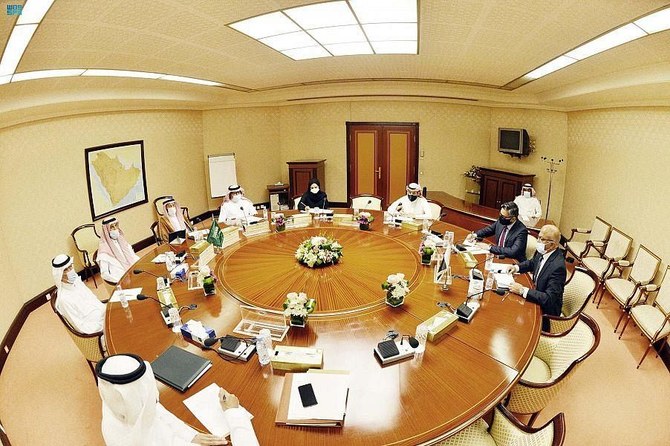
DiplomaticQuarter: UK, Pakistani envoys meet Shoura committees, agree to strengthen parliamentary friendship

Pakistani Ambassador Bilal Akbar meets with the Saudi-Pakistani Parliamentary Friendship Committee of the Shoura Council. (SPA)
Short Url
Updated 10 June 2021
Follow

DiplomaticQuarter: UK, Pakistani envoys meet Shoura committees, agree to strengthen parliamentary friendship

RIYADH: UK Ambassador to Saudi Arabia Neil Crompton and Pakistani Ambassador to Saudi Arabia Lt. Gen. Bilal Akbar met with the respective parliamentary friendship committees of the Shoura Council to discuss ways of enhancing bilateral cooperation, especially in parliamentary relations.

Dr. Ghazi bin Faisal bin Zagr, chairman of the Saudi-British Parliamentary Friendship Committee, an affiliate of the Shoura Council, held a meeting with the UK ambassador in the presence of members of the committee, during which he stressed the importance of supporting the bilateral relations between the two friendly countries. He highlighted Saudi Arabia’s role in combating terrorism as well as its efforts to spread tolerance and encourage dialogue among different religions and cultures.

Crompton also affirmed the importance of bilateral relations between Saudi Arabia and the UK, noting the level of development in the two countries across various fields in the past five years.

They also discussed parliamentary relations between the Shoura Council and the UK House of Commons and how to use the role of the parliamentary friendship committees to promote their common interests.

Abbas bin Ahmed Hadi, chairman of the Saudi-Pakistani Parliamentary Friendship Committee of the Shoura Council, met with the newly appointed ambassador of Pakistan in the presence of members of the committee.

Hadi stressed the importance of the fraternal relations between the Kingdom and Pakistan, especially at the level of parliamentary affairs between the Saudi Shoura Council and Pakistan’s National Assembly.

The Pakistani ambassador expressed his hope that the historical relations between the two countries would be further strengthened, especially in the economic, investment and commercial fields, as Pakistan welcomes Saudi investors and businessmen.


Saudi Arabia’s KAUST named FIFA’s first research institute in MENA

The canal in the King Abdullah University of Science and Technology campus. (Shutterstock)
Updated 10 February 2026
Follow

Saudi Arabia’s KAUST named FIFA’s first research institute in MENA

  • KAUST President Prof. Sir Edward Byrne said that the university’s selection as the fifth FIFA Research Institute in the world — and the first in the region — marks a significant achievement, reflecting Kingdom’s growing presence in international football

RIYADH: FIFA has designated the King Abdullah University of Science and Technology as its first research institute in the Middle East and Asia to support the development of innovative football research, the Saudi Press Agency reported on Tuesday.

The recognition highlights KAUST’s commitment to integrating sports, academic research and industry through advanced, high-level initiatives grounded in rigorous scientific methodologies, contributing to the advancement of football studies.

KAUST President Prof. Sir Edward Byrne said that the university’s selection as the fifth FIFA Research Institute in the world — and the first in the region — marks a significant achievement, reflecting Saudi Arabia’s growing presence in international football.

The accreditation aligns with national efforts to invest in research and development and promote the knowledge economy, supporting Saudi Vision 2030’s goals of building an advanced sports system based on innovation and sustainability.

The collaboration’s first project focuses on developing advanced AI algorithms to analyze historical FIFA World Cup broadcast footage, transforming decades of match videos into structured, searchable data, according to the KAUST website.

This work opens new opportunities to apply state-of-the-art computer vision techniques and deepen understanding of how football has evolved over time.

The second project uses player and ball tracking data from the FIFA World Cup 2022 in Qatar and the FIFA Women’s World Cup 2023 in Australia and New Zealand to compile comprehensive datasets capturing in-game dynamics.

These datasets provide deeper insights into human movement, playing techniques and performance dynamics through AI-driven analysis.