

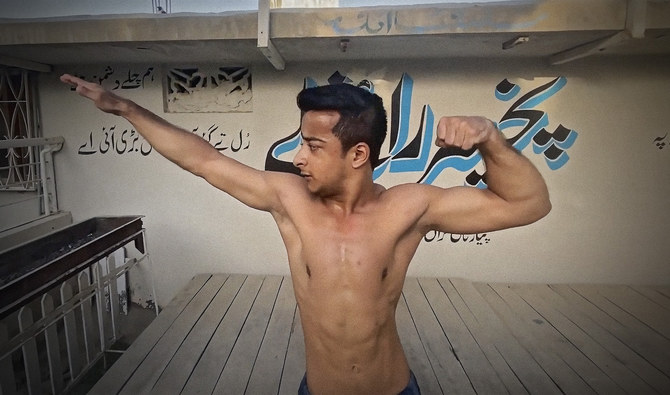

KARACHI: When doctors in November 2016 said Furqan bin Imran had an “incurable” genetic disorder of the bones, the diagnosis brought closure after a lifetime of injuries that doctors could not explain.
Now the disease had a name — a type of skeletal abnormality called pycnodysostosis — and Imran was resolved to fight it and fight it he did for the next five years, going on to become a fitness trainer, bodybuilder and YouTuber.
“The news came as a shock to me,” the 21-year-old told Arab News in an interview on Monday. “I had already suffered from the disease for 16 years and was trapped in a difficult phase of my life.”
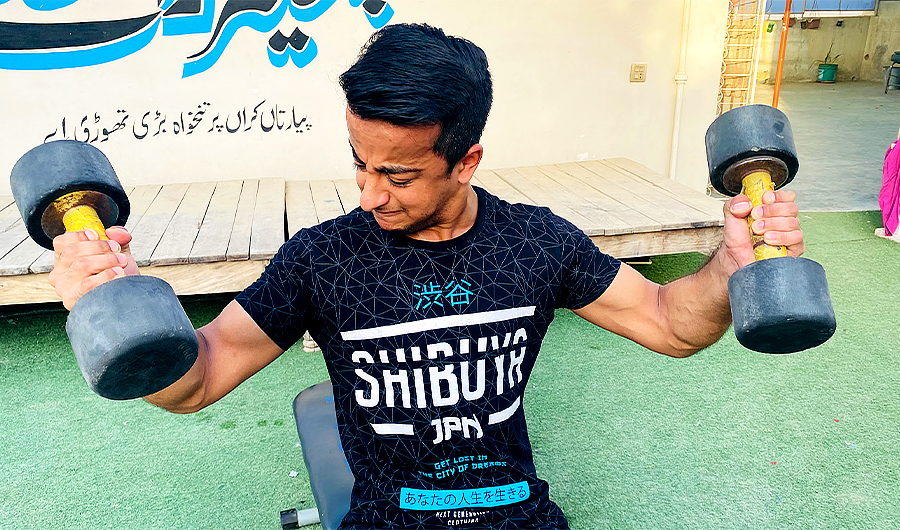
Furqan bin Imran, who suffers from a rare type of skeletal abnormality called pycnodysostosis, lifts weights at his residence in Karachi, Pakistan, on June 7, 2021. (AN Photo)
Just that year, Imran had visited hospital for the treatment of his eleventh fracture — the first one occurred in 2005, when he was only six years old.
It was Dr. Salman Kirmani, a consultant medical geneticist and pediatric endocrinologist at the Aga Khan University in Karachi, who finally determined that Imran had pycnodysostosis, a disease that inflicts one in a million to one in two million live births.
“No one really knows for sure how common it is in Pakistan,” Kirmani said, “but given the fact that we have a lot of intermarriages, and this is an autosomal recessive disorder, it is quite possible that we have a higher incidence.”
Since there is no clear medical treatment for the disorder, the doctor said patients were advised to be careful and not pursue any activities that could cause fractures and other injuries.
Imran completely ignored the advice, beginning a daily regimen of moderate and controlled exercise and following a healthy dietary regimen. He had a goal: to transform his body through fitness and bodybuilding.
“My doctors told me that it was a risk,” he said. “I totally ignored the advice … and I transformed myself by lifting heavy weights.”
It wasn’t easy, Imran said, describing how the initial training made his backbone “bend backwards,” and gave him the sense of “electric shocks” passing through every inch of his body.
“But I didn’t give up.”
His doctor said Imran’s achievements were unprecedented.
“Such a workout regimen [and] improving bone strength has never before been reported in pycnodysostosis,” Kirmani said. “Over the years, he has built up his muscle mass to a point … that he has no fractures at all.”
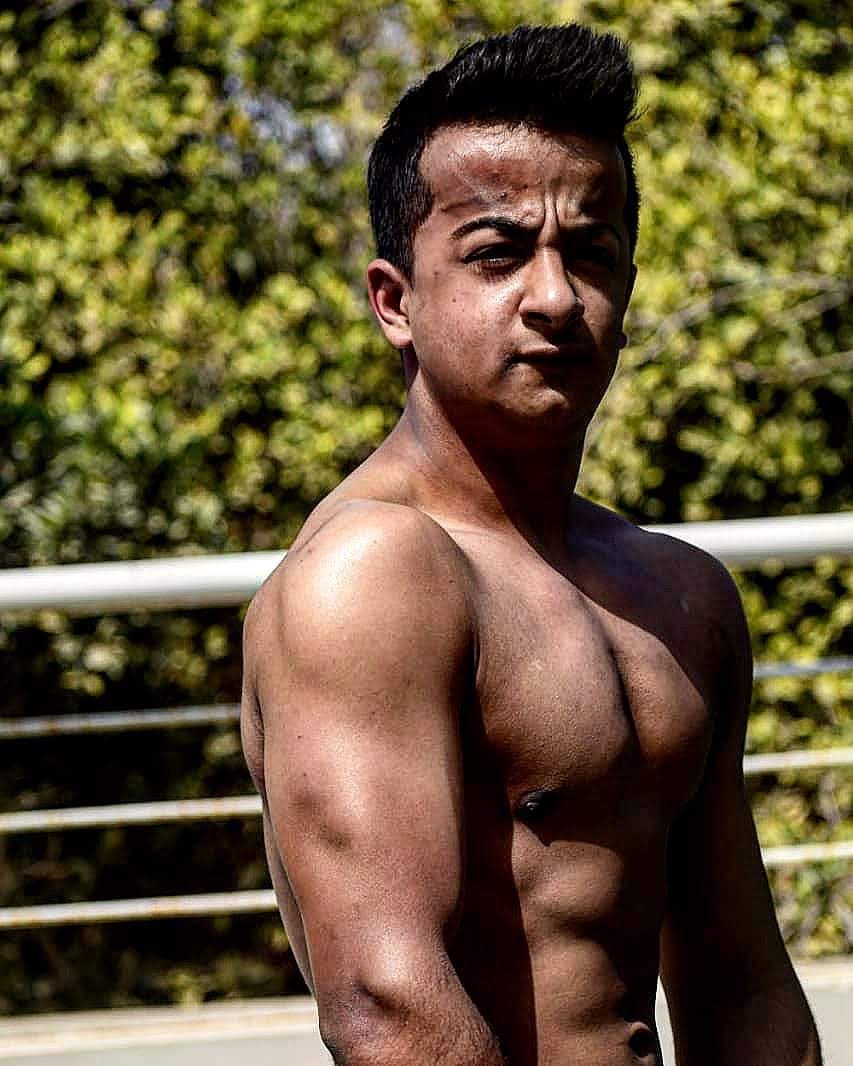
In this undated photo, Furqan bin Imran poses for a picture in Karachi, Pakistan. (Photo courtesy: Furqan bin Imran)
The doctor said Imran was a source of inspiration for others facing debilitating diseases but warned people not to do “anything that is unsafe or counterproductive for their health” while trying to emulate Imran’s achievements.
“Never give up … whatever your weaknesses are, turn them into your strengths,” Imran said. “It’s all related to your mind because Allah has built our mind in a beautiful way. If your mind is strong enough to bear all circumstances in your life … you will be able to cure any disease.”
“Now when I see myself in this phase of my life, I feel like I am out of this world,” Imran added, smiling. “I feel like I am a superman who can conquer this world with his power.”


