

Blinken says Trump administration had concerns about COVID-19 probe

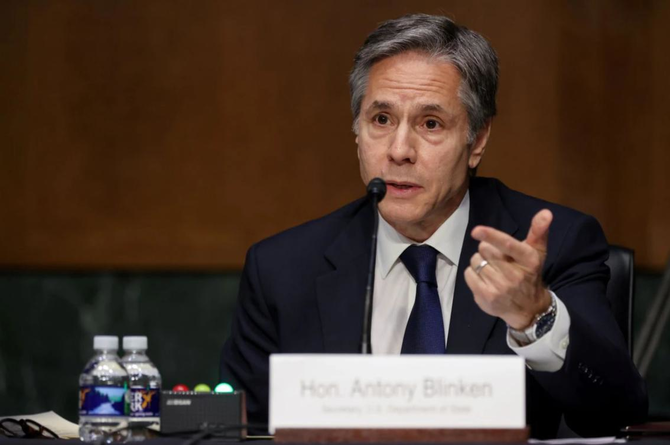
US secretary of state Antony Blinken. (File/Reuters)
Short Url
Updated 09 June 2021
Follow

Blinken says Trump administration had concerns about COVID-19 probe

  • President Joe Biden has ordered to look into the origins of the virus
  • Biden said US intelligence was considering two likely scenarios

WASHINGTON: US secretary of state Antony Blinken cast doubt on Tuesday on a probe into the origins of COVID-19 launched at the state department under the Trump administration and said the previous administration had had real concerns about its methodology.

Republican senator Mike Braun asked Blinken at a senate committee hearing about what he said was a Wall Street Journal report that the department had shut down the probe in January.

“I saw the report. I think it’s on a number of levels, incorrect,” Blinken replied, although it was not clear which report he and Braun were referring to.

Blinken said that to the best of his understanding, the Trump administration had asked a contractor to look into the origins of the coronavirus that causes COVID-19, with a particular focus on whether it was a result of a lab leak.

“That work was done, it was completed, it was briefed, to relevant people in the department. When we came in, we also were made aware of the findings,” Blinken said.

“The Trump administration, it’s my understanding, had real concerns about the methodology of that study, the quality of analysis, bending evidence to fit preconceived narrative. That was their concern. It was shared with us.”

Blinken said the study was the work of one office and a few individuals and not the “whole of government effort” president Joe Biden has ordered, led by the intelligence community, to look into the origins of the virus.

Reuters reported earlier that Blinken had referred in his remarks to a Wall Street Journal report on Monday. In that, the Journal cited a classified report by a US government national laboratory which it said had concluded that the hypothesis of a virus leak from a Chinese lab in Wuhan was plausible and deserved further investigation.

However, a source familiar with the situation, who did not want to be otherwise identified, said Blinken’s remarks had been referring to the findings of the contractor, not that of the national laboratory.

Asked whether he supported declassifying information as to the origins of the virus, Blinken said “we should have as much transparency as we possibly can with whatever information we find,” subject to the need to protect intelligence sources.

In announcing his 90-day probe, Biden said US intelligence was considering two likely scenarios — that the virus resulted from a laboratory accident or that it emerged from human-animal contact — but had not come to a conclusion.

A still-classified US intelligence report circulated during Trump’s administration alleged that three researchers at China’s Wuhan Institute of Virology became so ill in November 2019 that they sought hospital care, US government sources have said.


Fraudsters flee Cambodia’s ‘scam city’ after accused boss taken down

Updated 7 sec ago
Follow

Fraudsters flee Cambodia’s ‘scam city’ after accused boss taken down

SIHANOUKVILLE: Hundreds of people dragged away suitcases, computer monitors, pets and furniture as they fled a suspected Cambodian cyberfraud center, after the country’s most wanted alleged scam kingpin was arrested and deported.
Boarding tuk-tuks, Lexus SUVs and tourist coaches, an exodus departed Amber Casino in the coastal city of Sihanoukville, one of the illicit trade’s most notorious hubs.
“Cambodia is in upheaval,” one Chinese man told AFP. “Nowhere is safe to work anymore,” he said Thursday.
Similar scenes played out at alleged scam compounds across Cambodia this week as the government said it was cracking down on the multibillion-dollar industry.
But residents said many of the people working inside the tightly secured buildings moved out several days before the arrival of authorities, and an analyst dubbed it “anti-crime theater.”
From hubs across Southeast Asia, scammers lure Internet users globally into fake romantic relationships and cryptocurrency investments.
Initially largely targeting Chinese speakers, transnational crime groups have expanded operations into multiple languages to steal tens of billions annually from victims around the world.
Those conducting the scams are sometimes willing con artists, sometimes trafficked foreign nationals who have been trapped and forced to work under threat of violence.
AFP journalists visited several alleged Internet scam sites in Sihanoukville, in the wake of the high-profile arrest in Cambodia and extradition to China of internationally sanctioned accused scam boss Chen Zhi.
Few of those departing the casinos, hotels and other facilities were willing to speak with AFP, and none were willing to be identified due to concerns for their safety.
“Our Chinese company just told us to leave straight away,” said a Bangladeshi man outside Amber Casino.
“But we’ll be fine. There are plenty of other job offers,” he added.
Studded with casinos and unfinished high-rises, the glitzy resort of Sihanoukville has become a cyberscam hotbed, where thousands of people involved in the black market are believed to operate cons from fortified compounds.
Before Chen was indicted last year by US authorities who said his firm Prince Group was a front for a transnational cybercrime network, the Chinese-born businessman ran multiple gambling hotels in Sihanoukville.
A 2025 Amnesty International report identified 22 scam locations in the coastal resort, out of a total of 53 in the country.
The UN Office on Drugs and Crime estimates global losses to online scams reached up to $37 billion in 2023, and that at least 100,000 people work in the industry in Cambodia alone.

- Tipped off -

But the Cambodian government claims the lawless era has come to an end, with Prime Minister Hun Manet pledging on Facebook to “eliminate... all the problems related to the crime of cyber scams.”
Cambodia’s anti-scam commission says it has raided 118 scam locations and arrested around 5,000 people in the last six months.
Following Chen’s deportation to China, the Cambodian government has tightened the screws on some Prince Group affiliates, ordering Prince Bank into liquidation and freezing home sales at several of its luxury properties.
In recent months, China has stepped up its pursuit of the scam industry, sweeping up Chen and other key figures from across Southeast Asia to try them on its own soil.
But while Cambodia says it is “cracking down,” there are suspicions over the timing.
A tuk-tuk driver in Sihanoukville told AFP hundreds of Chinese people left one compound this week before police arrived.
“Looks like they were tipped off,” said the 42-year-old, declining to give his name.
Mark Taylor, former head of a Cambodia-based anti-trafficking NGO, said the “preemptive shifting of scam center resources,” including workers, equipment and managers, had been seen ahead of law enforcement sweeps.
It was “seemingly the product of collusion,” he added, in a strategy with “dual ends” of boosting the government’s anti-crime credentials while preserving the scamming industry’s ability to survive and adapt.
Amnesty has accused the Cambodian government of “deliberately ignoring” rights abuses by cybercrime gangs, which sometimes lure workers with offers of high-paying jobs before holding them against their will.
AFP journalists saw several coachloads of Mandarin speakers leaving Sihanoukville on the main highway to the capital Phnom Penh.
Multiple people said they “didn’t know” where they were going or what their plans were, but appeared anxious as they anticipated law enforcement closing in.
Outside the Amber Casino, holding a fake designer hold-all, the Bangladeshi man fell in with the crowd, saying: “This is about survival now.”