



ISLAMABAD: The Pakistani government on Tuesday blamed dilapidated railway tracks for a train crash this week in which 57 people were killed and over 100 injured, as railways data showed that eight accidents had taken place since the current government of the Pakistan Tehreek-e-Insaf (PTI) party came to power in 2018, with 195 people killed.
According to railway officials, about 1,100 passengers were on board the two trains. One of them derailed and the other crashed into its carriages near Ghotki town, about 420 km north of Karachi, Pakistan’s largest city and capital of the Sindh province.
Railway accidents are common in Pakistan, with derailments and collisions at unmanned railway crossings frequently reported in the media.
“As you know, this railway track is almost 150 years old,” Nazia Jabeen, a Pakistan Railways spokesperson, told Arab News, explaining the reason behind recurrent train accidents in the country.
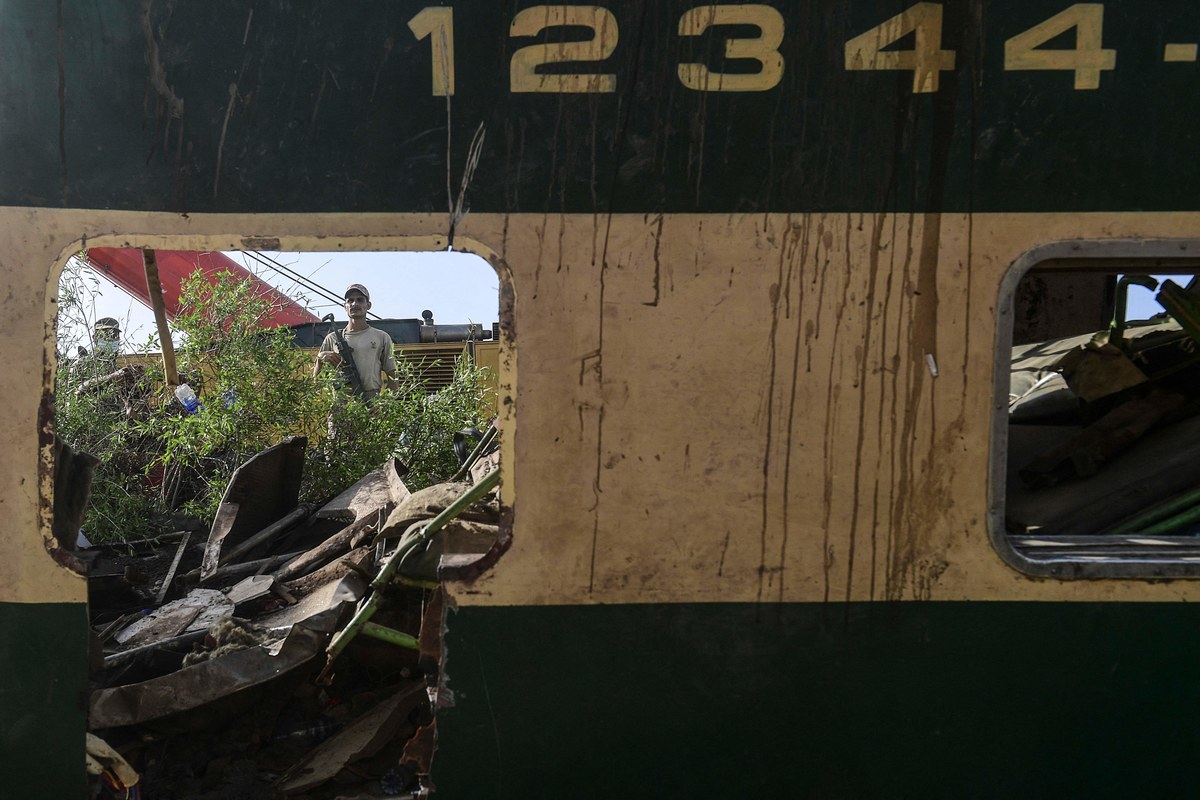
A paramilitary soldier (L) stands guard near the wreckage of a train in Daharki area of Pakistan's Sindh province on June 7, 2021. (AFP)
Since 2013, Pakistan has witnessed at least 19 major train crashes with 341 people killed and several hundreds injured, according to official data. Eight of these accidents have taken place during the present government’s term.
“We keep doing maintenance [of the track] where necessary,” Jabeen said. “However, as you know this is a public transportation service and we cannot just stop it.”
She said the country was working with China to expand and reconstruct the Main Line-1 (ML-1) and upgrade railway infrastructure.
Pakistan approved the project last year, its costliest to date, as part of the multibillion-dollar China-Pakistan Economic Corridor (CPEC) agreement, giving the go-ahead for a $6.8 billion project to upgrade its railway lines.
The railway project is meant to be built on a cost-sharing basis between Islamabad and Beijing, with major financing expected through China’s Government Concessional Loan (GCL), though Pakistani authorities will also provide about $800 million as equity for the project.
The country’s entire rail-related infrastructure would be modernized under the project, officials say, including doubling of tracks from Karachi to Peshawar. The speed of passenger trains will also be improved from 110 kilometers per hour to 160 kilometers per hour.
“The government of Pakistan has completed all its work, but negotiations with the Chinese government on the loan [for the project] are still underway,” Jabeen said. “We don’t have a timeframe for this, but we are ready [to implement the project] and waiting for China’s official approval.”
According to the Ministry of Railways, one side of the two train tracks has been cleared and work is now in progress to clear the other one to help restore traffic.
Railway is an essential mode of intercity traveling, especially among middle- and lower-income groups, with a network of tracks across Pakistan. However, carriages are often overcrowded, and many trains are said to be in a poor condition.
Muhammad Aftab Akbar, a former chief executive officer at Pakistan Railways, said the transportation service had deteriorated due to the old tracks and quality of human resources.
“The number of fatal train crashes has increased since 2013 since our governments have not invested in the improvement of the railway infrastructure,” he told Arab News, adding that the government’s focus on the ML-1 project had held it back from making other “much-needed” investments in the sector.
Akbar said the 300 to 350 kilometers railway track in Sukkur division on which Monday’s accident occurred was “the weakest,” with its infrastructure eroding due to seepage from a canal.
“The government needs to improve the whole railway infrastructure on a war footing,” Akbar said, “since that is the only way to save this cheap public transportation mechanism.”


