Pushed out by machine-made Iranian rugs, carpet art disappears from Pakistan

Abdul Samad displays carpets at his shop on Double Road in Quetta, Balochistan, June 2, 2021. (AN photo by Saadullah Akhter)
Short Url
Updated 07 June 2021
Follow

Pushed out by machine-made Iranian rugs, carpet art disappears from Pakistan

  • Carpets from Iran cost less on the market than what carpet business owners pay their staff
  • Weavers say the art is dying as Pakistanis are no longer able to afford hand-knotted qaleen carpets

QUETTA: Famous hand-knotted qaleen carpets are disappearing from southwestern Pakistan as weavers say their craft has been pushed to the brink of extinction by cheap, machine-made rugs from Iran.

The neighborhoods of Hazara Town, Ghosabad and Marriabad in Quetta, the capital of Balochistan province, used to be Pakistan's main qaleen center, with regular exports to the United States and Europe giving employment to thousands of weavers. Now, only a few such workshops are left.

Muhammad Mehdi, who ten years ago inherited his father's qaleen business at Shoukat Stop of Krani Road, remembers how weavers would throng the one hundred khadis (looms) at his family's workshop.

"Hundreds of women, children and young workers used to come for this antique art of weaving, but today we have not a single khadi in our workshop," Mehdi said.

"Now, we only receive three or four orders a year from major carpet companies in Punjab and Sindh. We have hired workers who have their own khadis."

He pays his weavers $42 per square meter. The carpets then go to Lahore and are finished there to be ready for export, with the price per square meter jumping to about $300 and making it unfordable for most Pakistanis.
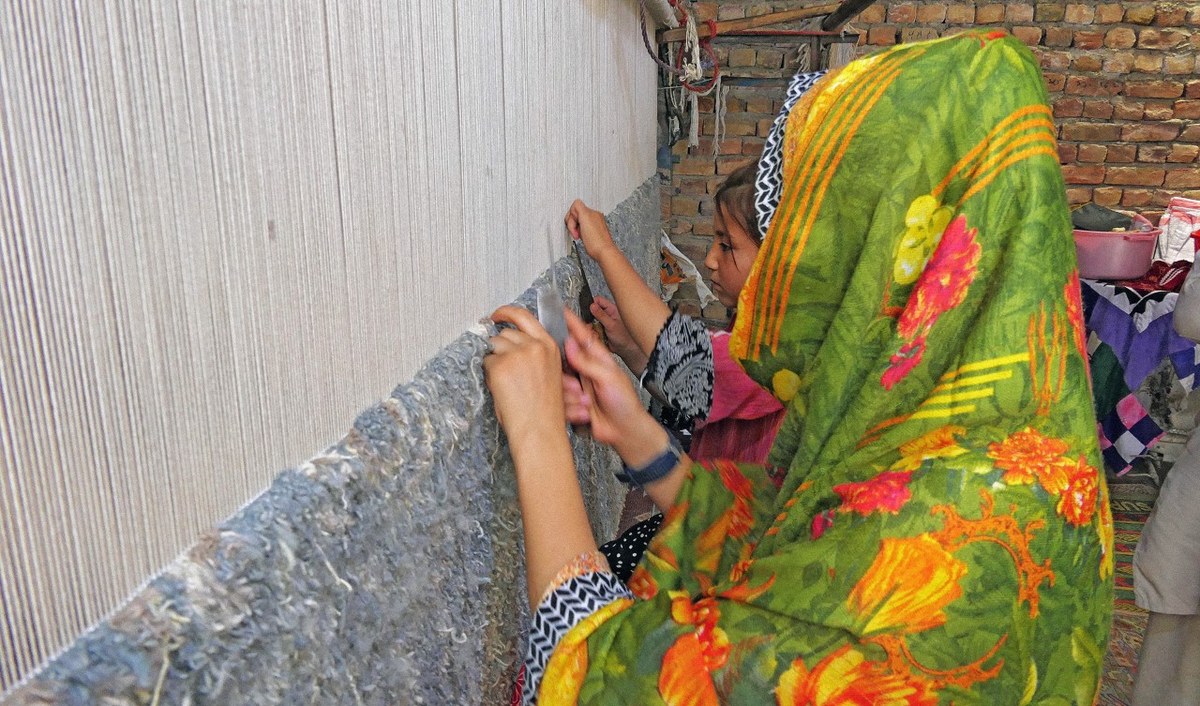


Girls knot a 30-meter rug at their home in Hazara Town, Quetta, Balochistan on June 2, 2021. (AN photo by Saadullah Akhter)

Iranian carpets, meanwhile, cost less than what Mehdi pays his contractors.

Some allege that what makes the Iranian carpets so cheap is not only machine-weaving but also that they enter Pakistan through the porous border without duty. Customs officials say, however, that the scale is not large.

"Indeed, the Iranian rugs are being smuggled to Pakistan but not in large numbers because the smugglers travel through the desert and rugged mountainous routes, which could damage the quality of rugs," a Quetta Customs official told Arab News on condition of anonymity as he is not authorized to talk to the media.

He added that while the Baloch carpets are still exported to the US and Europe, they are no longer sent from Balochistan. Quetta weavers only do the low-paid hard work, which is later sent for finishing to centers such as Lahore. Meanwhile, the local market is flooded by the cheap Iranian rugs.
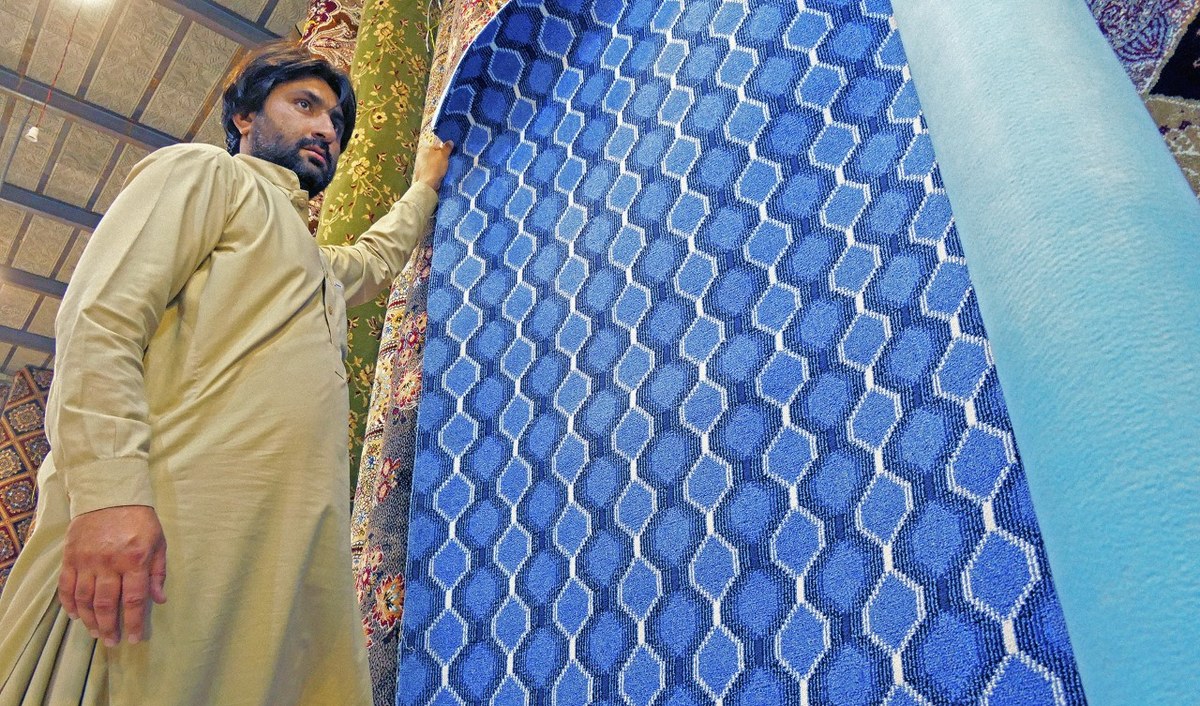


Abdul Samad shows a machine-made Iranian carpet on Double Road in Quetta, Balochistan, June 2, 2021. (AN photo by Saadullah Akhter)
 

"Balochistan didn’t export a single hand-knotted carpet abroad for the last three years," the official said.

Abdul Samad, a Quetta carpet seller who has been in the business for the past 22 years, says the downfall of his craft reflects increasing poverty across the whole country, with people who used to buy hand-made carpets no longer able to afford them.

"The cost of an Iranian rug of 10 to 13 meters is Rs60,000 ($390) while a hand-knotted rug of the same size would cost up to Rs400,000," he said. 

"Pakistani people can't buy them, except for the elites."

Bangladesh refuse to go to India for T20 World Cup

Updated 5 sec ago
Follow

Bangladesh refuse to go to India for T20 World Cup

  • Bangladesh board’s response comes a day after ICC rejected its demand to shift World Cup matches from India to Sri Lanka
  • Row erupted in January when India’s cricket board asked IPL franchise to drop Bangladesh player amid political tensions

DHAKA, Bangladesh: Bangladesh will not travel to India to play in next month’s T20 World Cup, its cricket board said on Thursday, effectively ruling the country out of the tournament.

“Our only demand is to play the World Cup — but not in India,” Bangladesh Cricket Board (BCB) President Aminul Islam Bulbul told reporters.

The refusal came a day after cricket’s governing body rejected Bangladesh’s plea to play its games in Sri Lanka instead.

“There is no scope for changing our decision,” said Asif Nazrul, an adviser for youth and sports issues in Bangladesh’s interim government.

The T20 World Cup begins on February 7, with Bangladesh scheduled to play their four group matches in the Indian cities of Kolkata and Mumbai.

The row between the neighboring nations erupted on January 3 when the Indian cricket board ordered the Indian Premier League (IPL) franchise Kolkata Knight Riders to release Bangladesh fast bowler Mustafizur Rahman.

Mustafizur’s removal from the IPL followed online outrage by right-wing Indian Hindus who invoked alleged attacks on a fellow community in Muslim-majority Bangladesh.

Dhaka maintains that Indian media had exaggerated the scale of the violence.

The sport’s global governing body said on Wednesday it had “engaged with the BCB in sustained and constructive dialogue” to ensure Bangladesh could participate in the tournament, but added that those efforts had been “rebuffed.”

The International Cricket Council (ICC) said “independent security assessments, comprehensive venue-level security plans and formal assurances from the host authorities” found there was “no credible or verifiable threat to the safety” of the Bangladesh team.

‘LOSE A HUGE AUDIENCE’

However, Nazrul said Bangladesh’s security concerns “did not arise from speculation or theoretical analysis.”

“They arose from a real incident — where one of our country’s top players was forced to bow to extremists, and the Indian cricket board asked him to leave India,” he said.

Bangladesh will hold elections during the World Cup, its first since a mass uprising in 2024 toppled then-prime minister Sheikh Hasina, a close ally of New Delhi.

Political relations have since soured between Bangladesh and India, where Hasina fled after she was ousted.

There are wider issues for India, which is preparing to host the 2030 Commonwealth Games that are seen as a stepping stone for its ambitions to host the 2036 Olympics.

“Bangladesh is a cricket-loving nation. If a country of nearly 200 million people misses the World Cup, the ICC will lose a huge audience,” the BCB’s Bulbul said.

“Cricket is entering the Olympics in 2028, Brisbane in 2032, India is bidding for 2036. Excluding a major cricket-loving country like Bangladesh would be a failure.”

Bangladesh’s appeal to the ICC was not without precedent, with India’s arch-enemy Pakistan to play all its games in Sri Lanka.

That deal was struck after India, a financial and administrative powerhouse within cricket, refused to travel to Pakistan for the 2025 Champions Trophy and played its matches in Dubai instead.

However, the ICC said a year later a similar shift was impossible for Bangladesh.

“There are many precedents worldwide where matches have been moved to other venues due to security risks,” Bangladesh’s Nazrul said.

ICC sources told AFP this week that Bangladesh could be replaced by Scotland, the highest-ranked team that did not qualify outright for the World Cup.