

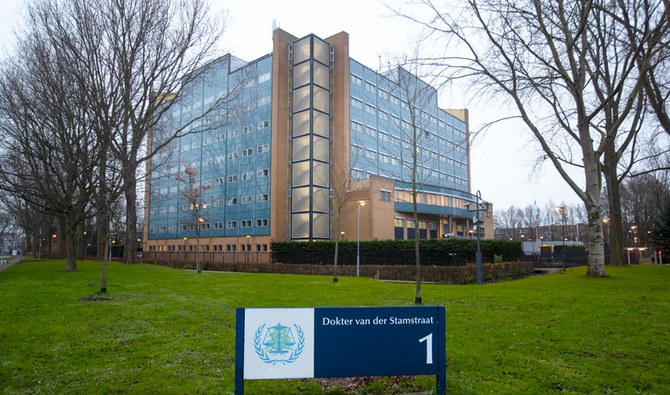

BEIRUT: Lebanon officially announced on Friday its inability to pay its share for the Special Tribunal for Lebanon (STL) which was inaugurated in 2009 to prosecute those involved in the assassination of former premier Rafic Hariri and related cases.
On Friday, caretaker PM Hassan Diab sent a letter to the UN Secretary General Antonio Guterres, in which he announced Lebanon’s default on payments “due to the country’s deep economic crisis”.
Diab called on Guterres to “urgently explore different and alternative means of financing STL with the Security Council and member states, to help the tribunal complete its mission in line with the resolution n.1757 and the related agreement between the UN and Lebanon to set up the international tribunal.”
Lebanon’s position came two days after STL announced that “it is facing an unprecedented financial crisis, and that without immediate funding, it will not be able to operate beyond July 2021.”
In this context, STL launched an urgent appeal for international contributions, “otherwise, it will not be able to resume its work beyond July.”
The tribunal is funded by 51% by voluntary contributions and 49% by the Lebanese government.
In his letter to Guterres, Diab considered that “the recent donation ($15,503,355) by the UN General Assembly to support STL’s financial resources and overcome the shortfall in Lebanon’s share, did not resolve the problem.”
Diab considered that “these financial difficulties should not hinder the completion of STL’s work to the end,” and that “the most painful consequences of the cessation of the STL's work lie in the reflection of a fragmented and incomplete justice for all justice seekers and those who believe in the sovereignty of the law and the need to prevent impunity.”
STL’s Trial Chamber has cancelled “the trial of fugitive Salim Ayyash, convicted of the assassination of Hariri and related cases, which was supposed to begin on June 16.”
The chamber has also suspended “all decisions on filings presently before it, and on any future filings until further notice.”
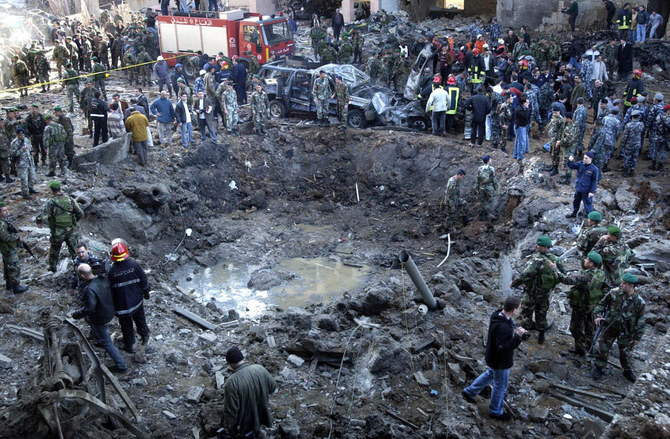
Ayyash’s trial proceedings are in relation to three attacks against prominent political figures Marwan Hamade, Georges Hawi and Elias Al- Murr, on Oct.1st, 2004, Jun. 21, 2005, and Jul. 12, 2005, respectively. Hamade and Al-Murr made it out alive, while Hawi was killed in a car bomb.
STL has announced that “these attacks are connected to the attack of Feb. 14, 2005, which killed former premier Rafic Hariri and many others.”
Families of the victims of the terrorist attacks against Hawi, Hamade and Al-Murr held a press statement on Friday, at the the Press Federation's headquarters.
They considered that they “have been killed twice; the first time when they lost their loved ones and the second time when their cases are being deliberately dropped.”
Nara Georges Hawi said the victims’ families have been informed of “the cancellation of the session to begin proceedings in our cases due to the shortage in funding”.
She considered that “when the case reached the trial phase, the international community distanced itself from the tribunal, amid the total nonchalance of the government and political leadership.”
“Isn’t the international community responsible for the tribunal’s mismanagement? Aren’t influential countries the ones who designate the registrar, the judges, the public prosecutor and the head of defense office? Why are you holding the victims responsible for your bad choices and poor control over the tribunal’s work?”
She added that Hawi’s family “will hold every person who is proved to be behind the delay in serving justice responsible in the assassination case.”
“Our family has been robbed of justice and we were denied access to the confidential filings in the case”
“If the court closes its doors, the family of George Hawi will sue every official either in the tribunal or in the United Nations who caused delays in our case, and every official in the Tribunal who took away the competence of Lebanese courts and deprived us of justice for 16 years,” she said.
Widower of Ghazi bou Karroum, one of the victims who were killed in the bombing that targeted Hamadeh, said “the tribunal’s closure means killing all our hopes for justice and accountability for us and for the victims of this nation.” She urged the international community and donor countries “not to abandon the victims of Lebanon and their families.”
Osama Abdelsamad spoke on behalf of the family of Khaled Moura, who was killed in the bombing that targeted Al-Murr and said: “The worst thing that could happen to the Lebanese is not only for the tribunal to close due to funding problems, but for the official authorities to remain passive and do nothing. In this case, justice will never be served.”


