

Amnesty urges Iraq to account for 643 missing boys and men

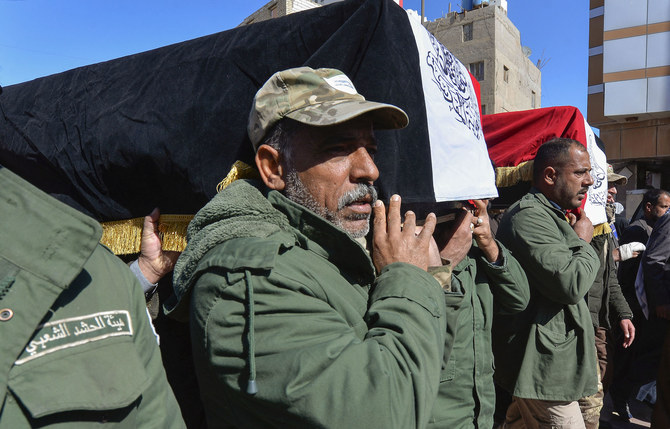
At least 11 fighters from Iraq’s state-sponsored Hashed Al-Shaabi force were killed in an ambush by the Daesh group January 23, Hashed security sources said. (File/AFP)
Short Url
Updated 03 June 2021
Follow

Amnesty urges Iraq to account for 643 missing boys and men

  • The men and boys disappeared during an operation carried out by the Hashed Al-Shaabi in June 2016
  • The Iraqi government is under fire for closing camps for those displaced in the fight against the Daesh group

BAGHDAD: Amnesty International on Thursday urged Iraq to reveal the whereabouts of 643 Sunni Muslim boys and men abducted five years ago by Shiite paramilitaries fighting the Daesh group.

The men and teenagers disappeared during an operation by the Hashed Al-Shaabi in June 2016 to retake Fallujah in the western desert from Daesh, which then held the country’s Sunni provinces.

The Hashed have since been integrated into Iraq’s state security forces.

Witnesses cited by Amnesty International said that on June 3 gunmen wearing Hashed uniforms “took an estimated 1,300 men and boys considered to be of fighting age away from their families.”

“At sunset, at least 643 men and boys were boarded onto buses and a large truck. Their fate remains unknown” while the rest alleged they were tortured, the human rights watchdog said in a statement.

On June 5, Iraq’s then prime minister Haider Al-Abadi established a committee to investigate disappearances and abuses during military operations to retake Fallujah.

“The committee’s findings have never been made public,” Amnesty said.

“For five years, the families of these men and boys have been living in anguish, not knowing the fate of their loved ones, or whether they are even alive,” said the London-based rights watchdog.

“The families deserve to know what happened to their loved ones. They deserve an end to their suffering.”

The Hashed denies having abducted or arbitrarily arrested people, but its commanders often claim to have jails packed with militants, without proving the prisoners really belong to Daesh.

Sunnis regularly claim to be discriminated against in post-Daesh Iraq, where thousands of them have been arrested and often sentenced to prison or death for belonging to Daesh, rightly or wrongly.

Today, the Iraqi government is under fire for closing camps for those displaced in the fight against the Daesh group.

“The government has closed 16 camps over the last seven months, leaving at least 34,801 displaced people without assurances that they can return home safely, get other safe shelter, or have access to affordable services,” Human Rights Watch said.

The displaced forced to leave their tent cities have often had their homes destroyed or are considered “terrorists” by the authorities and their communities, accusations “without any evidence,” HRW said in a statement.


Syrian government says it controls prison in Raqqa with Daesh-linked detainees

Updated 23 January 2026
Follow

Syrian government says it controls prison in Raqqa with Daesh-linked detainees

  • Prison holds detainees linked to Daesh, and witnessed ⁠clashes in its vicinity between advancing Syrian government forces and Kurdish fighters

Syria’s Interior Ministry said on Friday it had taken over Al-Aktan prison in the city of Raqqa ​in northeastern Syria, a facility that was formerly under the control of Kurdish-led Syrian Democratic Forces (SDF).

The prison has been holding detainees linked to the militant group Daesh, and witnessed clashes in its vicinity this week between advancing Syrian government forces and the SDF.

It ‌was not ‌immediately clear how many ‌Daesh ⁠detainees ​remain in Al-Aktan ‌prison as the US military has started transferring up to 7,000 prisoners linked to the militant Islamist group from Syrian jails to neighboring Iraq. US officials say the detainees are citizens of many countries, including in Europe.

“Specialized teams were ⁠formed from the counter-terrorism department and other relevant authorities to ‌take over the tasks of guarding ‍and securing the prison ‍and controlling the security situation inside it,” ‍the Interior Ministry said in a statement.

Under a sweeping integration deal agreed on Sunday, responsibility for prisons housing Daesh detainees was meant to be transferred to ​the Syrian government.

The SDF said on Monday it was battling Syrian government forces near ⁠Al-Aktan and that the seizure of the prison by the government forces “could have serious security repercussions that threaten stability and pave the way for a return to chaos and terrorism.”

The US transfer of Daesh prisoners follows the rapid collapse of Kurdish-led forces in northeast Syria. Concerns over prison security intensified after the escape on Tuesday of roughly 200 low-level Daesh fighters from Syria’s ‌Shaddadi prison. Syrian government forces later recaptured many of them.