

Israeli official rolls back army chief comments on AP Gaza

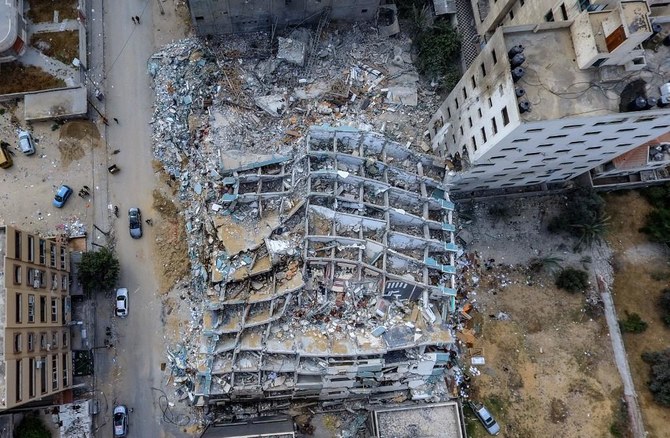
The Israeli army gave occupants of the building one hour to evacuate before the May 15 airstrike. (File/AFP)
Short Url
Updated 01 June 2021
Follow

Israeli official rolls back army chief comments on AP Gaza

  • Israeli defense minister distances himself from a comment by military chief of staff on the bombing of the Associated Press building in Gaza.
  • The Associated Press building in Gaza was targeted and destroyed by the Israeli army on May 15.

JERUSALEM: Israel’s defense minister on Monday distanced himself from comments made by his military chief after Israel bombed a Gaza Strip high-rise housing an Associated Press office and other news outlets, saying the remarks were not meant to be taken literally.

In an article published on the website of Channel 12 news over the weekend, the military chief of staff, Lt. Gen. Aviv Kohavi, was quoted as saying that “the building was destroyed justly” and he did not have a “gram of regret.”

The article claimed that the Hamas militant group that rules Gaza used various floors of the Jalaa Tower for “significant electronic warfare” meant to disrupt Israeli air force GPS communications.

The article then said Kohavi had told “a foreign source” that AP journalists drank coffee each morning in a cafeteria in the building’s entrance with Hamas electronics experts, whether they knew it or not.

The AP called the comments “patently false,” noting that “there was not even a cafeteria in the building.”

Asked about Kohavi’s comments, Defense Minister Benny Gantz told foreign journalists that the military chief was only speaking in figurative terms.

“When the chief of staff talked about it, he was trying to portray the atmosphere, not the actual aspects,” Gantz said.

Gantz again alleged that “there was Hamas infrastructure in offices that operated from this building.”

Asked to respond to Gantz’s comments, the military spokesman’s office also said Kohavi’s statements were meant to be figurative.

“It was never claimed that AP journalists were knowingly interacting with Hamas personnel. On the contrary, due to the nature of Hamas’ activities, AP journalists had no means of knowing that Hamas personnel were in the building,” it said.

“The chief of the general staff explained the possible circumstances of such an encounter where the terrorist organization Hamas embeds itself within the civilian population and uses civilian buildings for military purposes,” it said.

The Israeli army gave occupants of the building one hour to evacuate before the May 15 airstrike. No one was injured, but the high-rise was flattened into a pile of rubble.

The AP has said it had no indication of a Hamas presence in the building and was never warned of any possible presence before that day. It has called for an independent investigation and urged Israel to make public its intelligence.

Gantz said Israel has shared its intelligence with the US government. But he indicated that Israel has no intention of making the information public, saying it did not want to divulge its sources.


Pioneering Asharq Al-Awsat journalist Mohammed al-Shafei dies at 74

Updated 25 sec ago
Follow

Pioneering Asharq Al-Awsat journalist Mohammed al-Shafei dies at 74

  • Egyptian was known for his fearless coverage of terrorist, extremist groups
  • One of handful of reporters to interview Taliban leader Mullah Omar in 1970s

LONDON: Mohammed al-Shafei, one of Asharq Al-Awsat’s most prominent journalists, has died at the age of 74 after a 40-year career tackling some of the region’s thorniest issues.

Born in Egypt in 1951, al-Shafei earned a bachelor’s degree from Cairo University in 1974 before moving to the UK, where he studied journalism and translation at the University of Westminster and the School of Oriental and African Studies.

He began his journalism career at London-based Arabic papers Al-Muslimoon and Al-Arab — both of which are published by Saudi Research & Publishing Co. which also owns Arab News — before joining Al-Zahira after Iraq’s 1990 invasion of Kuwait.

Al-Shafei joined Asharq Al-Awsat in 1991 and spent 15 years on the sports desk before shifting to reporting on terrorism. He went on to pioneer Arab press coverage in the field, writing about all aspects of it, including its ideologies and ties to states like Iran.

His colleagues knew him for his calm demeanor, humility and meticulous approach, marked by precise documentation, deep analysis and avoidance of sensationalism.

Al-Shafei ventured fearlessly into terrorist strongholds, meeting senior terrorist leaders and commanders. In the 1970s he was one of only a handful of journalists to interview Mullah Omar, the leader of the Taliban, and conducted exclusive interviews with senior figures within Al-Qaeda.

He also tracked post-Al-Qaeda groups like Daesh, Hay’at Tahrir al-Sham and Boko Haram, offering pioneering analysis of Sunni-Shiite extremism and how cultural contexts shaped movements across Asia and Africa.

During the war on Al-Qaeda, he visited US bases in Afghanistan, embedded with international forces, and filed investigative reports from active battlefields — rare feats in Arab journalism at the time.

He interviewed Osama bin Laden’s son, highlighting a humanitarian angle while maintaining objectivity, and was among the few Arab journalists to report from Guantanamo, where his interviews with Al-Qaeda detainees shed light on the group’s operations.

Al-Shafei married a Turkish woman in London in the late 1970s, with whom he had a son and daughter. He was still working just hours before he died in London on Dec. 31.