- Pakistan Media Development Authority will try cases in special tribunals whose verdicts can only be appealed in Supreme Court
- Federal journalists’ union, Pakistan Bar Association, civil society bodies say the ordinance aims to institutionalize censorship
ISLAMABAD: The Pakistan government is planning to pass an ordinance that will repeal the country’s existing media laws and establish a new Pakistan Media Development Authority (PMDA) that will try media-related cases in special tribunals whose verdicts can only be appealed in the Supreme Court of Pakistan.
The proposed Pakistan Media Development Authority Ordinance, 2021, has rattled journalists and rights advocates who fear it could be used to stifle dissent and free speech and institutionalize censorship.
According to a copy of the ordinance available with Arab News, it aims to create an “independent, efficient, effective, and transparent” institution to regulate all forms of media and bring them under a single and converged regulator and statutory authority.
The new regulator will oversee films and monitor electronic, print and digital media, including Web TV, over-the-top content platforms and news websites.
The ordinance proposes to repeal all current media related laws including The Press Council Ordinance 2002, The Press, Newspapers, News Agencies and Books Registration Ordinance 2002, the Newspaper Employees, (Conditions of Services Acts) 1973, Pakistan Electronic Media Regulatory Authority Ordinance 2002 as amended by PEMRA Amendment Act 2007, and The Motion Pictures Ordinance 1979.
Farrukh Habib, Minister of State for Information and Broadcasting, told Arab News a copy of the proposed ordinance had been distributed among media associations and civil society organizations for review before it was sent to the Pakistani president for final approval and then enforced in the country.
“It is under discussion with stakeholders, like media persons right now,” Habib said on Monday, adding that the ordinance would be presented to the president for approval “after meaningful discussions with all relevant stakeholders.”
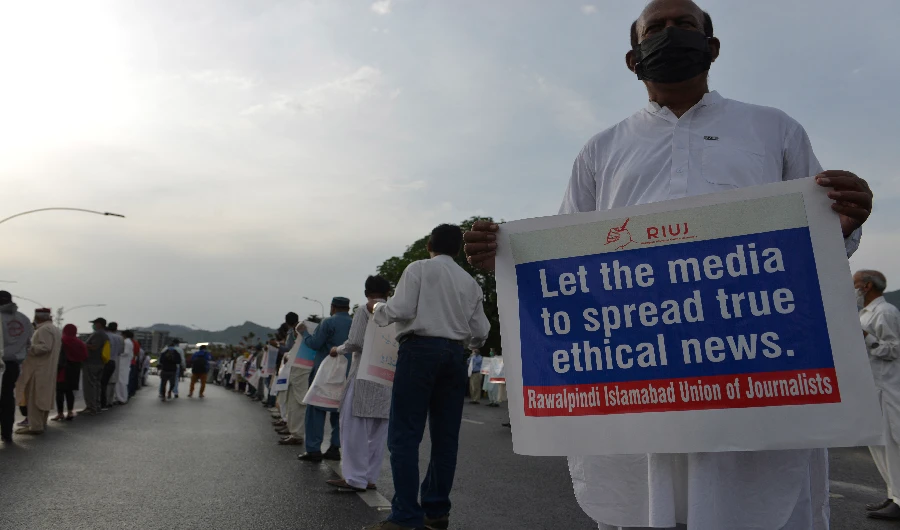
The Pakistan Federal Union of Journalists (PFUJ), the Human Rights Commission of Pakistan and the Pakistan Bar Association have jointly rejected the proposed ordinance as an attempt to impose “media martial law” in the country and institutionalize censorship.
The draft law says that “any licensee and registered entity, declaration and NOC [no objection certificate] holder or person who violates or abets the violation of any of the provision of this Ordinance shall be guilty of offense punishable with imprisonment for a term which may extend to three years or with a fine which may extend up to twenty-five million rupees or with both.”
The authority can act against any individual or media outlet under its jurisdiction without issuing a show cause notice and affording them an opportunity for a hearing, according to the draft. The proposed authority or its chairman may also order in writing to seize the equipment of a media organization or seal the premises of the licensee.
Any person aggrieved by a decision or order of the authority can file an appeal within 30 days, which will be decided by media tribunals within 45 days. Under the new law, only the Supreme Court of Pakistan can hear appeals against the tribunals’ verdicts.
The licensees will also be bound not to broadcast, distribute or put anything online which may be deemed as defamatory or ridicule the head of state, officials of the armed forces or members of the legislative and judicial organs of the state.
“The proposed law is draconian in scope and devastating in its impact on the constitutional principles and guarantees of freedom of expression, media freedoms and the right to information as well as the profession of journalism,” PFUJ president Shahzada Zulfiqar said, vowing to resist the government’s attempt to “silence the media.”
“The government has already imposed a major censorship regime on mainstream media and now wants to extend it from TV, radio and print to online journalism,” Zulfiqar added.
Journalist and talk show host Munizae Jahangir said it was against the spirit of the constitution that the proposed law allowed only the Supreme Court to hear appeals against tribunal verdicts.
“How can you take away a right of appeal from an aggrieved person,” she said. “God forbid, if this law is implemented, then only those who pursue the state narrative will be recognized as journalists.”
Syed Amjad Shah, former vice chairman of the Pakistan Bar Council, said the draft law was designed to help sitting governments “crush independent journalists and curtail freedom of press” in Pakistan.
“This law will further suppress the freedom of expression and freedom of press in the country,” he told Arab News. “We are opposing this ordinance and hopefully the government will also drop it.”